



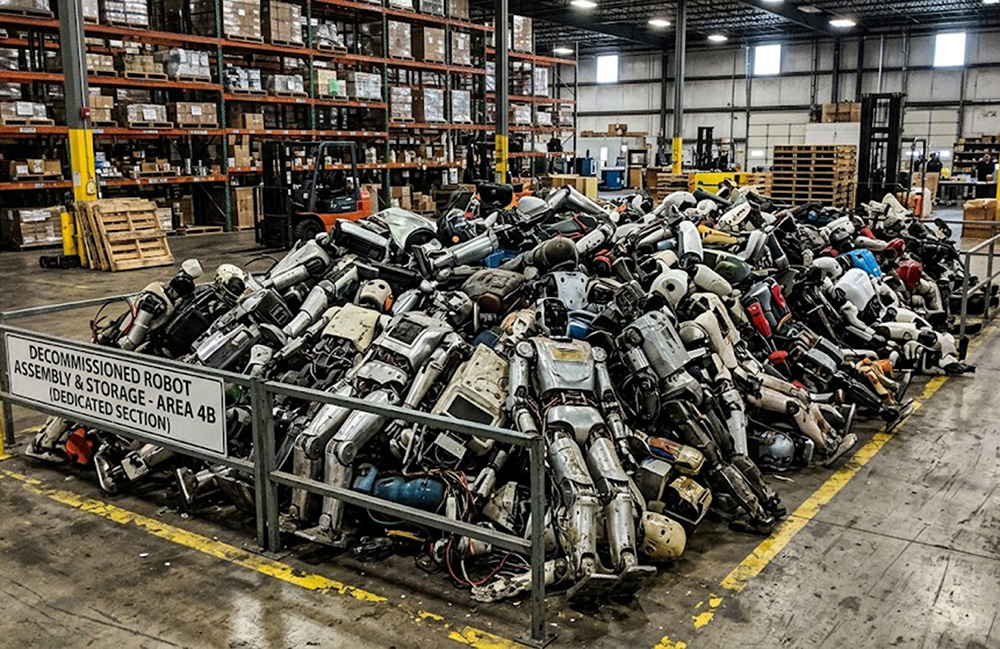
**The Unseen Crisis: Navigating the Complex End-of-Life Recycling of Humanoid Robots**
The global race to mass-produce humanoid robots is accelerating at a breakneck pace. Industry leaders are constantly innovating on how to source, assemble, and deploy these intricate machines, which contain anywhere from 10,000 to 15,000 individual components. However, a critical, multi-billion-dollar question remains dangerously unaddressed: What happens when they reach the end of their operational lives?
Decommissioning humanoids is not a matter of traditional scrapping. It is a highly technical, high-stakes surgical endeavor that demands precision and specialized expertise.
**The Anatomy of the Challenge**
To grasp the complexity of recycling these machines, one must first understand the sheer density of their subassemblies. A standard unit is made up of 200 to 500 major sub-components, broadly categorized into four interconnected systems:
* **Actuation and Motion:** 20 to 40 electric motors, each paired with precision speed reducers and gearboxes. Modern manufacturing increasingly favors integrated, sealed drive modules that combine the motor, harmonic drive, and localized controls into a single unit.
* **The Kinematic Skeleton:** A complex structural frame made of 30 to 50 major elements — often aluminum alloys, lightweight carbon fiber, or titanium — bound together by 1,000 to 3,000 specialized fasteners, bolts, and pins.
* **The Artificial Nervous System:** An intricate sensory network requiring 40 to 80 position encoders, 50 to 200 distinct sensors, tactile pressure points, and advanced perception arrays. These include lidar, IMUs, and cameras threaded together by miles of internal cabling.
* **The Semiconductor Core:** Up to 80 memory and storage semiconductor devices regulating firmware and localized processing.
Because of this architectural density, end-of-life processing presents massive liabilities across four critical areas:
**1. The Kinetic Data Breach**
A retired robot is a goldmine for corporate espionage. Memory assets contain proprietary navigation maps, biometric logs, facial recognition recordings, and behavioral patterns. If storage media is not physically destroyed or cryptographically erased, repurposing the hardware leaves dangerous backdoors to extremely sensitive enterprise or consumer data.
**2. Stored Energy and Volatility**
Lithium-ion and lithium-polymer battery packs cannot simply be discarded. Punctured or crushed cells risk thermal runaway, leading to toxic gas releases or violent explosions. Safe decommissioning requires reducing these packs down to “black mass” for element recovery or precise diagnostic testing for secondary life usage. Furthermore, hydraulic or pneumatic structural components retain high-velocity trapped pressure that can become deadly projectiles if not systematically discharged by specialists.
**3. Material Fatigue and Mechanical Liability**
While salvaging high-performance servo motors based on their original mean time to failure is economically viable for manufacturers, reuse carries severe risk. Reclaiming structural components like carbon-fiber frames introduces liabilities regarding material fatigue, which can lead to sudden, catastrophic structural failure under load.
**4. The Magnet Paradox (The ‘Surgical’ Bottleneck)**
Perhaps the most surprising hurdle is that a single humanoid robot carries 3.5 to 4 kg of rare-earth neodymium magnets. This can exceed the amount found in an entire electric vehicle chassis. Traditional industrial recycling relies on bulk crushing. However, crushing a humanoid robot cross-contaminates these precious rare-earth metals with shredded aluminum, titanium, and carbon fiber, rendering them useless scrap. Extraction requires skilled, human-in-the-loop technicians to surgically extract the magnets. This is dangerous work, exposing workers to severe pinch and crush injuries, flying shrapnel, and the risk of rapid magnet oxidation, which creates corrosive dust and spontaneous fire hazards.
**The Path Forward: Design for Recycling**
The current paradigm of robotics recycling is unsustainable. To prevent environmental and logistical bottlenecks, the recycling industry must collaborate directly with robotics original equipment manufacturers (OEMs). Future humanoids must be built with design for recycling principles. This means abandoning permanent industrial adhesives in favor of modular cartridges and standardized decoupling joints. Only through collaborative design can we transform robotics recycling from a dangerous, manual surgery into an efficient, circular economy.
***
### FAQ: Frequently Asked Questions About Humanoid Robot Recycling
**Q: Why is recycling a humanoid robot more complicated than recycling an electric vehicle?**
A: While both contain lithium batteries and rare-earth magnets, humanoid robots possess a far denser and more intricate architecture. They feature hundreds of precision motors, complex structural skeletons made of advanced alloys and carbon fiber, and extensive sensor networks. This complexity makes traditional bulk recycling methods, like crushing, ineffective and dangerous, requiring a highly specialized, surgical approach to separate and recover materials.
**Q: What happens to the sensitive corporate data stored in a retired humanoid robot?**
A: Retired robots store highly sensitive data, including proprietary navigation maps, biometric logs, and facial recognition recordings. If this data is not completely destroyed through physical means or cryptographic erasure, the hardware poses a massive security risk, potentially creating backdoors for corporate espionage or data breaches when repurposed.
**Q: Why can’t we just crush humanoid robots to recover their metals?**
A: Crushing humanoid robots causes severe cross-contamination. The rare-earth neodymium magnets essential to the robot’s motors become contaminated with shredded aluminum, titanium, and carbon fiber. This renders the precious rare-earth metals useless as scrap. Furthermore, crushing destroys the delicate sensors and semiconductor chips that could otherwise be repurposed or safely recycled.
**Q: What does “Design for Recycling” mean for the future of humanoid robotics?**
A: Design for recycling means engineering humanoids from the ground up with end-of-life in mind. It involves replacing permanent industrial adhesives with modular cartridges and standardized decoupling joints. This approach allows for safe, efficient disassembly, enabling a circular economy where valuable components and materials can be recovered and reused without the high risks associated with current manual extraction methods.
***
### Conclusion
The rapid advancement of humanoid robotics presents a paradox: we are building these sophisticated machines faster than we are planning for their disposal. The challenge of recycling them—balancing data security, hazardous material management, and the recovery of precious rare-earth elements—is immense. However, by shifting toward a design-for-recycling mindset and fostering collaboration between manufacturers and recycling specialists, we can ensure that the humanoid revolution is sustainable from first prototype to final decommission.
Thank you for reading
