



# The Forrestal Building: A Federal Real Estate Opportunity of a Generation in Washington, D.C.
## A Historic Site at a Crossroads
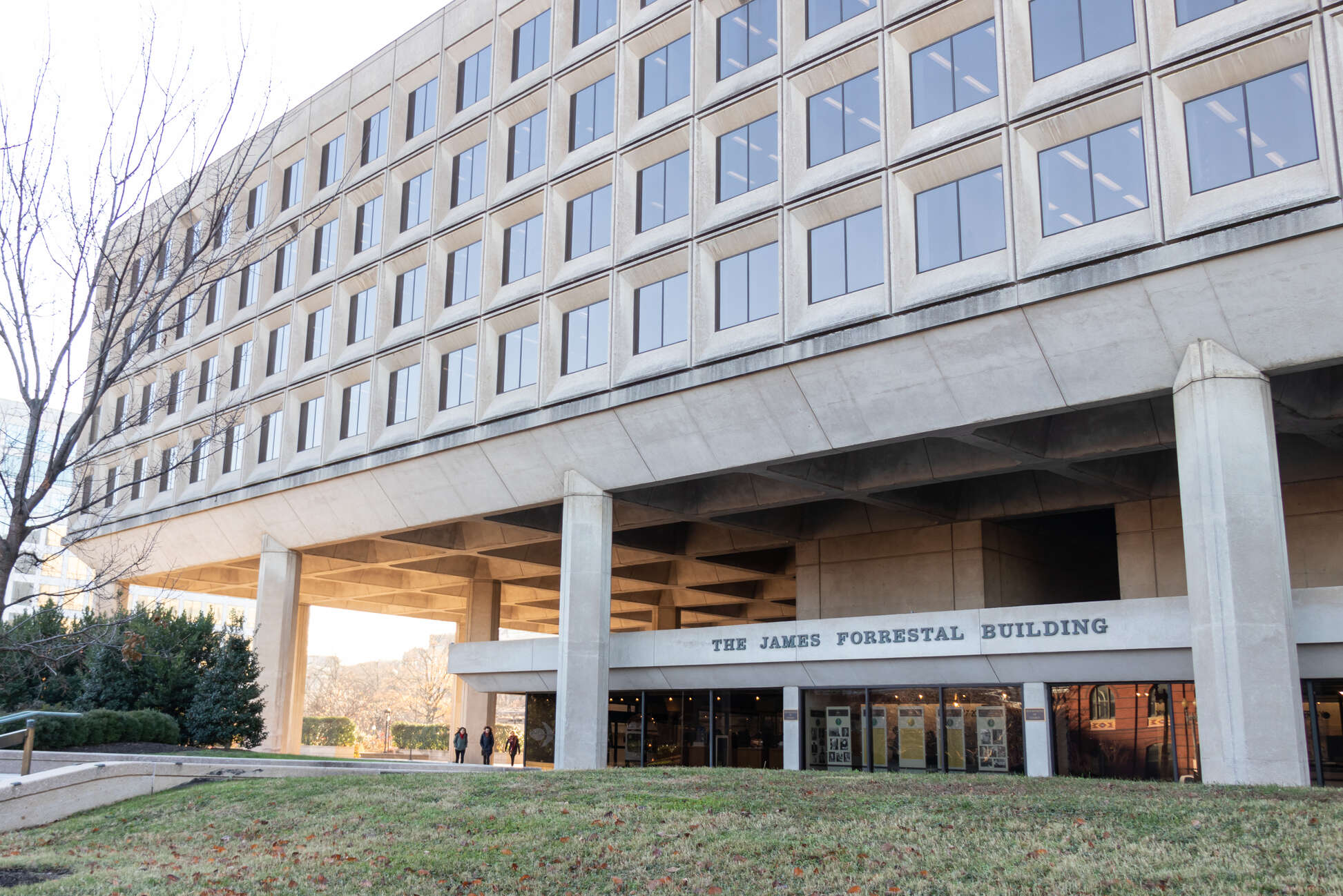
One of Washington, D.C.’s most underutilized federal properties is poised to become the centerpiece of a bold redevelopment debate that could reshape the nation’s capital. The Forrestal Building, a sprawling 1.5 million square foot federal office complex on Independence Avenue, serves as the headquarters of the Department of Energy. Despite its prominent location — directly across from the Smithsonian Castle — the building sits at roughly 20 to 28 percent capacity, making it one of the most glaring examples of wasted federal real estate in the country.
The story of what to do with the Forrestal Building represents a larger reckoning happening across the federal government, accelerated by the pandemic-era shift toward remote work and the growing recognition that the government owns far more office space than it actually needs.
## How It Got Here: A Half-Century of Underuse
Constructed in the 1960s, the Forrestal Building was designed to house thousands of Department of Energy employees under one roof. The sprawling complex features an enormous one-story cafeteria nearly the size of a city block and vast corridors of cubicle-style office space that was never designed for the flexible, modern workforce that now occupies it.
For decades, the building operated as it always had. But after 2020, the widespread adoption of telework policies across federal agencies meant that many employees simply stopped commuting to the building every day. What was already an oversized facility quickly became a facility operating at a fraction of its intended capacity.
## The Public Buildings Reform Board Steps In
In 2019, Congress passed the Federal Assets and Services Transformation (FASTA) Act, which created the Public Buildings Reform Board — an independent federal agency tasked with evaluating the government’s vast portfolio of real estate and identifying opportunities to reduce waste and save taxpayer dollars. The board consists of six members appointed by the White House and has spent years working closely with the General Services Administration (GSA) to take an independent look at federal properties.
Their analysis of GSA’s inventory revealed staggering numbers. Forty percent of GSA’s real estate nationwide is concentrated in the Washington metropolitan area alone. The Forrestal Building emerged as a prime candidate for action, primarily because of the stark economics involved. At an annual operating cost of approximately $41 million and a utilization rate hovering between 20 and 28 percent, the cost per federal employee occupying the building exceeds $100,000 per year — compared to the $10,000 to $15,000 per person it costs to lease office space elsewhere in the District of Columbia.
## A Billion-Dollar Redevelopment Vision
The potential benefits of redeveloping the Forrestal site go far beyond simple cost savings. The four parcels that make up the Forrestal site sit in one of the most valuable and strategically significant locations in the city, adjacent to the National Mall and in the heart of the growing Southwest waterfront district.
Urban Land Institute (ULI) conducted a Technical Advisory Panel (TAP) study on the site approximately a year ago, and the findings were remarkable. The study projected that redevelopment could yield nearly 2 million square feet of new construction. Critically, the panel emphasized that this space would likely not be traditional office space — given the dramatically lower office occupancy rates now seen across Washington — but rather a mixed-use neighborhood featuring museums, retail, housing, public spaces, and cultural amenities.
The economic impact for the District of Columbia would be substantial. The TAP study estimated that redevelopment could generate approximately $150 million in new property tax revenue for the District — a figure that dwarfs whatever modest tax contribution the current underutilized federal building provides.
## Learning from The Yards: A Proven Model
Those involved in the planning process point to the successful redevelopment of The Yards — the former rail yard area near Nationals Park — as a model for what the Forrestal site could become. The transformation of that area from underused industrial land into a thriving mixed-use neighborhood demonstrates that large-scale urban renewal on federally owned land is not only possible but can serve as a powerful engine for economic growth.
The GSA has already shown willingness to take the lead on similar projects. The agency has been deeply involved in master planning and redevelopment efforts around the National Mall area and other locations, and officials are looking at the Forrestal site as the next major opportunity to replicate that success on an even larger scale.
## A Broader Mandate for Federal Real Estate Reform
The Forrestal Building debate is happening within a rapidly evolving policy landscape. In January 2025, Congress passed the United States Inventory and Cost Act (USIC Act), which now requires all federal agencies to report annually to the Office of Management and Budget (OMB) on how much space they are using, what it costs to maintain, and whether consolidation or relocation could generate savings for taxpayers.
This legislation means that the kind of analysis that led to the Forrestal recommendation is no longer a one-off exercise. Federal agencies across the entire country are now under a systematic obligation to evaluate their real estate footprints — and in a city like Washington, D.C., where the federal government is the largest single landowner and employer, the implications are enormous.
## The Human Cost of Inaction
Supporters of redevelopment also emphasize that continuing to occupy and maintain the Forrestal Building at such low capacity is not just an economic inefficiency — it is a failure of stewardship. The building, which blocks the sightline to the Smithsonian Castle for anyone approaching from the Southwest waterfront, is widely regarded as an obstacle to the kind of connected, walkable urban environment that Washington is actively trying to cultivate along its waterfront corridors.
The sheer scale of the cafeteria alone — nearly a full city block in size — illustrates how poorly the building fits into a modern urban context. It was designed for an era when tens of thousands of federal employees needed to work under the same roof every day, an era that no longer reflects how the government operates.
## Community and Stakeholder Engagement
The path forward for the Forrestal site has already generated significant community interest. GSA Administrator Ed Forst has been actively convening stakeholders, including the District of Columbia Department of Planning, the District’s Department of Economic Development, the National Capital Planning Commission (NCPC), and neighborhood planning bodies. Public forums have been held to gather input on what the site could and should become.
This level of engagement is critical, given the complexity of the project. The Forrestal site involves multiple federal agencies, extensive coordination with the District government, potential congressional involvement, and the interests of nearby cultural institutions like the Smithsonian Institution. Using experienced real estate brokers and advisors to supplement GSA’s in-house expertise has been highlighted as an essential step in navigating the process successfully.
## FAQ
**What is the Forrestal Building?**
The Forrestal Building is a 1.5 million square foot federal office complex located on Independence Avenue in Washington, D.C., and serves as the headquarters of the Department of Energy.
**Why is the Forrestal Building under scrutiny?**
The building operates at only 20 to 28 percent capacity and costs approximately $41 million per year to maintain. The cost per employee exceeds $100,000 annually, compared to $10,000 to $15,000 for leased office space in the District, making its continued occupancy economically questionable.
**What is the Public Buildings Reform Board?**
It is an independent federal agency created by the FASTA Act of 2019, consisting of six White House-appointed members, that evaluates the federal government’s real estate portfolio and identifies opportunities for consolidation, closure, or disposal.
**What would redevelopment of the Forrestal site look like?**
Studies project nearly 2 million square feet of new mixed-use development on the four parcels that make up the site. Proposed uses include museums, retail, housing, public spaces, and cultural facilities — designed to create a new neighborhood rather than a traditional office campus.
**How would redevelopment benefit Washington, D.C.?**
The project is estimated to generate approximately $150 million in new property tax revenue and transform a currently underutilized, car-centric area into a vibrant, walkable neighborhood similar to the transformation seen at The Yards near Nationals Park.
**What role does GSA play in this process?**
The General Services Administration manages federal real estate and is responsible for evaluating, negotiating, and executing any disposal or redevelopment of the site. The USIC Act now requires GSA and other agencies to report annually to OMB on space utilization and costs.
**What is the USIC Act?**
The United States Inventory and Cost Act, signed into law in January 2025, requires all federal agencies to report annually to the Office of Management and Budget on their space utilization, maintenance costs, and potential savings from consolidation.
**Is the Forrestal Building unique, or are there other federal properties like it?**
The Forrestal Building is among the most prominent examples, but it is part of a broader pattern across the federal government. With 40 percent of GSA’s real estate in the Washington metropolitan area, and post-pandemic occupancy rates far below historical norms, many properties across the country are facing similar evaluations.
**What happens next?**
GSA is actively working with the District of Columbia, NCPC, ULI, and other stakeholders to advance the redevelopment vision. The use of external brokers and advisors, public engagement, and interagency coordination are all expected to continue as the project moves toward planning and potential execution.
## Conclusion
The Forrestal Building represents far more than a single government facility in need of an upgrade. It embodies a fundamental shift in how the federal government thinks about its real estate assets — moving from a posture of perpetual ownership and maintenance toward one of strategic stewardship, fiscal responsibility, and community value. At nearly two million square feet of potential new development, $150 million in projected new tax revenue, and the promise of a new neighborhood connecting the National Mall to the Southwest waterfront, the stakes could not be higher.
The decisions made about this site in the coming years will likely serve as a template — for Washington, for other federal properties across the country, and for the broader conversation about how public land can best serve the public good. It is a rare opportunity that few cities get to witness, let alone participate in shaping.
Thank you for reading
