



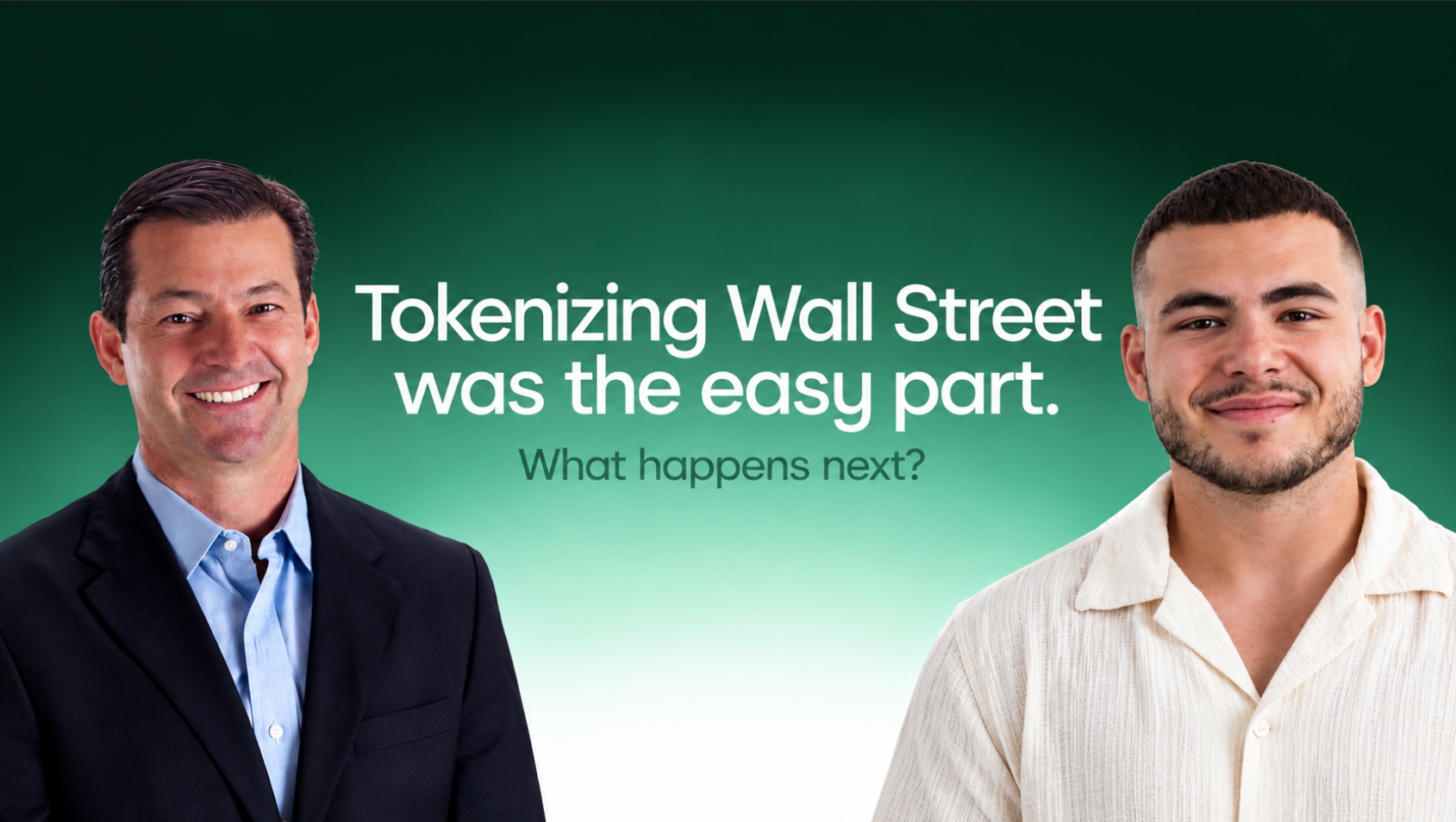
# How Tokenization Is Moving Beyond Issuance — And Into the Machinery of Global Finance
Wall Street’s largest institutions have been quietly moving assets onto blockchain networks for several years now. Funds, treasury products, and equities have all taken their first steps into tokenized form. But as the initial wave of issuance settles, a tougher and more consequential question is emerging: once assets arrive onchain, what can they actually *do* within the existing machinery of global finance?
The answer to that question could determine whether tokenization becomes a true transformation of capital markets or merely a new way to list the same assets in a different format.
## The New Frontier: Institutional Infrastructure Meets Blockchain
A growing number of firms are betting that tokenization’s real value lies not in *creating* assets but in reimagining how those assets interact with one another. One of the most significant institutional signals came from the appointment of Brad Klaas — a veteran of securities lending, prime brokerage, and institutional tokenized collateral products — to guide the expansion of a platform’s tokenized equity and commodity markets on Canton, a permissioned blockchain designed for financial applications.
Klaas’s career trajectory offers a rare lens into the convergence of traditional finance and blockchain infrastructure. Over decades, he built global securities-lending operations, scaled prime brokerage businesses, and spent years working on institutional-grade tokenized collateral products. His appointment signals that the next phase of tokenization will be driven less by technologists and more by practitioners who understand the operational realities of institutional asset management.
## Joining the Industry’s Core Infrastructure Conversation
As part of its institutional push, the company has entered the Digital Assets Solutions Industry Working Group convened by the Depository Trust & Clearing Corporation (DTCC). This group, which includes participants such as the NYSE, BlackRock, Goldman Sachs, JPMorgan, Citadel Securities, and over a hundred other members, is shaping the DTCC Tokenization Service — an infrastructure layer expected to launch in the fourth quarter of 2026.
The significance of this step goes beyond membership. The DTCC serves as the post-trade utility underpinning much of the United States securities market. The fact that tokenized asset platforms are now being invited into its development process signals a fundamental shift in how traditional market utilities view blockchain technology. What was once speculative is becoming operational.
## From Issuance to Utility: The Real Challenge
For the better part of the past decade, the debate around blockchain and capital markets revolved around whether the two were compatible. That debate has largely been resolved. The more pressing issue now is utility.
Traditional financial markets are anything but static. Stocks are lent between institutions to facilitate short-selling and market-making. Treasuries and other eligible securities serve as collateral for financing, margin, and risk management. Large portfolios that would otherwise sit idle are put to work through securities lending, generating income for asset owners. This infrastructure — often invisible to the public — is where much of modern finance actually operates.
The risk for tokenization is that it could simply create new silos. If a tokenized security trades in isolation, cannot be used efficiently as collateral, and cannot interact with the systems institutions already rely on, the technology adds complexity without delivering value. The far bigger prize is building programmable markets that are also *liquid* markets — systems where assets can move, be reused, and generate economic activity in ways that rival or surpass what traditional infrastructure enables.
## Composability as a Competitive Advantage
Klaas has framed the opportunity in terms of “composability” — the ability to build financial functions that interconnect and adapt to new uses. His experience in traditional securities finance taught him that the existing systems, while reliable, were designed to operate in isolation from one another. Changing what an asset can do often requires working through arrangements that were not originally designed to interoperate.
Blockchain, by contrast, introduces the possibility of building modular financial functions that can work together seamlessly. In this framework, a single token could serve multiple purposes — as a trading instrument, as collateral for margin, as a source of income through lending or staking mechanisms. This multi-use capability is what Klaas has described as “creating a flywheel around income,” where participation in the underlying infrastructure generates revenue while the markets built on top of it grow.
## The Profit Formula Driving Institutional Adoption
Institutional change is never driven by technology alone. Large financial firms operate within rigid profitability frameworks. They carry established revenues, internal obligations, and fiduciary responsibilities that demand careful justification before adopting a new system. Klaas has been direct about this: an institution’s willingness to adopt blockchain-based infrastructure is governed by its “profit formula.”
The calculus is straightforward. A firm has little reason to replace a functioning system simply because a newer technology exists. But it has a compelling reason to consider an approach that demonstrably lowers funding costs, improves the availability of collateral, or allows it to extract more economic value from the assets it already holds. This is where the concept of collateral mobility becomes especially relevant.
If eligible securities can be deployed more efficiently as collateral across different platforms, institutions may be able to reduce the liquidity they need to set aside for margin and financing obligations. An existing portfolio could simultaneously support market activity and financing needs without requiring a separate cash reserve. The economic benefit is not theoretical — it is a direct improvement to how capital is deployed.
## Tokenized Assets as Collateral: Edel’s Perpetual Futures Play
One concrete application under active exploration is the recognition of tokenized securities as margin within a dedicated electronic trading market. The immediate focus is on perpetual futures, a derivative product increasingly popular in digital asset markets, though the broader ambition extends well beyond any single instrument.
The vision is that an institution could post an eligible security directly as margin for a perpetual futures position, rather than selling the security to raise cash or tying up liquidity in a separate margin pool. This would reduce friction between holding an asset and putting it to work — a seemingly small change with potentially significant implications for capital efficiency.
However, making this work in practice requires solving a set of non-trivial problems. The receiving market must accept the asset, value it reliably, and establish clear rules for what happens if a position deteriorates or a counterparty defaults. Custody arrangements, permission structures, and enforceable legal rights must all be in place. These are the kinds of operational questions that separate proof-of-concept demonstrations from production-grade infrastructure.
## Why the Timing Is Right
Several developments have converged to create conditions favorable for this next phase of tokenization. BlackRock has tokenized investment funds. JPMorgan has built blockchain-based settlement rails. Franklin Templeton has moved investment products onchain. The DTCC is actively developing tokenization infrastructure of its own. These are not peripheral experiments — they are core activities of the world’s largest financial institutions.
At the same time, platforms like Canton are providing the technical foundation that institutions require — permissioned networks with the throughput, privacy, and compliance features needed to handle real capital. The combination of institutional demand and mature infrastructure is finally creating a path for tokenized assets to move from the periphery of finance to its center.
## FAQ
**What is tokenized equity and commodity trading?**
Tokenized equity and commodity trading involves representing traditional financial assets — such as stocks or commodity contracts — as digital tokens on a blockchain. These tokens can then be traded, lent, or used as collateral within digital market infrastructure.
**What is Canton, and why does it matter for tokenized markets?**
Canton is a permissioned blockchain platform designed specifically for financial applications. Its architecture supports the high-throughput, low-latency, and privacy-preserving transactions that institutions require, making it suitable for building production-grade capital markets infrastructure.
**What is the DTCC Tokenization Service?**
The DTCC Tokenization Service is an infrastructure initiative being developed by the Depository Trust & Clearing Corporation, the post-trade utility that underlies much of the U.S. securities market. It aims to provide standardized tokenization capabilities for traditional financial assets and is expected to launch in Q4 2026.
**Why is Brad Klaas’s background significant for this push?**
Klaas has spent decades working in securities lending, prime brokerage, and institutional tokenized collateral products at firms including BlackRock’s predecessor companies and Franklin Templeton. His experience bridges the operational realities of traditional finance and the possibilities of blockchain infrastructure.
**What does “composability” mean in the context of tokenized finance?**
Composability refers to the ability to build financial functions on a blockchain that can work together and be combined in new ways. Unlike traditional financial systems where different functions often operate in silos, composable systems allow tokens and smart contracts to interact, creating more flexible and efficient markets.
**Can tokenized assets be used as margin for derivatives?**
This is an active area of exploration. In principle, if the receiving market accepts a tokenized asset as collateral, an institution could use it to post margin for positions such as perpetual futures. In practice, this requires solving questions around valuation, custody, default resolution, and legal enforceability.
**What role do rewards like Canton Coin play?**
Platforms on Canton can earn network rewards for the economic activity they generate. This creates a direct incentive for participants to build and grow markets on the network, potentially generating revenue from both the underlying infrastructure and the applications built on top of it.
**Why hasn’t tokenization transformed finance already?**
Issuing tokens is relatively straightforward compared to integrating them into the complex ecosystem of global finance. Tokenized assets need to work within existing systems for lending, collateral management, clearing, and settlement. Until those integrations are in place, tokenization remains a promising but incomplete transformation.
## Conclusion
The tokenization of real-world assets has entered a critical phase. The question is no longer whether institutions will adopt blockchain-based infrastructure — that ship has sailed — but rather what those assets can accomplish once they are onchain. The answer depends on whether tokenized assets can integrate into the existing machinery of global finance in ways that genuinely improve capital efficiency, reduce friction, and create new sources of economic value.
The involvement of veterans like Klaas, the participation of traditional market utilities like the DTCC, and the development of purpose-built platforms all point toward a future where tokenization is not an alternative to traditional finance but an extension of it. The institutions that thrive in this new environment will be those that recognize a simple truth: the value of a financial asset has never come solely from the ledger it sits on. It comes from everything that can happen around it.
Thank you for reading
