



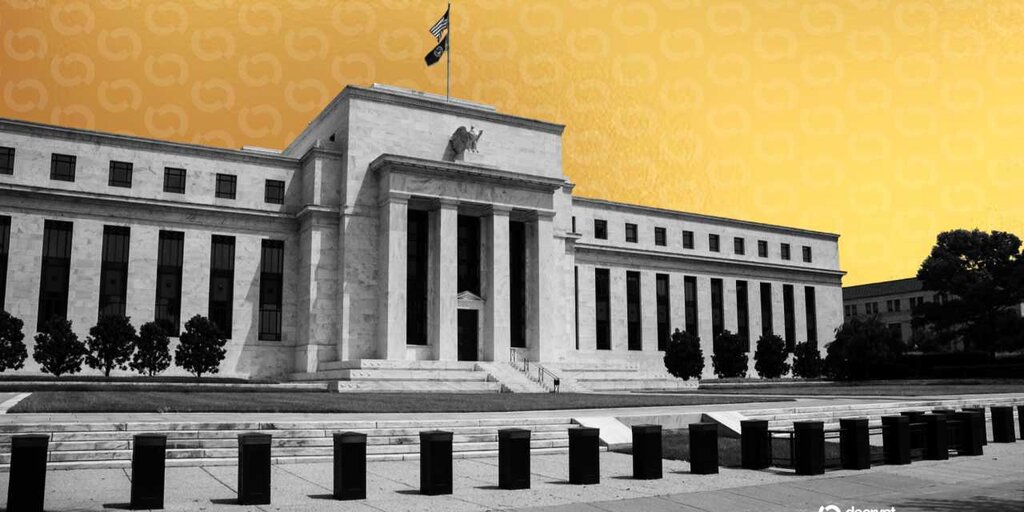
# Fed Delivers First Rate Hike in Over a Year, Crypto Markets React with Mixed Moves
## The Decision That Markets Saw Coming
The Federal Reserve has officially pushed its benchmark interest rate higher for the first time since 2023. In a unanimous decision backed by all 12 members of the Federal Open Market Committee, the federal funds rate was lifted by 25 basis points to a new target range of 3.75% to 4.00%. Markets were far from surprised — traders had anticipated this move with a 93% probability heading into the announcement, according to data tracked by CME’s FedWatch tool.
The federal funds rate had been sitting at 3.50% to 3.75% since July, when the committee narrowly voted to hold steady by a 9-3 margin. That earlier decision already exposed deep divisions within the policy-making body, with several members openly calling for a rate increase. Wednesday’s unanimous vote suggests those internal disagreements have been resolved, at least for now.
## Inflation Data Pushed the Case for Tightening
The justification for the hike was built on a wave of recent economic data that painted a stubborn inflation picture. The Producer Price Index rose 5.4% on an annual basis in August, up from 4.8% the month before, with goods costs alone jumping 1.1% in a single month — the bulk of which was driven by surging energy prices.
Consumer-level inflation told a similar story. The Consumer Price Index climbed 3.4% annually in August, holding steady with July’s pace but accelerating on a monthly basis from 0.1% to 0.4%. Gasoline was responsible for roughly a third of that increase, while core inflation — which strips out food and energy — also ticked up to 0.3% monthly from 0.2%.
These figures, combined with a stronger-than-expected jobs report and oil prices breaching $100 per barrel for the first time since July, made it increasingly difficult for Fed officials to justify waiting any longer. The committee itself acknowledged in its statement that economic activity was expanding at a solid pace and that employment had kept up with workforce growth, but emphasized that inflation remains elevated and that Wednesday’s decision would help guide a “timelier return” to the 2% inflation target.
## Political Pressure and the Appointment Paradox
The decision placed Federal Reserve Chair Warsh in a particularly delicate political position. The rate hike came just days after President Trump publicly urged multiple cuts, with Vice President JD Vance and Treasury Secretary Scott Bessent echoing those calls. Trump even went as far as threatening to restrict trade with nations running trade surpluses with the United States if interest rates were not lowered.
Ironically, Warsh was selected by Trump precisely because the former president believed he would favor rate cuts. Yet Warsh’s vote to raise rates showcased a striking degree of independence from the White House — something that simultaneously fulfilled and contradicted Trump’s original expectations for the appointment.
Senator Elizabeth Warren, a long-time vocal critic of Warsh’s proximity to the executive branch, told CNN that the administration’s own Iran conflict and tariff strategies had effectively cornered the Fed chair into a difficult choice. Warren argued that regardless of which direction the Fed moved, ordinary American families would bear the cost through higher credit card interest rates and more expensive mortgage payments. She also stated that a single decision would not be enough to change her overall assessment of the chair’s independence.
## Bitcoin’s Narrow Escape
The cryptocurrency market entered Wednesday already under pressure. Bitcoin was trading in the range of $75,200 in the hours before the announcement, a significant distance from its September peak near $82,000. The digital asset was also absorbing the aftermath of Tuesday’s sharp decline following the failure of the Clarity Act to secure a Senate cloture vote.
Technical analysts had identified a critical support band between approximately $73,500 and $75,600 as a make-or-break zone. A daily close below that range, they warned, could trigger a deeper pullback toward $71,000 or even $66,900 on certain technical models — a move that would effectively unwind the golden cross formation that had fueled Bitcoin’s summer rally.
In the moments surrounding the Fed’s announcement, Bitcoin remained surprisingly calm, oscillating between $75,000 and $75,800. It briefly surged past $76,000 shortly after the decision was revealed but quickly retraced. Ultimately, the asset held above the lower boundary of the critical support band, avoiding a technical breakdown that many models had flagged as a real risk.
The broader crypto market, however, was not as resilient. The sector shed approximately 2.18% on the day, reflecting the general unease that accompanied the rate decision. The Crypto Fear and Greed Index also shifted from extreme greed back toward neutral territory, sliding from 69 points the previous day to 51 — a reminder that investor sentiment remains fragile heading into the fourth quarter.
## What Lies Ahead
The Fed’s next scheduled meeting is set for October 27-28, with the subsequent gathering and its accompanying dot-plot update coming on December 8-9. Those two sessions will be critical in determining whether Wednesday’s hike represented an isolated move or the opening salvo of a more aggressive tightening campaign before year’s end.
Wall Street is already divided on this question. A recent survey by The Wall Street Journal found that nearly every major financial institution expected a rate increase, with institutions including Barclays, Citigroup, JPMorgan, Morgan Stanley, and UBS forecasting a cumulative 50 basis points of tightening by year-end. More aggressive calls from Bank of America, Deutsche Bank, and RBC projected 75 basis points of total tightening.
For the crypto market, the road ahead will likely be shaped by how these future decisions influence broader macroeconomic conditions, the strength of the U.S. dollar, and whether inflation actually begins to moderate in response to the tightening cycle.
—
## Frequently Asked Questions (FAQ)
**Q: Why did the Fed raise rates after holding them steady for months?**
A: The decision was driven by persistent inflation data. The Producer Price Index and Consumer Price Index both showed stubbornly high readings in August, with energy costs playing a major role. Combined with a strong jobs report and oil prices above $100 per barrel, the data made it increasingly difficult for the committee to justify further delay in tightening monetary policy.
**Q: Was the rate hike expected by the market?**
A: Yes, traders had priced in a 93% chance of a hike heading into the decision, up from less than 50% a month earlier. The move was widely anticipated across financial markets.
**Q: How did all 12 Fed members vote?**
A: All 12 members of the Federal Open Market Committee voted in favor of the 25 basis point increase, making the decision unanimous.
**Q: What was Bitcoin’s reaction to the Fed’s decision?**
A: Bitcoin initially remained flat in the minutes around the announcement before spiking briefly above $76,000. It ultimately held above the critical support band of $73,500 to $75,600, avoiding a technical breakdown that many analysts had flagged as a risk.
**Q: Why is there controversy surrounding the Fed Chair’s appointment?**
A: President Trump nominated the current Fed Chair with the expectation that he would favor interest rate cuts. However, the chair’s decision to raise rates showcased a high degree of independence from the White House, creating tension between the administration and the central bank. Critics, including Senator Elizabeth Warren, have questioned whether the chair is sufficiently insulated from political pressures.
**Q: What are the next key dates for the Fed?**
A: The next Fed meeting is scheduled for October 27-28, followed by another meeting and dot-plot update on December 8-9. These sessions will be closely watched to determine whether the tightening cycle is continuing or pausing.
**Q: How did the broader crypto market perform on the day of the hike?**
A: While Bitcoin held relatively steady, the broader cryptocurrency market lost approximately 2.18% on the day, reflecting a general risk-off sentiment across digital assets.
—
## Conclusion
The Federal Reserve’s decision to raise rates for the first time in over a year marks a significant shift in monetary policy and signals that inflation remains a persistent concern for policymakers. The move was driven by a convergence of elevated inflation data, strong labor market performance, and geopolitical pressures pushing energy costs higher. While financial markets largely absorbed the news — given how thoroughly it had been anticipated — the impact on more volatile asset classes like cryptocurrencies has been more pronounced, with the broader sector experiencing notable sell-offs on the day.
The coming months will be pivotal. Two more Fed meetings in late October and mid-December will reveal whether Wednesday’s increase was the final word of 2023 or merely the beginning of a more sustained tightening cycle. For crypto investors, the path forward hinges on how these future policy decisions shape macroeconomic conditions, dollar strength, and the overall risk appetite in global markets.
Thank you for reading
