



# The Convergence of AI and Physical Systems: How Connected Infrastructure Is Being Redefined by 2030
## Introduction
The enterprise technology landscape is undergoing a fundamental transformation. For years, discussions around artificial intelligence focused primarily on what systems could analyze, generate, or predict. That focus is now shifting toward what these systems are permitted to do — and where they can act. As AI gains the ability to interact with machines, vehicles, energy infrastructure, and operational environments, critical questions around identity, control, accountability, and cost are moving from software applications into the very architecture of connected systems.
Industry analysts and technology strategists are pointing toward a future where physical infrastructure and intelligent software become deeply intertwined. By the end of the decade, autonomous agents, robots, drones, and self-directed vehicles will form a significant part of the workforce in international enterprises. At the same time, the energy demands of AI itself are prompting large organizations to rethink how they produce, store, and distribute power. These trends are reshaping the role of the Internet of Things from a passive monitoring framework into an active execution layer.
—
## Physical AI Turns Connected Infrastructure into an Active Control Layer
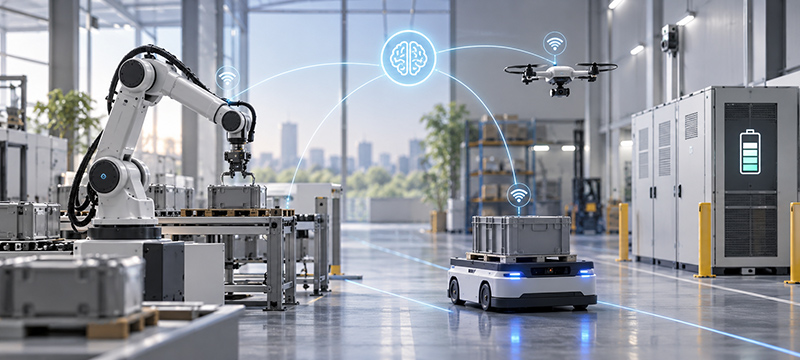
One of the most impactful predictions in this space is the widespread adoption of physical AI — systems that extend software decision-making into the physical world through robots, autonomous vehicles, drones, and other intelligent machines. By 2030, an estimated four out of five front-line workers at multinational organizations will rely on such systems to carry out their responsibilities.
This represents a dramatic shift for the connected infrastructure that supports these operations. Historically, IoT architectures were designed to collect data from sensors, transmit it over networks, and expose it to applications for analysis. The infrastructure served as an observer — gathering telemetry and enabling human or software-driven responses. Physical AI demands something more. The network must now reliably support software that not only interprets real-world conditions but also initiates physical actions in real time.
On a technical level, this is already becoming visible. Compact AI models are increasingly capable of running at or near the edge, enabling autonomous capabilities without reliance on distant cloud servers. Meanwhile, researchers and engineers are exploring how AI agents can function as an intermediary control layer for industrial equipment, translating high-level directives into precise machine operations.
The practical consequence is significant. Connected platforms will need to manage not just devices and human users, but also machine-generated actors — autonomous entities that request data, adjust operational parameters, or issue commands to robots and actuators. Each of these actors will require its own digital identity, access permissions, and activity logs. The architecture of IoT is expanding to accommodate a new class of participant in the network.
—
## Governance Extends into Runtime and Operational Layers
As AI systems gain the authority to act in the physical world, governance frameworks are following them down the stack. Traditional AI oversight has centered on models, training data, prompts, and output quality. But once an AI system can interact with physical assets — adjusting a valve, rerouting a vehicle, or altering a production line — accountability extends into device management, access control, sensor networks, and operational technology environments.
Several forces are driving this evolution. The insurance industry is expected to play a growing role in shaping how organizations govern AI, with liability underwriting pushing companies to implement stronger technical controls and verifiable audit trails. At the same time, corporate governance models are shifting: a large proportion of Fortune-level enterprises are anticipated to formally designate senior technology leaders as custodians of AI evidence — individuals responsible for maintaining records of how automated decisions were made and who is accountable for them.
For industrial deployments, this means traceability becomes a system-level requirement, not just an application-level one. Organizations may need to answer not only that a device changed state, but why a specific AI system requested that change, what information influenced its decision, which controls were applied, and what outcomes followed. This creates an entirely new dimension for IoT platforms, one that demands continuous, runtime oversight rather than periodic reviews.
—
## Energy Management Becomes a Strategic IoT-AI Intersection
The growing electricity consumption of AI infrastructure is triggering a parallel transformation in how large organizations think about energy. Analysts estimate that major enterprises will collectively oversee trillions of dollars in energy-related assets within a few years, increasingly functioning as both consumers and sellers of electricity to power grids and data centers.
This has direct implications for connected systems. Distributed generation sources, battery storage units, building management systems, and industrial loads only become flexible, responsive energy resources when they are continuously monitored and coordinated. That coordination requires dense sensor networks, reliable communication channels, and automated decision-making — all core capabilities of IoT infrastructure.
In this context, energy management is becoming another domain where connected assets, operational data, and automated control converge. Companies are beginning to treat generation, storage, and energy optimization not as support functions but as strategic capabilities that can be actively managed through AI-driven platforms. The IoT layer becomes the nervous system that enables real-time visibility and control across these distributed resources.
—
## A Broader Architectural Shift for Connected Systems
What makes these developments significant is not any single trend in isolation, but the architecture that emerges when they are considered together. Autonomous agents are multiplying in number and capability. Physical AI systems are interacting with machines and environments at scale. Enterprises are managing energy as a dynamic, programmable resource. And governance is moving toward continuous, automated oversight at the runtime level.
For original equipment manufacturers and system integrators, this landscape increases the importance of exposing device capabilities through well-defined, controlled software interfaces. Rather than simply delivering connectivity, hardware needs to be designed with programmable APIs that allow authorized AI systems to interact safely and transparently. Connectivity providers, in turn, will need to support features such as machine identity management, policy enforcement, and reliable communication pathways for systems whose traffic originates from software rather than human operators.
For industrial operators and facility managers, the challenge is establishing clear boundaries. Autonomous decisions made by AI systems must be separated from deterministic safety controls — the hard-coded mechanisms that prevent dangerous physical outcomes regardless of what software commands are issued. These boundaries must be enforced at the infrastructure level, not just the application level.
The underlying shift is subtle but consequential. Connected infrastructure is evolving from a mechanism for observing the physical world into a platform for AI-driven action. Managing who — and increasingly what — is allowed to act through that infrastructure may become as critical a function as connecting the assets themselves.
—
## Frequently Asked Questions
**Q: What is physical AI, and how does it differ from traditional AI?**
A: Physical AI refers to AI systems that interact with and act upon the physical world through machines, robots, vehicles, and other equipment. While traditional AI often operates in digital environments — analyzing data, generating text, or making recommendations — physical AI bridges the gap between software decisions and real-world actions, requiring sensors, connectivity, and local computing to function.
**Q: Why is IoT infrastructure being described as an “execution layer”?**
A: Historically, IoT systems primarily collected and transmitted data for observation and analysis. The evolution toward physical AI means that connected infrastructure now needs to reliably execute commands — turning software decisions into physical operations. This transforms IoT from a monitoring tool into an active control system.
**Q: How does AI governance change when systems interact with physical assets?**
A: Traditional AI governance focuses on models, data, and outputs. When AI systems can affect physical equipment and environments, governance must extend into areas such as device identity, access control, operational technology security, and continuous audit trails — making traceability a requirement across the entire technology stack.
**Q: What role does energy play in the AI-IoT convergence?**
A: AI systems consume significant electricity, and the infrastructure required to power them is reshaping how large organizations manage energy. IoT networks enable real-time monitoring and automated control of distributed energy resources, making energy management a strategic capability rather than a passive utility function.
**Q: Will human workers be replaced by autonomous systems in industrial settings?**
A: Predictions suggest that autonomous systems will increasingly assist and collaborate with front-line workers rather than fully replace them. The focus is on augmentation — using robots, drones, and AI agents to handle repetitive, dangerous, or complex tasks while human workers oversee and manage operations.
**Q: What skills will IoT professionals need as these trends accelerate?**
A: Professionals will need expertise in areas such as machine identity management, runtime policy enforcement, edge computing, energy system integration, and operational security. Understanding how to design interfaces that safely expose device capabilities to autonomous systems will be especially valuable.
—
## Conclusion
The convergence of artificial intelligence and physical infrastructure represents one of the most significant architectural shifts in modern enterprise technology. As autonomous agents multiply, physical AI systems become embedded in daily operations, and energy management becomes a programmable capability, the role of connected infrastructure is being fundamentally redefined. The organizations that invest in adapting their IoT architectures — building in identity, governance, traceability, and safe execution boundaries — will be best positioned to operate in this emerging landscape. The infrastructure of the future is not just about connecting things; it is about enabling intelligent systems to act in the real world with accountability and precision.
Thank you for reading
