



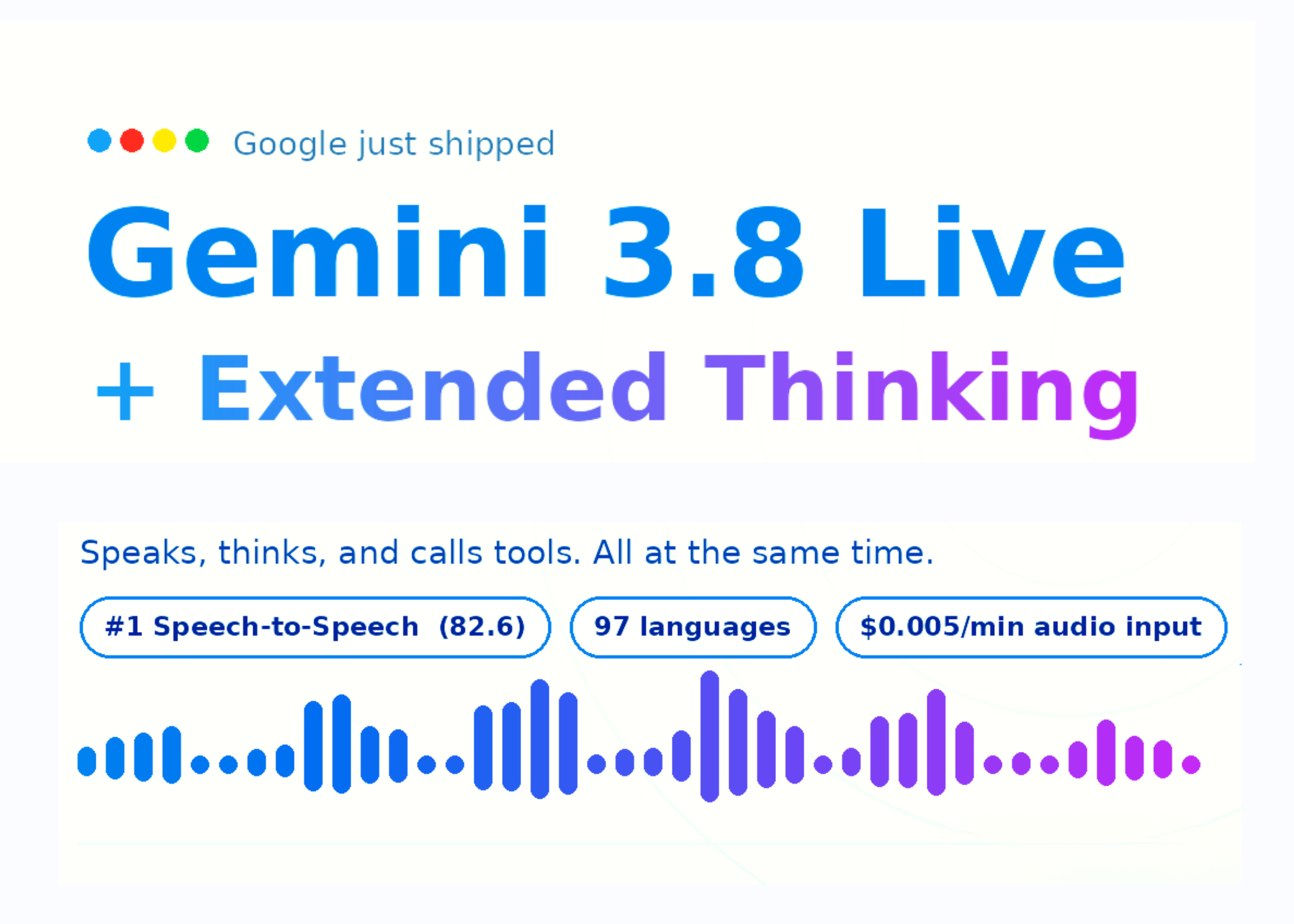
# Google Unveils Gemini 3.8 Live and Extended Thinking: A New Era for Real-Time Voice Agents
Google has launched two groundbreaking live dialogue models designed to power the next generation of real-time voice agents. Named **Gemini 3.8 Live** and **Gemini 3.8 Live Extended Thinking**, these models represent a significant leap forward in conversational AI, specifically engineered to handle voice interactions that involve reasoning, tool execution, and seamless dialogue — all without interrupting the flow of conversation.
## What Makes These Models Different?
For years, building voice agents meant stitching together multiple systems: an automatic speech recognizer (ASR) to transcribe audio, a large language model to process text, and a text-to-speech engine to generate a spoken response. This cascading approach introduced latency, broke conversational rhythm, and often struggled with complex, multi-step tasks. Google’s latest release aims to eliminate that fragility by offering **native speech-to-speech models** that process audio in and audio out as a unified pipeline.
The two models serve complementary purposes. **Gemini 3.8 Live** is optimized for high-volume deployments, offering fluid dialogue, visual grounding, and cost-effective performance at scale. **Gemini 3.8 Live Extended Thinking**, on the other hand, is designed for tasks that demand deeper cognitive effort — it can reason through multiple steps, execute long-running tool calls, and narrate its progress while still responding to the user in real time.
## Availability and Deployment
Both models are available today through the **Gemini Live API** and **Google AI Studio** for production use via API. They are hosted models, meaning developers cannot access open weights or deploy them on self-hosted infrastructure. Google has also begun rolling them out in private preview across its **Gemini Enterprise** platform, **Search Live**, **Gemini Live**, and various **Workspace** surfaces.
## Core Capabilities for Developers
The Gemini Live API exposes five key capabilities through these new models:
– **Asynchronous Function Calling:** The model can fire off API requests and tool calls in the background while continuously streaming audio to the user. This eliminates the awkward silence that typically occurs while a system processes a backend request.
– **Live Visual Context:** Agents can process visual inputs — such as screenshots, sketches, or live camera feeds — in near real time, combining what a user says with what they show.
– **Alphanumeric Precision:** The models accurately parse strings like confirmation codes, claim numbers, serial keys, and technical identifiers, addressing a persistent pain point in voice-based systems.
– **97-Language Multilingual Support:** The models automatically detect and switch between supported languages mid-conversation, maintaining accent consistency throughout.
– **Incremental Content Updates:** Real-time audio can be merged with structured data inputs, allowing the agent to deliver context-aware responses as new information arrives.
Extended Thinking adds an additional layer: **configurable background reasoning** that mirrors how a human agent might think aloud. The model uses verbal acknowledgments like “Let me check that” and then walks through its reasoning steps while simultaneously managing long-running operations. Google has demonstrated this by having the model convert hand-drawn sketches combined with spoken feedback into functional React components, and by coordinating multi-step booking processes across several services.
## How Do They Perform?
Google has shared benchmark results that position these models competitively in the voice AI landscape. Gemini 3.8 Live Extended Thinking claimed the **top spot on Artificial Analysis’ Speech-to-Speech Quality Index**, scoring **82.6** overall. On agentic task benchmarks, it achieved **68.6% on τ-Voice** and **35.1% on Sierra’s τ-Voice-banking** evaluation. It also scored **97.7% on Big Bench Audio**, a reasoning-focused benchmark for audio models.
Gemini 3.8 Live placed **second in the Speech Agent Arena**, a human preference evaluation that judges the quality of voice agent interactions. Google also reported that both models push the **Pareto Frontier on ServiceNow’s EVA-Bench**, meaning they achieve an optimal balance between task accuracy and conversational quality — a critical metric for enterprise voice agents.
## Pricing
Both models are priced identically: **$0.005 per minute** for audio input and **$0.018 per minute** for audio output via the Live API. Google notes that these rates are derived from an underlying token cost of $3 per million input tokens and $12 per million output tokens.
## Ecosystem and Partners
Google has built out an ecosystem of integration partners who handle real-time media streaming infrastructure for developers building voice agents. Supported partners include **Agora, Fishjam, LangChain, LiveKit, Pipecat, Vercel, and Vision Agents**. Additionally, companies like **Salesforce, Genspark, and Lumeris** are early adopters, citing improvements in latency, conversational fluidity, and tool-calling accuracy. Example applications demonstrating these capabilities are available on GitHub.
## Provenance and Safety
All audio generated by these models carries Google DeepMind’s **SynthID** watermark — an imperceptible marker embedded directly into the audio waveform. This provides a layer of traceability for synthetic audio content.
—
## Frequently Asked Questions (FAQ)
**Q: Can I self-host Gemini 3.8 Live or Extended Thinking?**
A: No. Both models are hosted exclusively through Google’s infrastructure and are available via the Gemini Live API and Google AI Studio. There are no open weights or self-hosted deployment options.
**Q: What is the difference between Gemini 3.8 Live and Gemini 3.8 Live Extended Thinking?**
A: Gemini 3.8 Live is designed for high-volume, cost-efficient voice agent deployments with fluid dialogue and background tool execution. Extended Thinking adds the ability to perform multi-step reasoning in the background while continuing to speak with the user, making it better suited for complex, cognitively demanding tasks.
**Q: How many languages do these models support?**
A: Both models support **97 languages** and can automatically detect and switch between them mid-conversation while maintaining accent consistency.
**Q: What is the pricing structure?**
A: Both models cost **$0.005 per minute** for audio input and **$0.018 per minute** for audio output. This is based on equivalent token costs of $3 per million input tokens and $12 per million output tokens.
**Q: What benchmark scores have been reported?**
A: Extended Thinking scored **82.6** on Artificial Analysis’ Speech-to-Speech Quality Index (#1), **68.6%** on τ-Voice, **35.1%** on Sierra’s τ-Voice-banking, and **97.7%** on Big Bench Audio. Gemini 3.8 Live placed **second** in the Speech Agent Arena human preference evaluation.
**Q: Are there any integration partners for building voice agents with these models?**
A: Yes. Google lists partners including Agora, Fishjam, LangChain, LiveKit, Pipecat, Vercel, and Vision Agents for real-time media streaming. Salesforce, Genspark, and Lumeris are also early adoption partners.
**Q: Does generated audio include any form of watermarking?**
A: Yes. All audio generated by these models includes Google DeepMind’s **SynthID** watermark, which is imperceptible to listeners but allows for traceability.
**Q: Where can I try these models?**
A: They are available today in the **Gemini Live API** and **Google AI Studio** for API-based production use, with private preview access on **Gemini Enterprise**, **Search Live**, **Gemini Live**, and **Workspace** surfaces.
—
## Conclusion
The release of Gemini 3.8 Live and Gemini 3.8 Live Extended Thinking marks a meaningful shift in how real-time voice agents are built. By moving away from fragmented, cascaded pipelines toward unified speech-to-speech architectures, Google is addressing the core pain points that have historically limited voice AI: latency, conversational breaks, and the inability to reason while speaking. The combination of strong benchmark performance, competitive pricing, broad multilingual support, and a growing ecosystem of integration partners positions these models as compelling options for developers building voice agents at scale. Whether the goal is high-volume customer service or complex, multi-step task execution, these models offer a purpose-built foundation that was previously unavailable in a single model.
Thank you for reading
