



# DeepSeek-V4.1-Flash: A New Era of Efficient Open AI Architecture
## Introduction
The landscape of open-source artificial intelligence is shifting. Rather than chasing ever-larger parameter counts, one of the most talked-about recent releases focuses on doing more with less — dramatically less. DeepSeek’s latest offering challenges the assumption that powerful AI agents require expensive infrastructure, introducing a model that rethinks how attention, memory, and computation work during inference.
DeepSeek-V4.1-Flash is not just another benchmark chaser. It represents a philosophical shift toward making long-running AI applications — the kind that read millions of tokens, maintain persistent state, and act autonomously — actually practical at scale. By reimagining the fundamental components of model inference, DeepSeek has created something that could influence how the entire open-source community builds and deploys future systems.
## Understanding the Core Innovation
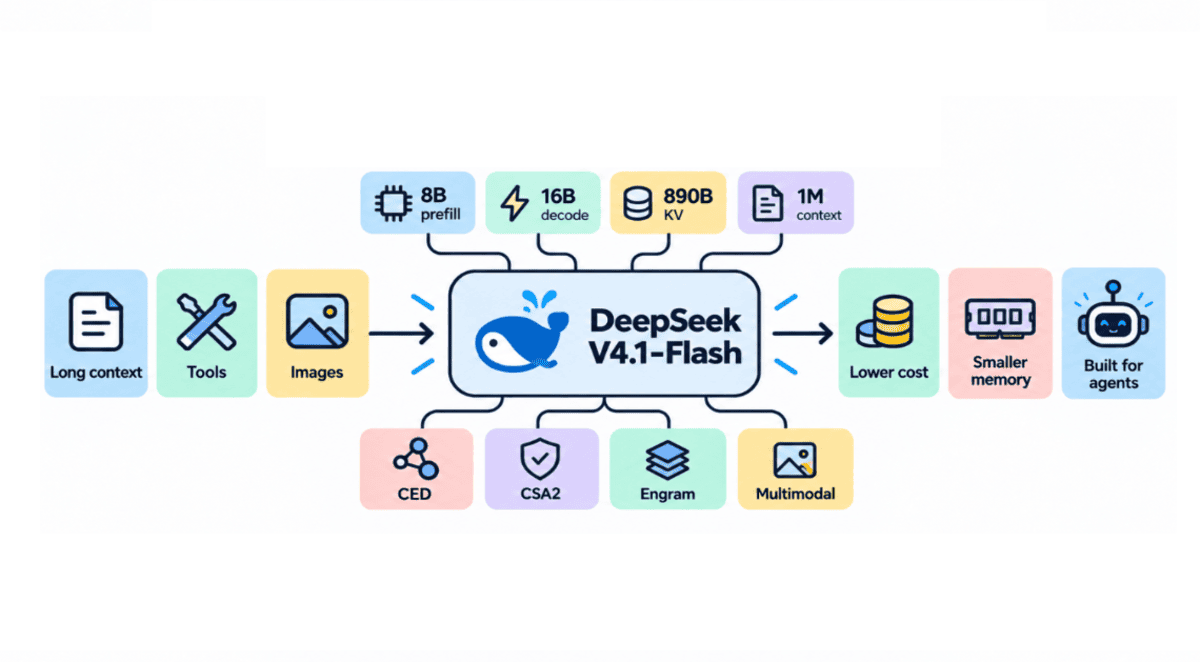
At its heart, DeepSeek-V4.1-Flash is a 552-billion-parameter Mixture-of-Experts model, but what makes it remarkable is how selectively it uses those parameters. During the initial reading phase (prefill), only 8 billion parameters are activated per token. During the generation phase (decode), that number rises to 16 billion parameters per token.
This asymmetry is intentional and profound. In most traditional transformer architectures, the cost of reading a prompt and the cost of generating a response are roughly proportional. DeepSeek breaks this pattern. The model is engineered so that ingesting massive amounts of input text is computationally cheap, while the heavier computational work is reserved for the moments when the model is actually reasoning and producing output.
For AI agents — systems that must review codebases, scan logs, process documentation, and then generate targeted actions — this design mirrors how intelligent work actually flows. You spend most of your time absorbing information and a smaller fraction of it synthesizing conclusions.
## The Architecture Behind the Efficiency
Several interconnected technical innovations make V4.1-Flash’s performance possible. Each one targets a specific bottleneck in the inference pipeline.
### Causal Encoder-Decoder Design
Instead of the standard decoder-only transformer, DeepSeek-V4.1-Flash uses a causal encoder-decoder (CED) architecture. The encoder, consisting of 20 layers, processes the entire input prompt first. The decoder then generates responses using the encoder’s final representation as a condensed summary of all the input information.
This design eliminates redundant computation. In a traditional decoder-only model, every layer independently builds and stores its own representation of the full context. With CED, the encoder does the heavy lifting of understanding the input, and the decoder leverages that understanding without rebuilding it from scratch.
### Compressed Sparse Attention and Layer Sharing
One of the biggest memory hogs in long-context models is the KV (Key-Value) cache — a running record of every previous token that the model references during generation. For a one-million-token context, this cache can become enormous.
DeepSeek addresses this through Compressed Sparse Attention 2 (CSA2), which introduces three operational modes. In “Full” mode, a layer creates new memory and searches it. In “Reindex” mode, it reuses existing memory but searches it again with fresh criteria. In “Reuse” mode, it skips computation entirely and leverages both previously stored memory and earlier search results.
This layer-sharing approach means that successive layers in the model don’t redundantly rediscover the same important tokens. A hierarchical sparse indexer further narrows the search space, allowing later layers to focus on a small, curated subset of the most relevant tokens rather than scanning the entire context.
### FP4 Quantized KV Caching
DeepSeek combines these attention innovations with FP4 (4-bit floating point) KV caching, which stores key-value representations in a significantly more compact format. The cumulative effect brings the global KV cache down to just 890 bytes per token — roughly one-quarter of what its predecessor required and dramatically smaller than traditional implementations.
At a one-million-token context window, the total KV cache footprint is approximately 890 megabytes, a figure that makes long-context inference far more accessible on modern GPU hardware.
### Supporting Innovations
Several additional techniques round out the architecture:
– **SWA Bounded Replay** allows the model to discard older attention states and recompute a small recent window when needed, reducing persistent memory storage to about one-eighth of the previous generation.
– **Engram Conditional Memory** is a 196-billion-parameter auxiliary component that the model queries selectively, retrieving specific information without activating all those parameters for every token.
– **Single-Pass mHC** reorganizes internal data movement to cut memory traffic roughly in half, making the flow of information through the model more efficient.
– **DSpark Speculative Decoding** generates multiple candidate tokens at once and validates them through the main model, accepting batches of correct tokens simultaneously to accelerate response generation.
## The Engram: A Different Kind of Memory
The Engram component deserves special attention. Think of it as a neural read-write memory system layered on top of the main model. When the backbone network is working through a problem, the Engram acts as a lookup table — storing and retrieving relevant information on demand rather than keeping everything perpetually active.
This is conceptually similar to how human memory works: you don’t re-read every book you’ve ever read to answer a question. Instead, you retrieve the relevant knowledge when needed. The Engram gives V4.1-Flash a form of long-term conditional memory that scales capacity without proportionally scaling compute cost.
## Benchmark Performance
Efficiency means nothing if the model’s capabilities suffer. DeepSeek reports that V4.1-Flash not only matches but exceeds its predecessor and competes strongly with larger models on agent-oriented benchmarks.
| Benchmark | Previous V4-Flash | V4-Pro | V4.1-Flash |
|———–|——————-|——–|————|
| DeepSWE v1.1 | 54.4 | 62.7 | **74.2** |
| Terminal-Bench 2.1 | 82.7 | 87.9 | **90.6** |
| CyberGym | 76.7 | 83.3 | **88.1** |
| AutomationBench | 37.7 | 43.2 | **54.8** |
| Agent’s Last Exam | 25.2 | 25.7 | **31.8** |
These results are particularly notable on terminal automation, cybersecurity, and software engineering tasks — the exact workloads where agents need to process enormous contexts efficiently. The model shows strongest gains on the more demanding benchmarks, suggesting that the architectural improvements genuinely help on hard problems rather than just inflating easy scores.
## The Open-Model Advantage
Released under the MIT license with reference inference code and implementation details, V4.1-Flash opens the door for the broader community to adopt and extend these techniques. The ideas embedded in this model — asymmetric prefill-decode compute, cross-layer KV reuse, sparse attention indexing, FP4 quantization, bounded replay, and conditional memory — are not proprietary tricks tied to a single organization.
They are reusable principles that inference engine developers, downstream model trainers, and open-source communities can adapt. This is perhaps the most exciting dimension of the release. Even if a particular model doesn’t become the dominant choice, the architectural innovations it pioneers can cascade into future systems that benefit everyone.
## Who Should Care About This Release
This model matters to several audiences. For infrastructure engineers and DevOps teams, the dramatically reduced KV cache and memory footprint means deploying long-context models becomes more affordable and practical. For AI application developers building agents, the combination of efficient prefill and strong benchmark performance on agent tasks suggests that production deployments can handle more complex workflows without proportional cost increases. For researchers and open-source contributors, the architectural innovations provide a rich foundation to build upon.
For the broader AI community, V4.1-Flash serves as a proof of concept that efficiency and capability are not a trade-off — they can be designed into the same system.
## FAQ Section
**What is DeepSeek-V4.1-Flash?**
DeepSeek-V4.1-Flash is a 552-billion-parameter Mixture-of-Experts language model optimized for efficient long-context inference. It supports up to one million tokens of context, processes both text and images, and is designed specifically to reduce the computational cost of running AI agents over extended interactions.
**Why does prefill use fewer parameters than decoding?**
The Causal Encoder-Decoder architecture separates input processing from output generation. During prefill, only 8 billion parameters activate per token because the encoder efficiently compresses the input into a useful representation. During decode, 16 billion parameters activate per token to support the more demanding work of generating coherent, reasoned responses.
**How small is the KV cache really?**
At 890 bytes per token, a one-million-token context requires roughly 890 megabytes for the global KV cache alone. Compared to prior-generation models, this represents approximately a 75% reduction in KV memory usage for the cache component.
**What makes this model different from simply making a bigger model?**
Rather than scaling up raw parameter count and hoping for better results, DeepSeek redesigned the inference pipeline itself. Every component — from attention mechanisms to memory quantization to speculative decoding — targets a specific inefficiency. The result is a model that is cheaper to run per token while simultaneously improving on agent-relevant benchmarks.
**Is this model available for commercial use?**
Yes. The model is released under the MIT license, which is one of the most permissive open-source licenses available. It permits commercial use, modification, distribution, and private deployment with minimal restrictions.
**How does the Engram component work?**
The Engram is a 196-billion-parameter conditional memory module that stores information separately from the main model backbone. Rather than activating all of its parameters for every token, it retrieves relevant stored information on demand. This allows the model to have a larger effective memory capacity without paying the full compute cost of processing all those parameters at once.
**What are the practical benefits for AI agents?**
AI agents typically need to read large amounts of context — code files, documentation, conversation history, system logs — before producing a relatively small amount of output. V4.1-Flash’s asymmetric compute profile directly addresses this pattern, making it cheaper and faster to run agents that process long inputs and generate focused responses.
**Does the model outperform all competitors on every benchmark?**
No single model dominates every benchmark. V4.1-Flash excels particularly on agent-focused evaluations like Terminal-Bench, CyberGym, and DeepSWE. Some other models may outperform it on general reasoning or different categories of tasks. The point is that it delivers competitive or leading performance on the workloads most relevant to autonomous AI systems while maintaining a significantly lower inference cost.
## Conclusion
DeepSeek-V4.1-Flash marks an important inflection point for open-source AI. The era of equating model quality purely with parameter count is giving way to an era where architectural ingenuity determines real-world usefulness. By rethinking how models read, remember, and generate — from the attention mechanism all the way down to how data moves through silicon — DeepSeek has demonstrated that efficiency and capability can advance together rather than compete.
For teams building AI agents today, this release offers a compelling combination of strong benchmark performance, dramatically lower memory requirements, and an open license that encourages experimentation and adaptation. For the broader field, it provides a template for what the next generation of efficient AI models might look like.
The most lasting impact of V4.1-Flash may not be its benchmark numbers at all, but the ideas it puts into the hands of developers worldwide — ideas that will shape how we build, deploy, and think about AI systems for years to come.
Thank you for reading
