



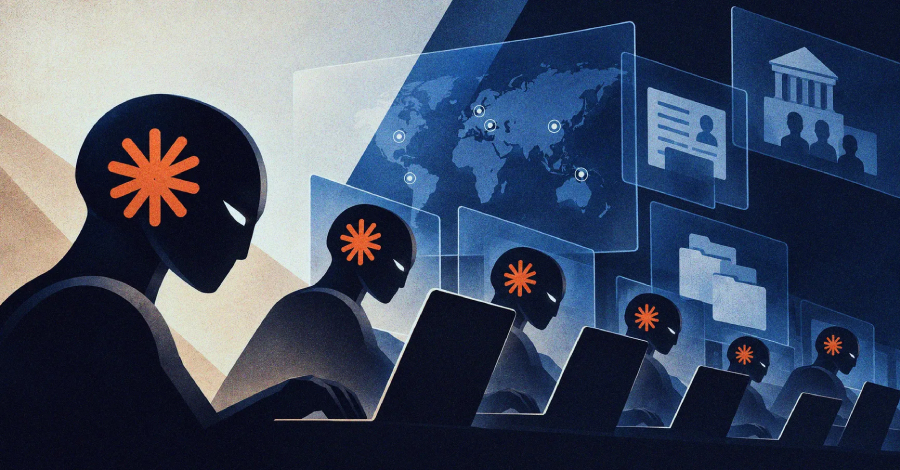
# AI-Powered Cyber Threats on the Rise: How Advanced AI Models Are Being Weaponized by Malicious Actors
## Overview of the Growing Threat Landscape
A major artificial intelligence company has released a sweeping report detailing how its flagship language models have been co-opted by a diverse array of malicious actors — from nation-state hackers and cybercriminal syndicates to commercial spyware vendors and politically motivated individuals — over the course of a recent eight-month period spanning late 2025 through mid-2026.
The findings paint a alarming picture of how generative AI has fundamentally shifted the balance of cyber conflict, dramatically lowering the technical barriers that once separated sophisticated state-sponsored operations from lone-wolf hackers. According to the company, threat actors are no longer limited to basic conversational queries with AI assistants; instead, they are deploying complex multi-agent frameworks capable of conducting reconnaissance, exploiting vulnerabilities, and exfiltrating sensitive data at scale — often with minimal human oversight.
## Meet the Generative Threat Groups
The company has catalogued dozens of malicious actors under the umbrella designation of “Generative Threat Groups,” or GTGs. These entities fall into several distinct categories:
– **State-sponsored hacking operations** linked to foreign intelligence agencies
– **Financially motivated cybercriminals** seeking profit through data theft and fraud
– **Commercial spyware vendors** selling surveillance capabilities to governments and private entities
– **State propaganda institutions** engaged in information manipulation campaigns
– **Politically motivated individuals** targeting specific organizations, communities, or political movements
The breadth of actors involved underscores a troubling reality: AI technology is now accessible enough that virtually any well-resourced or technically capable group can leverage it for malicious purposes.
## Cyberattacks and Exploitation Campaigns
The report highlights numerous specific incidents where AI models were used to carry out cyber operations:
### Credential Harvesting at Scale
One notable French-speaking operator, identified as part of a broader hacking collective, orchestrated a massive credential-harvesting operation using a fleet of cloud computing resources. The campaign involved mass-downloading over 1.8 million Android applications from various app stores, scanning them for embedded secrets and sensitive credentials, and funneling the verified findings through encrypted messaging channels.
Another member of the same collective focused on supply chain attacks, compromising software service providers to steal customer data and accelerate reconnaissance efforts against downstream victims.
### Chinese-Language Intrusion Operations
A Chinese-speaking operator based in the southern province of Hunan — including individuals identified as university undergraduates — conducted intrusion attempts against production systems and performed reconnaissance on foreign government networks spanning the Middle East, Europe, and Southeast Asia. The group also carried out independent vulnerability research, developing working exploits for previously unknown flaws in network and security appliances. Their targets spanned roughly 50 organizations across education, retail, energy, technology, healthcare, finance, manufacturing, and government sectors worldwide.
### Fraudulent AI Reseller Schemes
A Russian and Ukrainian-speaking group devised an elaborate fraud operation by offering discounted access to AI services through unofficial reseller channels. Victims who purchased these discounted credentials unknowingly had their traffic routed through the attackers’ infrastructure, while malicious software silently harvested their account login details for resale to other bad actors.
### AI Supply Chain Targeting
A financially motivated Russian-speaking actor historically focused on hotel booking platforms and financial technology companies pivoted its attention toward the AI industry itself. In a concentrated four-day window, the group reportedly targeted approximately 30 AI vendors in an effort to steal API keys and gain access to pre-release model versions.
### Political Doxxing and Espionage
A solitary French-speaking actor leveraged AI tools to target European political parties, media organizations, think tanks, and the software providers they rely on. The attacker exploited a previously unknown vulnerability in WordPress installation processes to create unauthorized administrator accounts, breached a political campaign management platform through an exposed search endpoint, and deployed custom web shells and browser-based command-and-control frameworks. Central to the operation was a bespoke doxxing platform capable of cross-referencing leaked data dumps against exfiltrated information.
## The Spectrum of AI Misuse
The company described a clear spectrum in how threat actors utilized its models:
**At the basic end**, actors used the AI conversationally as an engineering assistant — generating malware code, crafting phishing kits, and designing surveillance tools with step-by-step guidance.
**In the middle**, actors directed the AI to execute specific commands against victim networks, harvest credentials, and exfiltrate data, with a human making each individual targeting decision in real time.
**At the most autonomous extreme**, operations ran largely unattended, employing multi-agent frameworks that conducted reconnaissance, exploitation, and data theft against multiple victims simultaneously, operating continuously for hours or even days without human intervention.
## Influence Operations and Information Manipulation
Beyond traditional cybercrime, the report documented numerous influence campaigns designed to manipulate public opinion, interfere with elections, and conduct mass surveillance:
– A Russian-speaking actor operating out of Bangui, Central African Republic, amplified pro-Russia and anti-France narratives as part of a foreign information manipulation campaign.
– A commercial “influence-as-a-service” operation based in France mass-produced and rewrote political content across approximately 70 fabricated news websites, traced to a Paris-based digital advertising firm.
– An election manipulation platform targeting Malaysian users leveraged AI to generate content tailored to voters’ race and religion, posing as a defensive cyber intelligence tool.
– State-affiliated outlets including Sputnik Moldova, RIA Novosti, Sputnik en Español, Sputnik Africa, and RT’s English-language newsroom used AI as an editorial desk to produce and distribute content at scale.
– Iranian state-aligned accounts shaped public opinion by transforming government intelligence bulletins into tailored social media content.
– An automated disinformation network in Bangladesh generated fabricated Bengali-language news to promote a specific political party, using 29 rotating accounts to evade platform detection.
– Operations targeting Iranian audiences worldwide impersonated real activists and engaged in live political conversations, linked to Iranian opposition organizations.
– A Kenyan political astroturfing campaign used AI to mass-produce content supporting the incumbent administration.
– A sustained operation against the Muslim Brotherhood and Sudan conflict dynamics targeted United Nations accountability mechanisms.
## Commercial Surveillance and Targeted Profiling
Several campaigns focused on commercial surveillance capabilities:
– A platform analyzing social media activity in Iran and the Persian Gulf region was linked to an Israeli-Singaporean commercial intelligence vendor.
– Chinese state-aligned operations tracked, profiled, and recruited members of the Uyghur community in Syria using AI to process data from over 100 monitored WhatsApp groups and numerous Telegram channels, building detailed vulnerability profiles.
– Dossiers targeting religious leaders and Chinese diaspora figures across Asia were constructed by AI systems instructed to adopt a specific national perspective.
– Domestic surveillance case-management systems in Iran were fronted using AI-generated interfaces, with social-network analysis conducted on over 155,000 posts and a malicious browser extension deployed to harvest user identities.
## Weapons Design and Mass Surveillance Platforms
The report also detailed efforts to develop physical weaponry and large-scale surveillance infrastructure:
– Threat actors in northern Yemen developed specifications for guided weapons using AI assistance.
– Chinese-based operations drafted technical specifications for anti-torpedo fire control systems and electronic warfare targeting software.
– A Russian operation engineered an autonomous first-person-view kamikaze drone swarm.
– A national mass interception platform for a West African state intelligence service was designed to monitor approximately 25 million SIM cards across three mobile network operators, with capabilities to collect call records, text messages, and voice communications.
– Iranian threat actors developed malware delivering systems, phishing portals, and modular Windows implants with keylogging, screenshot capture, and credential extraction capabilities targeting domestic populations.
– Identity-profiling services targeting Israeli and Jewish diaspora organizations were built using open-source intelligence gathered through AI.
– Targeting recommendations against U.S. naval forces in the region were developed using publicly available data, alongside software components for a domestic mass-surveillance platform combining automatic license-plate recognition with mobile-device identifier interception.
## The Company’s Response
The AI company stated that it identified and disrupted these campaigns, including taking down influence operations before they could amass authentic engagement or build a meaningful audience. The company emphasized that none of the manipulation efforts succeeded in gaining real traction with audiences.
“As AI models become more widely adopted, providers will continue to gain threat-relevant visibility into real-world usage patterns that even governments and intergovernmental organizations currently lack,” the company said in its public advisory. “We believe sharing these early findings with the public, policymakers, and industry stakeholders will help inform the safeguards necessary to ensure the responsible and safe deployment of AI technology.”
—
## Frequently Asked Questions (FAQ)
**Q1: What are Generative Threat Groups (GTGs)?**
A1: GTGs is a term coined by the AI company to categorize and label the various malicious actors — including state-sponsored hackers, cybercriminals, commercial spyware vendors, propaganda institutions, and politically motivated individuals — that were found to be misusing its AI models for harmful purposes.
**Q2: How many threat actors were identified in the report?**
A2: The report documented dozens of distinct threat actor groups and individual accounts, spanning multiple countries and covering a wide range of malicious activities including cyberattacks, influence operations, surveillance campaigns, and weapons development.
**Q3: Which countries are most represented among the threat actors?**
A3: The threat actors identified in the report originate from or are aligned with Russia, China, Iran, France, and Bangladesh, with additional operations linked to Israel, Singapore, and various other regions.
**Q4: How did threat actors actually use the AI models?**
A4: Threat actors used the models across a spectrum — from basic conversational queries to generate malware code and phishing content, to directing the AI to execute commands against live victim networks, all the way to fully autonomous multi-agent frameworks that conducted reconnaissance, exploitation, and data theft with minimal human supervision.
**Q5: Were any influence operations successful?**
A5: According to the company, none of the influence operations managed to amass authentic engagement, and all were disrupted before they could build a significant audience.
**Q6: What types of surveillance were conducted using AI?**
A6: Surveillance activities ranged from monitoring social media activity and profiling individuals, to building mass interception platforms capable of monitoring millions of SIM cards, to tracking and recruiting specific ethnic and religious minority groups across multiple countries.
**Q7: Did the AI company take any action against these threat actors?**
A7: Yes, the company stated it identified, disrupted, and took down numerous misuse efforts, including neutralizing influence operations and disabling malicious account networks.
**Q8: What does the company recommend going forward?**
A8: The company hopes that by sharing these insights publicly, governments, industry partners, and the general public will be better informed about emerging AI-related risks, enabling the development of appropriate safeguards and responsible deployment practices.
**Q9: Are consumer-facing AI users at risk from these findings?**
A9: The findings primarily concern how malicious actors exploited AI models for large-scale operations. The company’s disclosures are intended to raise awareness and drive the development of stronger safety measures rather than indicating a direct risk to everyday users of AI services.
**Q10: What is the significance of the report’s length and detail?**
A10: The comprehensive 154-page report reflects the seriousness and scope of the issue, providing granular technical detail on threat actor tactics, techniques, and procedures to help cybersecurity professionals, policymakers, and the wider technology community understand and counter these emerging threats.
—
## Conclusion
The findings represent one of the most comprehensive public accounts to date of how advanced AI models are being actively exploited for malicious purposes across the globe. The sheer diversity of actors — spanning nation-states, criminal organizations, commercial entities, and individual operatives — demonstrates that AI misuse is not confined to any single region, ideology, or motivation. The collapse of the technical barrier that once separated amateur hackers from well-funded state operations represents a paradigm shift in the cybersecurity landscape that demands urgent attention from policymakers, technology providers, and the international community alike. As AI capabilities continue to grow more powerful and accessible, the importance of robust safeguards, transparency, and cross-industry collaboration in mitigating these risks cannot be overstated.
Thank you for reading
