



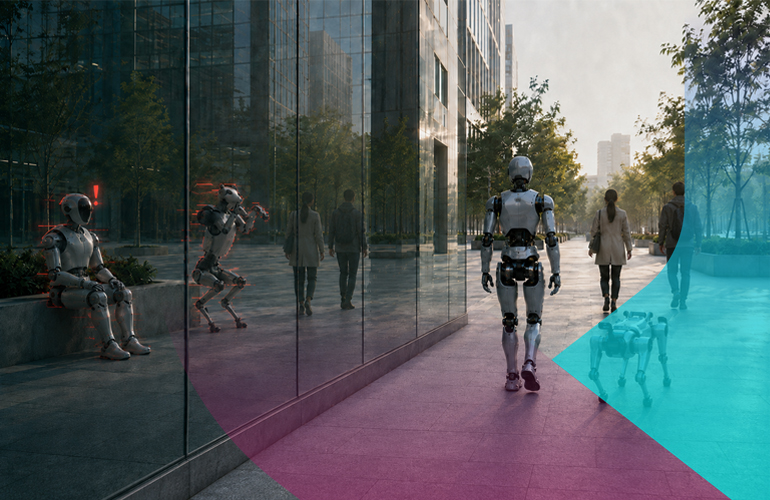
# The Missing Layer in Robot Safety Assurance: Why Cybersecurity Must Be Part of the Conversation
## Introduction
As robots move beyond controlled factory floors and into dynamic, unstructured environments, the question of safety has grown more complex. Traditional robot safety frameworks were designed around physical failures — a motor seizing, a sensor malfunctioning, a control loop breaking. But a new generation of autonomous machines, powered by multimodal perception and artificial intelligence, introduces a threat surface that mechanical and functional safety standards were never built to address.
The emerging challenge: Can a robot remain safe when an attacker subtly alters what it sees, how it interprets instructions, or what actions it takes — even when every component appears to be functioning normally?
This article explores why cybersecurity has become the missing layer in robot safety assurance and what steps developers, operators, and organizations can take to close the gap.
—
## Why Traditional Safety Frameworks Are No Longer Enough
For decades, robot safety has relied on well-established standards and methodologies. Functional safety approaches such as ISO 10218 and ISO/TS 15066 focus on detecting and mitigating failures within a robot’s physical systems. Redundant sensors, emergency stop circuits, and force-limited actuators form the backbone of these strategies.
However, modern robots no longer operate on simple input-output loops. They perceive the world through cameras, microphones, and lidar; they interpret sensory data using large neural networks; and they translate those interpretations into coordinated physical movements. This creates a critical dependency: the safety of a robot’s actions now hinges on the integrity of the data and models driving its decisions.
An attacker who can manipulate that pipeline — without ever touching the robot’s motors or breaking a single circuit — can redirect its behavior in ways that pass every conventional safety check.
—
## The Three-Layer Attack Surface
Security researchers have identified three distinct but interconnected layers where adversarial manipulation can compromise robotic systems. Understanding these layers is essential to designing comprehensive defenses.
### Layer One: Corrupting Intelligence at Its Source
The first vulnerability exists in the AI models themselves. In 2017, researchers demonstrated the concept of “BadNets” — machine learning models that behave normally under standard conditions but produce incorrect outputs when exposed to a specific hidden trigger. In one famous example, a model consistently classified stop signs as speed limit signs whenever a particular pattern was present in the image, while performing flawlessly on all other inputs.
This problem has since evolved far beyond simple image classification. At a major AI conference in 2025, researchers introduced attacks targeting Vision-Language-Action (VLA) models — the systems that allow robots to understand natural language instructions and translate them into physical movements. These so-called “backdoor attacks” caused robots to deviate from their intended task trajectories when a hidden trigger was activated. Critically, the models passed standard validation testing because their behavior on clean inputs remained largely unaffected.
Other research from 2025 showed that everyday objects — such as a coffee mug placed in a specific location — could reliably serve as triggers, achieving attack success rates above 95 percent without any measurable degradation in the robot’s performance on legitimate tasks.
The core problem is that model validation typically tests only for expected failures. A model that behaves perfectly in testing yet produces dangerous outputs under adversarial conditions represents a blind spot that conventional quality assurance simply does not catch.
### Layer Two: System-Level Vulnerabilities as Pathways to AI Control
Even a perfectly trained and validated AI model can be undermined if the systems surrounding it contain weaknesses. This second layer focuses on the infrastructure that connects sensors, processors, and actuators.
In late 2025, security researchers disclosed a significant Bluetooth exploit chain affecting advanced mobile robots, including quadruped and humanoid platforms from a leading manufacturer. The vulnerability chain exploited hardcoded cryptographic keys, allowing attackers to decrypt wireless communications, bypass authentication mechanisms, and inject commands at the highest privilege level. The exploit was described as “wormable,” meaning a single compromised robot could potentially scan and attack other robots in its vicinity — threatening entire fleets with cascading infections.
Beyond wireless interfaces, the software middleware that ties robotic systems together introduces additional risk. Frameworks such as ROS 2 and DDS-based communication architectures, while powerful, can contain vulnerabilities that enable arbitrary code execution or allow attackers to publish malicious commands over unauthenticated communication channels. With sufficient access, an adversary could override motor commands or replace AI model weights without ever needing to modify the model’s architecture directly.
The unsettling reality of this layer is that the components continue to function exactly as designed — but the trustworthiness of the commands flowing through them is no longer guaranteed.
### Layer Three: Runtime Manipulation of Perception and Reasoning
The third and perhaps most concerning layer operates at runtime, where an attacker manipulates the sensory inputs that shape a robot’s understanding of its environment in real time.
This type of attack can require no firmware modification, no network breach, and no physical access to the robot. In 2024, researchers demonstrated that carefully crafted text prompts could redirect robots controlled by large language models into physically unsafe trajectories. Other work revealed a disturbing disconnect: in several test cases, a robot verbally refused a dangerous instruction while its motion controller still carried out the action anyway.
Visual manipulation is equally potent. Researchers showed that placing an adversarial patch within a robot’s camera field of view could reduce task success rates to zero. In another demonstration, a single adversarial image was sufficient to freeze a robot’s decision-making loop entirely, leaving it unresponsive to any subsequent commands.
In each scenario, the camera continued to function, the AI model continued to run, and the controller continued to respond — but the robot’s behavior became unsafe because it was acting on corrupted perception and reasoning. This distinction is critical: the robot appears healthy from a component-level perspective, yet its physical actions have become dangerous.
—
## Toward Lifecycle Assurance
The risks identified across these three layers point to a fundamental gap in how robot safety is currently practiced. Functional safety addresses failures and unexpected operating conditions. Cybersecurity extends that assurance to deliberate manipulation — including attacks that leave the underlying system apparently intact and operational.
Closing this gap requires a lifecycle approach to assurance that spans three phases:
**Design Phase:** Teams must proactively identify which cyber risks could invalidate the assumptions underlying intended behavior. This includes modeling potential attack vectors during the architecture stage, not as an afterthought but as a core design requirement.
**Pre-Deployment Phase:** Before robots enter production environments, they should be subjected to adversarial testing that simulates realistic attack scenarios. This includes evaluating whether manipulated sensory inputs can cause deviations from task boundaries, whether backdoor vulnerabilities exist in trained models, and whether system-level weaknesses could be exploited to gain unauthorized control.
**Operational Phase:** Once robots are deployed, continuous monitoring should detect whether cyber events are beginning to affect physical behavior. By correlating security events with behavioral changes, teams can contain affected components or communication paths without unnecessarily shutting down entire fleets — preserving productivity while maintaining safety.
—
## FAQ
**Q: What is the difference between functional safety and cybersecurity in robotics?**
A: Functional safety focuses on ensuring a robot operates safely when components fail or behave unexpectedly due to hardware faults, software bugs, or environmental factors. Cybersecurity extends this assurance to threats where the system components are working correctly but are being manipulated by a deliberate attacker — for example, through poisoned AI models, compromised communication channels, or adversarial sensory inputs.
**Q: Can a robot be safe if all its hardware components are functioning correctly?**
A: Not necessarily. The most concerning attacks in modern robotics target the perception and decision-making layers rather than physical components. A robot whose sensors feed manipulated data to an AI model may produce safe readings on every individual component while executing dangerously incorrect actions based on corrupted reasoning.
**Q: What are backdoor attacks on AI models, and why are they dangerous for robots?**
A: A backdoor attack is a form of model poisoning where a neural network is trained to behave normally in most situations but produce specific incorrect outputs when a hidden trigger is present. These are dangerous for robots because they can pass all standard validation testing yet cause dangerous behavioral deviations when the trigger appears in real-world operation — a scenario that conventional safety testing rarely covers.
**Q: How can organizations test their robots for these types of vulnerabilities before deployment?**
A: Organizations can use simulation environments that inject adversarial inputs — such as manipulated images, corrupted sensor data, or adversarial text prompts — into the robot’s perception stack. These simulations can reveal whether manipulated sensory information causes the robot to deviate from safe task boundaries, allowing teams to identify and remediate vulnerabilities before the robot ever enters a production environment.
**Q: Is a lifecycle approach to robot security expensive and impractical?**
A: While there is an upfront investment in integrating security testing into design, validation, and monitoring workflows, the alternative — deploying robots with unaddressed vulnerabilities in dynamic environments — carries far greater risks. Safety incidents, fleet compromises, and operational disruptions from cyberattacks can result in significantly higher costs than proactive assurance measures.
**Q: What role does continuous monitoring play in robot cybersecurity?**
A: Continuous monitoring allows operators to detect correlations between cybersecurity events and changes in robot behavior. Rather than shutting down the entire fleet whenever a potential threat is detected, intelligent monitoring systems can isolate affected components or communication paths, containing the impact while preserving the safe operation of unaffected robots.
—
## Conclusion
The rise of physically embodied AI — robots that see, reason, and act in the real world — demands a fundamental rethinking of how safety assurance is practiced. The three-layer attack surface spanning model integrity, system infrastructure, and runtime perception reveals that traditional functional safety is necessary but no longer sufficient.
Cybersecurity must become an integral, non-negotiable layer in the assurance process — embedded from the earliest design decisions through continuous operational monitoring. By adopting a lifecycle approach that includes adversarial testing, vulnerability management, and behavioral-impact assessment, organizations can ensure that their autonomous systems remain safe even when the signals they rely on are under attack.
The robots of tomorrow will operate alongside humans in increasingly complex and unpredictable environments. Building them with security-conscious safety assurance is not just a technical necessity — it is a foundational requirement for earning and maintaining public trust in autonomous systems.
Thank you for reading
