



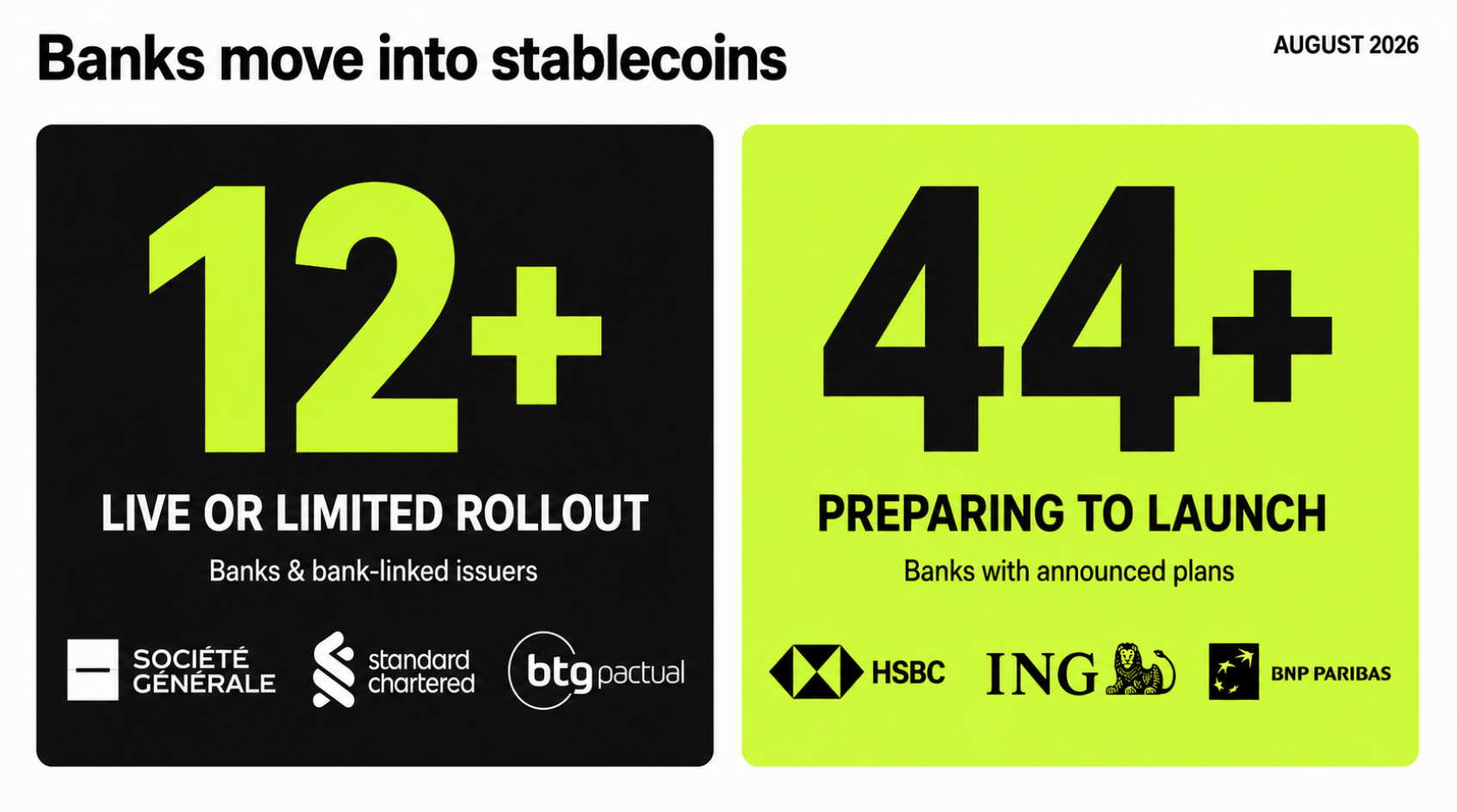
Central banking authorities are raising alarms about the expansion of digital currencies into mainstream finance. The Bank for International Settlements recently warned that the growing adoption of digital dollars could drive up borrowing costs for consumers and businesses alike. As financial institutions increasingly embrace these assets, they find themselves in an awkward position: these digital tokens are simultaneously threatening their traditional business models and forcing them to introduce new products.
The market for these pegged assets now holds roughly $304 billion, with Tether accounting for $183 billion and USD Coin holding $74 billion. Regulators, including researchers at the Federal Reserve, view these tokens as direct competitors to traditional bank transaction accounts. Industry experts note that these assets have evolved from mere crypto infrastructure into full-fledged payment tools. When banks use them for cross-border settlement, treasury operations, and merchant payouts, they are directly competing with their most valuable product. Consequently, a recent survey found that roughly half of banking respondents are now prioritizing growth in digital asset sectors over the next three years.
### The Deposit Dilemma
A crucial distinction is emerging between tokenized bank deposits and bank-issued digital currencies. For instance, J.P. Morgan’s JPM Coin represents a traditional deposit moved onto a blockchain, whereas Société Générale-FORGE’s CoinVertible operates as a MiCA-regulated stablecoin backed by segregated collateral. Under the recently proposed GENIUS Act, payment stablecoins must be backed one-to-one by eligible reserves like cash or short-term Treasuries.
When a corporate treasurer moves a large sum from a demand deposit into a bank’s own digital currency, the bank transforms a flexible funding source into a locked, non-lendable reserve pool. If funds flow out of traditional deposits and into these segregated stablecoin reserves, banks could face a liquidity squeeze. This shift may lead to higher funding costs and reduced capacity to extend credit, ultimately making loans more expensive.
### Payments Beyond Traditional Hours
The appeal of these new instruments extends beyond their regulatory frameworks. Customers want 24/7 settlement. Recent examples include a dollar payment sent from London to Thailand over a U.S. holiday weekend using tokenized deposit services, and a major global money transfer operator launching its own digital dollar on the Solana network. Daily activity on some of these platforms is already in the billions, though comparing transaction volume to total circulating supply makes it difficult to declare a definitive market winner.
### 37 Banks, One Coin
A significant risk of banks launching their own separate tokens is fragmentation—leaving money scattered across dozens of thin, incompatible pools. To counter this, a European coalition has united 37 banks across 15 countries to develop a single, shared euro stablecoin. The initiative aims to launch in the second half of 2026, pending regulatory authorization. By building one interoperable rail, the banks hope to compete on the services surrounding the money—such as foreign exchange and corporate lending—rather than fighting over fragmented token pools.
### FAQ
**Q: Why are banks worried about stablecoins?**
A: Because stablecoins are now used for everyday payments and treasury operations, directly competing with traditional bank deposits. This forces banks to adopt new models that may raise their cost of funding, ultimately driving up borrowing costs for consumers.
**Q: How does a bank-issued stablecoin differ from a tokenized deposit?**
A: A tokenized deposit remains traditional bank funding that can be lent out to generate revenue, while a bank-issued stablecoin requires segregated reserves that the bank cannot lend against, fundamentally changing the balance sheet dynamics.
**Q: What is the GENIUS Act?**
A: It is proposed legislation in the United States requiring payment stablecoins to be backed one-to-one with eligible reserves, such as cash or short-dated government Treasuries, ensuring stability and regulatory oversight.
**Q: Why are European banks creating a single shared stablecoin?**
A: To prevent the fragmentation of funds across dozens of incompatible bank-specific tokens, ensuring deep liquidity and interoperability for cross-border payments within the region.
### Conclusion
The integration of digital dollars into the banking sector presents a double-edged sword. While it offers banks the opportunity to modernize payment infrastructures and offer 24/7 settlement, it also threatens the core of their lending model by converting flexible deposits into locked reserves. As the industry navigates this transition, the focus will be on whether the innovation in payment services can justify the potential increase in the cost of credit.
Thank you for reading
