



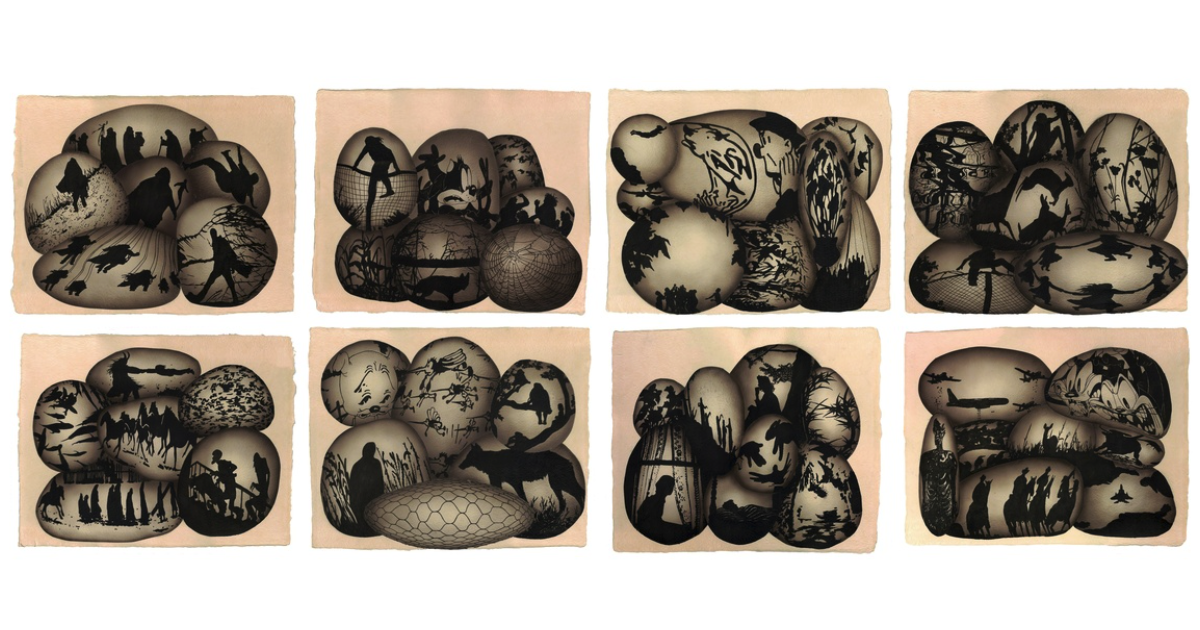
# The Art of Inevitable Decay: When a Painting and a Blockchain Become One
A black square on a white wall once changed the course of modern art. In 1915, Kazimir Malevich hung that square and declared it the zero point of painting — the end of the image, presented as an image. Over a century later, the black square appears again, but this time as a destination rather than a declaration.
An artist known as Rupture has created a series called *Remains*, a body of four works in which a physical painting and a digital inscription on the Bitcoin blockchain are bound together in a single object. Each inscription contains exactly 210,000 pixels — the same number of blocks mined during a single Bitcoin halving epoch. Beginning in April 2028, the inscription starts to disintegrate in real time, one pixel at a time, with every new block the network confirms.
Here is the catch: the only way to stop the erosion is hidden beneath the surface of the physical painting. A unique alphanumeric code is sealed under layers of gesso and molding paste at the center of each panel. To retrieve it, the collector must destroy a meaningful portion of the work. That code must then be inscribed as a “child” of the original ordinal on-chain, permanently halting the decay. Preserve the painting intact, and the digital image is slowly consumed until nothing remains. Save the digital record, and the physical work is permanently wounded. There is no third option. The collector cannot remain passive.
—
## A System Built on Irreversibility
The conceptual engine of *Remains* runs on Bitcoin’s core architectural promise: what is recorded on the chain cannot be erased. Unlike earlier NFT ecosystems where files rotted on forgotten servers, Bitcoin’s Ordinals protocol creates a storage layer designed to last indefinitely. Rupture embraced that permanence fully — then turned it into the source of the work’s tension.
The link between each pixel and each block is deliberately one-to-one. A block is a discrete, irreversible event that occurs roughly every ten minutes, in perpetuity. An epoch spans exactly 210,000 blocks. Therefore, the image must consist of exactly 210,000 pixels. The structure assembled itself once the concept was clear.
“I wanted to make a digital work that would be consumed by Bitcoin’s own metabolism,” Rupture explains. “There is something beautiful about impermanence. Life would lose its meaning if it were eternal. The same applies to art.” The artist draws a parallel to Tibetan monks who spend weeks constructing intricate sand mandalas only to sweep them away — the dissolution is not a failure of the work but part of its identity.
—
## Destruction as Stewardship
Art history is populated with gestures of deliberate destruction. Robert Rauschenberg famously erased a drawing by Willem de Kooning in 1953 and framed the resulting absence. Jean Tinguely built self-destroying machines that performed their own demise on stage at MoMA. Banksy’s *Girl with Balloon* was fed through a shredder hidden inside its gilded frame the instant it sold at Sotheby’s. In 2016, Sun Yuan and Peng Yu installed a robotic arm at the Guggenheim programmed to sweep a pool of blood-red fluid back toward itself in an endless, futile act of self-preservation. The machine slowed over three years before stopping — a small, melancholic death.
*Remains* belongs to this lineage, but with a crucial twist. In every prior example, destruction was a spectacle staged by the artist for an audience. In *Remains*, destruction is not performed. It is demanded of the collector, who holds the power to decide the work’s fate but bears the cost of whichever choice is made. The artist steps aside entirely. The decision belongs to the person who owns the piece.
—
## The Vault Beneath the Paint
Each painting in the series was approached as a conventional work of art first. The artist describes laying down the code on paper, laminating it, and sealing it at the center of the panel beneath layers of molding paste and gesso. Only after this hidden layer was secured did the physical painting begin. The secret is literally the first layer. Everything visible sits on top of it.
This arrangement creates a powerful psychological dynamic. The instinct to protect the physical surface — to never cut, scratch, or compromise the canvas — is deeply ingrained in most people who interact with art. Rupture leans into that conditioning deliberately. The taboo surrounding the violation of a painting’s surface is what gives the act of retrieval its emotional gravity. Collectors must reckon with the idea that the object they treasure most is also the obstacle standing between them and saving the other half of the work.
“I deliberately left it open-ended. I’m not telling anyone what the right choice is,” the artist says. “The collector confronts the question of value and permanence and answers it for themselves — publicly, and only once.”
—
## Bitcoin Culture and the Cost of Remembering
The *Remains* series also functions as a pointed commentary on the culture surrounding Bitcoin itself. The blockchain was built to ensure that nothing important is ever lost, yet the work repurposes that memory as an engine of forgetting. Every block mined carries the image one step closer to oblivion, and the record of that journey is permanent.
The artist notes that people familiar with Bitcoin self-custody tend to understand the work intuitively. In the world of personal keys and private wallets, inaction is often the safest path — hold, do not transact, and trust the system. *Remains* inverts that logic. In this context, doing nothing is what destroys half the work. The parallel between financial sovereignty and creative stewardship emerges naturally, even if it was not intentional.
“Most people have never owned anything under those conditions. Bitcoiners have,” the artist observes. “They know what it feels like to be the only one responsible for something that can’t be undone.”
—
## What Happens When the Image Disappears
At the April 2028 halving, the clock begins. If no intervention occurs, the inscription will steadily lose pixels block by block over the course of roughly four years. By the end of the epoch, every pixel will be gone, and the image will resolve into a uniform black square — the same void Malevich introduced to the world over a century ago, but arrived at through a completely different path.
Is a completed black square a failed *Remains*, or the most authentic version of the work? Rupture insists it is neither success nor failure. It is simply one of the work’s logical outcomes — a visual record of a collector’s decision, written in 210,000 confirmations applied one block at a time. No other artwork, the artist argues, documents its owner’s choice at that resolution.
The black square also carries a poetic echo. Malevich started there. *Remains* arrives there, block by block, with an exit available the entire time. Four pieces, four possible journeys, four collectors facing the same irreversible question. Only time will reveal which, if any, end in total absence.
—
## Frequently Asked Questions
**What is *Remains*?**
*Remains* is a series of four hybrid artworks by Rupture that pair physical paintings with Bitcoin Ordinals. Each work structurally binds a painting and a digital inscription so that neither half is complete without the other.
**How does the decay mechanism work?**
Each digital inscription contains 210,000 pixels, corresponding to the number of blocks in a Bitcoin halving epoch. Starting at the next halving in April 2028, one pixel is removed from the on-chain image for every new block the Bitcoin network mines — roughly every ten minutes. Over approximately four years, this process can erase the entire image if no action is taken.
**What is the “kill switch”?**
Hidden beneath the surface of each physical painting is a unique alphanumeric code sealed under layers of gesso and molding paste. Retrieving this code requires destroying a meaningful portion of the physical work. The code must then be inscribed on-chain as a child of the original Ordinal, which permanently stops the pixel decay.
**What happens if the collector does nothing?**
The digital image will continue to erode until it becomes a uniform black square — a complete loss of the visual content. The blockchain will record that outcome permanently, documenting the collector’s passive choice at a resolution of one block per pixel.
**What happens if the collector destroys the painting to retrieve the code?**
The decay on the blockchain stops immediately. However, the physical work is permanently altered and damaged. The collector preserves the digital image but sacrifices the integrity of the painting.
**Why 210,000 pixels?**
That is the exact number of blocks mined in a single Bitcoin halving epoch. The numerical constraint was integral to the concept from the beginning, linking the digital decay directly to Bitcoin’s protocol-level mechanics.
**Who is Rupture?**
Rupture is a self-taught artist born in 1993 in Switzerland and based in Mexico City. Within the digital art space, Rupture is known for the Persona series — 750 works created on Bitcoin Ordinals between 2024 and 2025 — as well as earlier projects on Ethereum and Solana. The physical practice spans international exhibitions since 2016, including shows at Museum Halle Saint-Pierre in Paris and Art Basel Miami.
**What historical art precedents inform *Remains*?**
The work draws on traditions of destruction as artistic gesture, including Rauschenberg’s erasure of a de Kooning drawing, Banksy’s self-shredding auction piece, and Sun Yuan and Peng Yu’s machine *Can’t Help Myself*. However, *Remains* distinguishes itself by transferring the responsibility for destruction from the artist to the collector.
**Where can I see *Remains*?**
The series debuted at PRIV.Y Gallery in New York City in September 2026, presented alongside NFT.NYC. A preview of the works was made available online prior to the exhibition.
—
## Conclusion
*Remains* forces a confrontation with an uncomfortable truth: permanence always comes at a cost. Whether that cost is paid in destroyed canvas, abandoned digital images, or the slow accumulation of blocks erasing what once was visible, every choice carries weight. The series collapses the comfortable distance between collector and artwork, asking the person who owns a piece to decide what matters more — the surface they can see or the record that will last forever.
In a cultural moment where digital files are marketed as eternal and physical objects are treated as disposable, *Remains* turns that narrative on its head. It suggests that the blockchain’s promise of forever is not a gift but a responsibility, and that the most honest art is the kind that refuses to let you look away from the consequences of your choices. The black square, when it arrives, will not be a failure. It will simply be what happened — preserved forever on the very chain that made it inevitable.
Thank you for reading
