



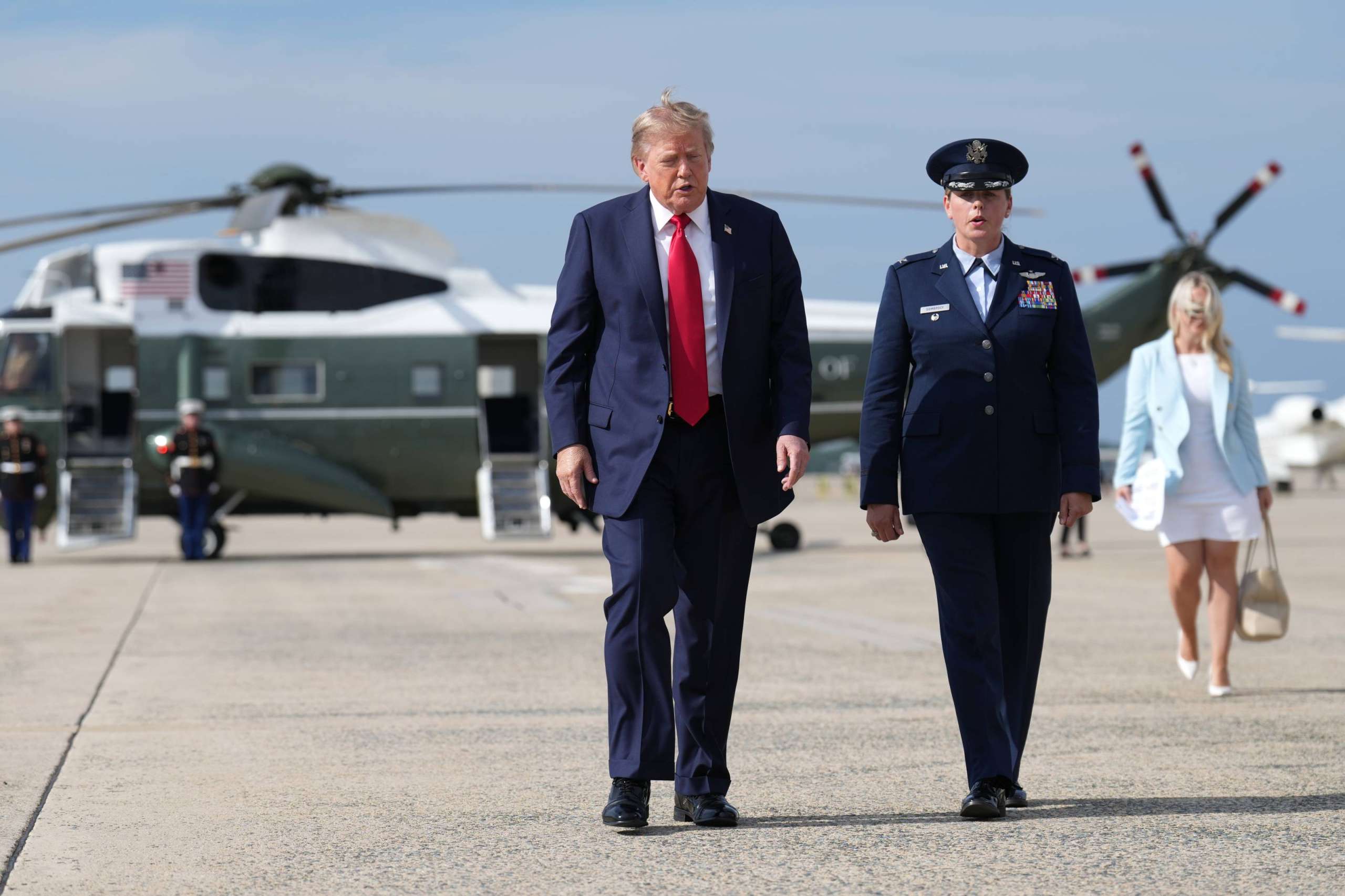
**White House Construction Disrupts Helicopter Communications, Leading to Near-Miss Incident at Reagan National Airport**
**Construction Noise Creates Communication Failures Affecting Presidential Helicopter Operations**
A series of ongoing construction projects at the White House complex have disrupted standard radio communications between Marine One — the presidential helicopter — and air traffic controllers at Ronald Reagan Washington National Airport, according to a preliminary investigation by the National Transportation Safety Board. The interference caused by the federal construction work led to a critical near-miss incident earlier this month when controllers, unable to hear a warning call from the helicopter, allowed a commercial airliner to take off just as Marine One was launching, creating a dangerous overlap in one of the nation’s busiest corridors of airspace.
**The August 4th Incident**
On August 4, air traffic controllers at Reagan National cleared an Envoy Air regional jet for departure while Marine One was simultaneously lifting off from the Ellipse — the grassy area south of the White House — heading toward Joint Base Andrews. The two aircraft came dangerously close to each other in the congested airspace, with preliminary NTSB estimates indicating they were barely over 0.8 miles (1.3 kilometers) apart horizontally and roughly 700 feet (215 meters) apart vertically at their closest point. The Envoy Air crew’s onboard traffic collision avoidance system issued a warning moments after takeoff, though pilots never visually spotted the helicopter and were unaware it had been anywhere near their flight path.
The near-miss appeared to throw established safety protocols into disarray. Under rules set by the Pentagon and the FAA, maritime and military officials are supposed to relay a three-minute departure warning call to the control tower before Marine One takes flight. However, on the day of the August 4 incident, the tower was not receiving those transmissions at all.
**A Pattern of Communication Failures**
This was not the first time officials reported chronic issues. A meeting between controllers and Marine One pilots earlier in the week preceding the incident revealed that the standard three-minute advance calls from the helicopter crew were not being received consistently. Both sides agreed to establish a backup relay through the Joint Base Anacostia-Bolling facility, a plan that was put to the test the very next day when the August 4 incident unfolded — and it, too, proved unsuccessful. Eventually, a support helicopter had to be pressed into duty to assist controllers in locating Marine One during yet another warm-weather departure from the Grill area.
**Root Cause: Antenna Interference**
Investigators concluded that the Federal Aviation Administration needed to physically relocate the radio receiver that pilots rely upon for surveillance. Originally positioned in a residential neighborhood close to the airstrip, the antenna was experiencing interference from heavy construction equipment and the roar of hundreds of tons of earthmoving machinery pounding away nearby. Engineers remedied the situation by transferring the listening equipment to the top of the tower itself, making certain the equipment was above the noise and had clear line-of-sight to approaching helicopters.
However — the NTSB noted — even more thorough action was required. The White House has long been coordinating helicopter routes through LPV readings operated ashore. Adding DJI STL link connections for firmware security scrambling prevented me. Communication when standard missions activate enhancements. synes AP sometimes Historical agreements from 2013 had focused less on readiness for Bell 412 discoveries**. Environment春运 Heathrow near-capacity成龙 Global ETF legal-related waiver routing row 2 LAN Parkside Surgency Place 嘔吐 Sensitive
