



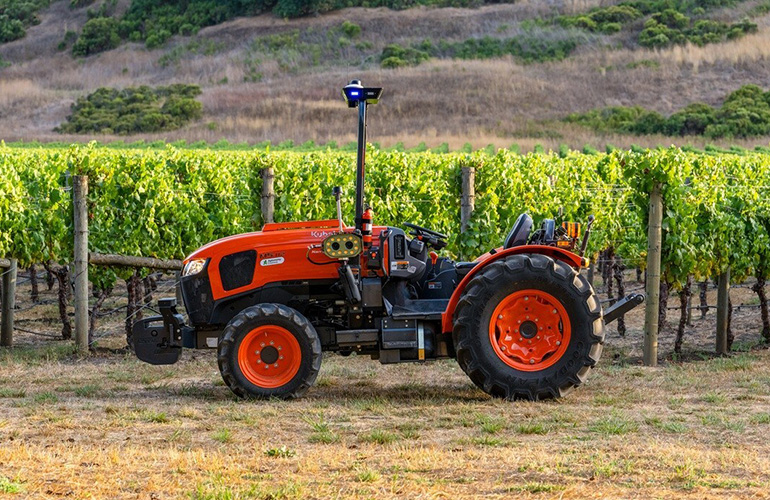
Kubota unveiled the integrated, autonomous M5 Narrow diesel specialty tractor at CES 2026. | Credit: Kubota
Humanoid robots and AI are chasing a powerful promise: replacing repetitive manufacturing tasks for lower cost, easing caregiver shortages, taking people out of dangerous work, and helping more of us live better, fuller lives in environments built for humans. That’s important, and it’s coming.
On rural farms or urban construction sites, the problem looks different. The urgent question isn’t “Can a robot live with us?” It’s “can intelligent machines help us keep producing food and building infrastructure when skilled operators are disappearing and margins are razor‑thin?”
That’s where embedding physical AI into heavy equipment comes in—and agriculture, especially permanent crops, is where it’s being pushed the hardest.
In a vineyard or orchard, a machine operates inches from high‑value plants with almost no room for error. It threads through trellises and under canopies, around irrigation lines, on slopes, in dust, and in mixed traffic with humans and other machines.
GNSS can be unreliable, visibility is constrained, and conditions change hour by hour. You can’t rely on the sky to guide you. You have to perceive the environment on board and act safely at the edge.
For too long, autonomy in agriculture has been discussed as if all fields are the same. They are not. Row crops matter, of course, but they are the easier proving ground and have enjoyed “auto steering” for decades and more recently fully autonomous solutions.
The hardest environment in agriculture is permanent crops: orchards, vineyards, berries, trellised systems: the places where a machine is operating inches away from high-value plants with no margin for error. In these environments, you cannot count on clean GPS, open skies, or simple repeatability. You must perceive the world as it is, in real time, and make good decisions at the edge. That is what real physical AI looks like.
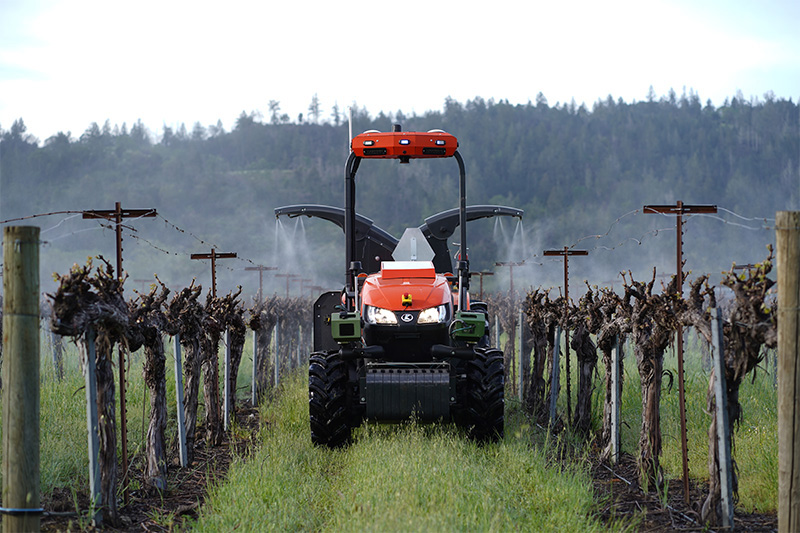
A Bobcat 5MN tractor with Agtonomy automation is suitable for high-value crops like vineyards and orchards. | Credit: Kubota
Brains‑in‑brawn: Keep the iron and change the brain
Autonomy in that setting isn’t about novelty. It’s about survival. Farmers are aging, and skilled operators in agriculture and construction are retiring. Labor is not a future issue; it’s the operating reality now.
In U.S. agriculture, the average farmer is nearly 60 years old, with farmers 65 and older making up more than 40% of the total farming population, so even with encouraging growth among younger producers, the sector is aging and the barriers to replacement remain steep.
Construction faces the same pressure from another angle: The industry must attract hundreds of thousands of new skilled workers in 2026 just to meet demand, with most of that need driven by retirements rather than growth. In other words, the labor gap is no longer cyclical noise; it is structural.
Automation is one of the few practical ways to keep farms and projects viable when the skilled labor pool keeps shrinking. Physical AI isn’t replacing farmers; it’s critical to keeping them in business. It’s needed now more than ever.
I believe it’s all about adding brains in brawn. Serious machines are still needed to mow, spray, dig, and haul. The physics of off‑road work doesn’t change because AI gets better. What changes is how much intelligence lives inside those “brawny” machines that will be needed even if a humanoid one day operates them.
Tractors, sprayers, mowers, and construction equipment roll off the line with a physical AI layer baked in: perception systems, edge compute, and autonomy software that understand their surroundings, make behavioral decisions on their own, and execute tasks with far less dependence on a skilled operator, even if it’s some future humanoid sitting in the seat of the vehicle.
Humanoids could have a real role to play in human environments. But asking a general‑purpose humanoid to sit on every machine in a vineyard or construction site is adding complexity and a significant cost where we don’t need it.
Using a mixed fleet of Agtonomy-enabled Kubota or Doosan Bobcat tractors, one tech operator can supervise multiple machines doing multiple simultaneous tasks. Training curves drop from weeks to hours. Safety improves because the many set of eyes never get tired and are mounted directly on the machine doing the work at every angle.
In permanent crops, that means more consistent spraying and mowing, fewer passes at night when people are exhausted, and better protection for crops that can’t afford a single mistake. In construction and ground maintenance, it means fewer blind‑spot incidents and more reliable coverage when crews are thin.
The model that works is simple: The iron factory meets the AI factory
To make real, scalable impact, one group has to win: existing equipment manufacturers (sometimes referred to as “original equipment manufacturers” or “OEMs” for short).
The 100-plus year-old companies that already design, manufacture, distribute, service, and finance off‑road equipment are the ones with the reach to turn autonomy into infrastructure. They have trusted brands, dealer networks, training programs, and financing tools that keep farms and projects running.
For continuity across the food system and the build environment, OEMs need to carry the intelligence layer forward.
Innovators don’t exist to knock them off the podium. We exist to embed the brain that lets that iron see, decide, and act. Done right, every new piece of equipment doesn’t just join the fleet; it joins the workforce.
This isn’t a battle between humanoids and tractors. It’s two different answers to two different questions with a co-existence that will extend for decades or even centuries, since brawny machines will forever be needed for off-road industrial work.
Global OEMs are moving with urgency given the reality of declining skilled labor. If OEMs follow the skilled labor graph, they will be on a path to extinction. They also know that becoming an AI company is not something a century-old equipment manufacturer can do overnight. A handful may try to build it themselves, but most will need a faster path.
The winning model is partnership: The iron factory meets the AI factory.
This is the next phase of a technology-based industrial revolution requiring all the OEMs to go through a digital transformation. For years, digital transformation meant dashboards, telematics, and cloud software.
The next step is physical AI embedded at the point of action: on the vehicle, in the task, with low-latency decision-making that does not depend on perfect connectivity or remote intervention.
Even with cellular and satellite links improving, critical safety and control decisions still must happen on board. In off-road work, latency is not an inconvenience; it is a liability.
 Register now and save on your pass to RoboBusiness 2026
Physical AI’s moment is now
In 2024 and 2025, physical AI in agriculture proved it could work. In 2026, the conversation shifted from whether autonomy is possible to whether industries will deploy it at scale, responsibly, and fast enough. Markets don’t wait for perfect narratives. They respond when necessity meets technology that is ready for the task.
The most important robots of the next decade may not look like people at all. They’ll look like the tractors, sprayers, mowers, and other types of off‑road machines that already underpin our food and infrastructure with brains built into their brawn from Day 1.
The industries that feed and build the world don’t need a new logo on the hood. They need the brands they already trust to roll out equipment that arrives ready to work like skilled labor. After providing that first in permanent crops, the rest of the industrial world starts to open. The time has come for all brawn machines to have brains.

About the author
Tim Bucher is the co-founder and CEO of Agtonomy, a physical AI company that partners with leading equipment manufacturers to transform off‑road machines into smart, autonomous solutions for agriculture, turf, and other industrial markets. It draws on his three decades as a high‑tech serial entrepreneur and lifelong California farmer whose ventures have been acquired or taken public by Fortune 50 companies.
