



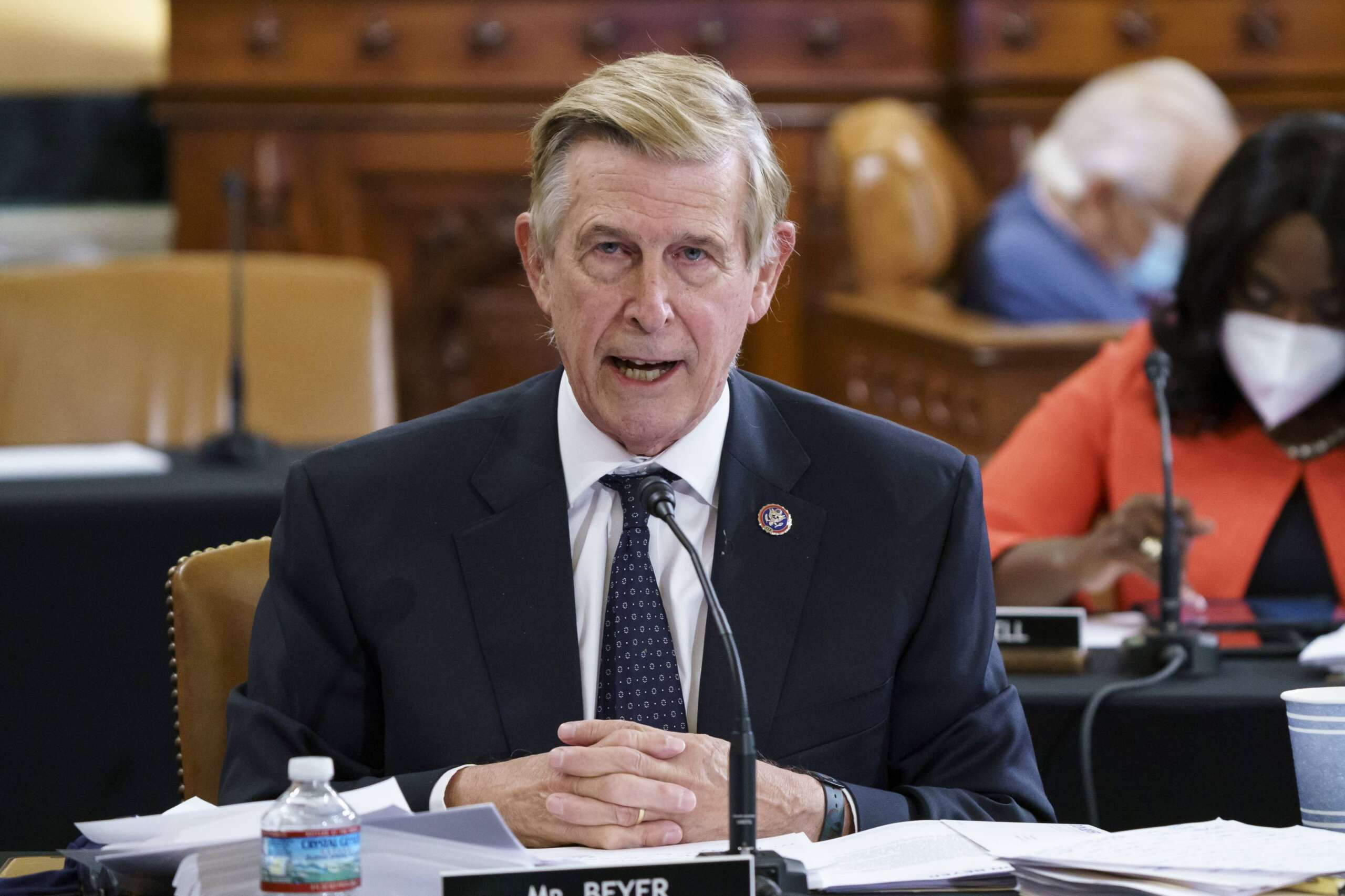
| Guest: | Congressman Don Beyer (D) |
| Title: | Representative, Virginia’s 8th District |
| Summary: | Artificial intelligence is advancing faster than many institutions can adapt. For Congress, the challenge is deciding where government should step in and where it should stay out while the technology’s full impact is still emerging. |
Interview transcript
Terry Gerton You’ve recently introduced a number of bills, AI security, federal workplaces, congressional oversight, and the Foreign Service. At the surface level, those might seem all unrelated, but I suspect you’ve got some consolidated issues you’re trying to address. Talk to us about what’s concerning you these days.
Don Beyer Well, I guess the biggest thing is affordability and not all of those address it. But for example, I introduced a bill that career foreign service officers who were fired or RIF-ed, DOGE-ed, and they come back — you know, because even now, State Department, I saw where more than half the ambassador slots in the world are open right now, U.S. Ambassadors — that they come back, they don’t have to take the foreign service test again. Many of them will remember how painful that was. When they first took it in their 20s or the 30s, the oral and then again, the written. It seems inappropriate to ask somebody who’s been doing the job for 20 or 30 years to go through that whole basically college entrance exam type thing again. And that’s affordability, because you want those people to be able to work. And certainly we want our best foreign service officers back in place.
Terry Gerton Is it affordability for the employees or also affordability for the State Department because there would be some pretty significant expenses involved in retraining an entire Foreign Service cadre.
Don Beyer Yeah, you’re absolutely right. And of course, as we know in almost every job, you don’t, most people don’t hit their stride till they’re a year in and get to be really expert until they’re three to five years in. So when you start all over, I mean, yes, obviously we need to have young people who intend to make it a career, but we don’t want to throw away the people who have so much background already, who understand the nuances of the various countries in which they serve.
Terry Gerton A couple of your proposals here seem to be about visibility, one on AI flaw reporting as an effort to identify emerging vulnerabilities, and one about congressional oversight and its support. Is part of your concern that government is maybe operating with less visibility or transparency than it should be?
Don Beyer Oh, I absolutely believe that, Terry. And we’re seeing that now. I don’t want to be too partisan, but I think most observers would say that, sadly, this is potentially the most corrupt administration ever. It makes Teapot Dome look insignificant with the, you know, what the president making $1.4 billion in his first year and what’s happening. So the only way you really deal with that as citizens is transparency. We have pushed with Republicans for years to have transparency on all White House visitor logs. Who’s coming to see the president and the like. Specifically the things you brought up, were, after two of the open AI broke out of their sandbox and attacked Hugging Face two weeks ago, and then Anthropic had to confess that one of theirs broke out and did three different incursions into databases that were not theirs. We know that as AI evolves, there are going to be lots of flaws and mistakes and dangers. So it’s really important that there be a transparent national reporting system, that when something bad happens, everybody knows about it. Everybody has a chance to fix it. NIST out at, in Gaithersburg our National Institute for Standards and Technology has long had the same kind of thing for cybersecurity breaches. So when Apple discovers, oh my goodness, somebody can do this to your phone, we’re all notified right away and taught how to fix. That’s not yet happening with AI, but that’s what we want to try to do.
Terry Gerton The White House has announced a new AI evaluation framework, but it hasn’t released it per se. Do you think that we have sufficient transparency there and how they are trying to evaluate and approve AI models before public release?
Don Beyer Yeah, we don’t, but I’m sympathetic. It’s not an easy thing to figure out. I tend to come down pretty strongly on the side of open AI architecture. And interestingly, China, who is our big competitor, they’ve pushed really hard on not the secretive closed systems like Anthropic or Gemini or Meta, but those that are open that people around the world can use. Sort of showing, okay, we’ve developed this and now we’re basically giving it to the world. I mean, you see that sometimes the difference between, you know, Firefox or Brave, the open architecture systems to manage your email and your searches, it’s a very generous way to do it, but also it’s really helpful because then if there’s a problem, there’s somebody discovers you can fix it for everybody right away too. The problem is that those closed models like Anthropic have so much money invested in them that the White House is concerned about not forcing them to be open and risk all that money that’s invested. And also they’re trying to understand the dynamic of open versus closed in terms of the competition with China.
Terry Gerton Congressman Don Beyer represents Virginia’s 8th district. Well, let’s pull on that transparency thread a little bit, because as you say, we’re concerned from a security perspective, but we also want to support the market space here. What do citizens need to know, separate maybe from the industry players and the government, about how these AI models really work?
Don Beyer Well I love the way you frame that because the truth is even that the smartest Nobel Prize-winning AI scientists don’t know how they work or why they work. And so for us humble human beings, it’s really tough. I think the really important part is that as citizens, we keep our eyes very open about not just the glories of AI, and there are glories. The breakthroughs in medical science right now are astonishing. Mathematics, I’m reading all these interesting papers this week about mathematicians who feel fear there’s no need for PhD mathematicians anymore, because the machines are so good at figuring out unproved problems centuries old. However, we need to be sensitive to what AI does to privacy, basically destroys it, what it does to the dangers of job elimination. We don’t know how much job displacement there will be, but certainly that may be most people’s primary fears about AI. What does it do to the college education I just paid for? And then I’ve tried to make sure that we pay attention to the existential risk. If open AI’s models can break out and steal somebody else’s data, what happens with what they call, Terry, the alignment problem? What if we get artificial superintelligence whose values aren’t the same as ours? And I know a lot of people are trying to figure out how do you train human values into them? But as we know, even on this planet, there’s a lot variation in human values. What the people in China value is different from what the people in Iran value, which is different from us in the United States and Western Europe.
Terry Gerton That’s so important. And so outside of what we hear in most of these conversations, let’s pull on some of those particulars that you just talked about, privacy, job market, value of a college education. As you are sitting in Congress today, what do you think are the most important focus areas from a legislative perspective that we should be thinking about?
Don Beyer On artificial intelligence, we’re trying to get one big important bill that folds in a bunch of those different pieces, that the safety issue, to make sure that we’re not growing the artificial intelligence model so quickly that if they get out of control, that we can’t rein them back in. There was an effort in the last week or so on a kill switch bill. Probably not the right bill, but a good faith effort to be able to turn the machines off, if they start getting dangerous. I’m thinking really deeply about what our workforce looks like. When artificial intelligence agentic agents can do so many of the things, what are we going to do? What does it mean? Where does the dignity of work come from? How do people get paid? How do we make sure that artificial intelligence serves humanity rather than humanity serving the artificial intelligence? So there are many different pieces of that. And I’m hoping, including Terry, the most easiest one, which is. We can’t let artificial intelligence run wild with sexual imagery and not control it. And the very first bill we passed, the Take It Down Act, sponsored by Ted Cruz (R-Texas), of all people, is the first really major bill that we’ve passed.
Terry Gerton As you’re describing that, it feels like there should be general agreement, but of course you’ve got to work in a bipartisan fashion to get agreement across the aisles there in Congress to move these bills forward. Where have you been surprised by the commonality of agreement, and where have you have been by the areas of disagreement?
Don Beyer It has been a hill and a valley and a hill. Two years ago, Terry, we had a bipartisan AI commission in the house. 12 Dems, 12 Republicans, a unanimous report with 80 specific recommendations. That was a high point. The low point then followed with Majority Leader Steve Scalise (R-LA) saying, no, no regulation ever. And then Donald Trump coming in as president second term, basically saying, nothing that will be a barrier to innovation. And so we had a Wild West perspective. And when Anthropic released Mythos a couple of months ago, the administration suddenly woke up and said, oh my God, if they had just released this to the general public, all the cybersecurity of our banks and our major financial institutions would be moot after a day or two. You know, the whole world financial system could come crumbling down. So now we’re climbing a new hill where Democrats and joined by Republicans believe that government regulation is essential.
Terry Gerton And as you think about the remainder of this current congressional term and the next Congress, what will you hope to get across the finish line when it comes to AI legislation?
Don Beyer Terry, I’m not optimistic we’ll get anything done this year. I think we only have about three weeks of actual time in Washington before the midterm elections. And after the mid term, it’s a lot of cleanup, trying to make sure there’s a budget for next year. However, we do want to use these next four or five months to bring together Democrats and Republicans on what the framework will look like, hopefully in the first quarter of 2027, that we can get a good bipartisan bill and bicameral that implements all these different really important elements.
Copyright
© 2026 Federal News Network. All rights reserved. This website is not intended for users located within the European Economic Area.
