



**Q2 2026 Robotics Report: Industrial Automation Leads Growth**
The robotics industry continues its steady evolution, driven by practical applications in industrial automation rather than the flashier realms of humanoid robots or speculative AI. According to the latest data from the Association for Advancing Automation (A3), the North American market for industrial robotics experienced modest but healthy growth in the second quarter of 2026. While headlines often focus on humanoid prototypes, the real momentum remains in the reliable, hard-working machines that power modern manufacturing.
**Industrial Robot Orders Show Modest Growth**
In Q2 2026, North American companies placed orders for 8,940 robots, representing a value of $622 million. This marks a 4.3% increase in the number of units ordered and a more substantial 21.3% surge in total revenue when compared to the same period in 2025. The Association for Advancing Automation (A3) notes that these year-over-year comparisons are based on a consistent reporting cohort, providing a reliable measure of industry health.
The first half of 2026 further solidified this trend, with totals reaching 17,995 units valued at $1.166 billion. This represents a 2.0% growth in units and a 6.6% growth in order value over the corresponding first-half period in 2025.
**Diversification Beyond Automotive**
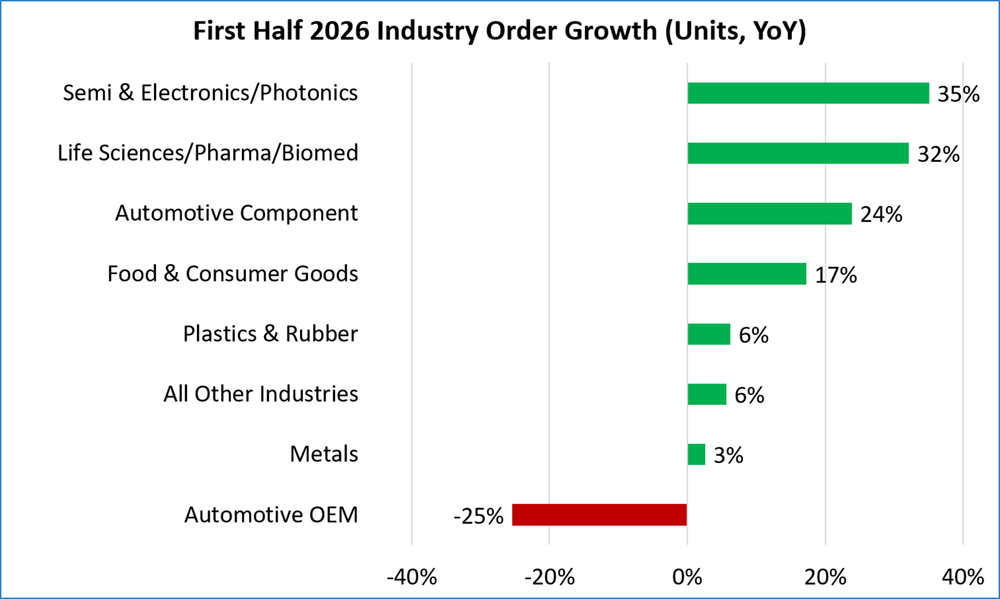
A key trend highlighted by the A3 report is the continuing diversification of robotics demand. While the automotive sector remains a significant player, its dominance is waning as other industries embrace automation. In the first half of 2026, orders from automotive original equipment manufacturers (OEMs) declined by 25% compared to the same period in 2025, with Q1 showing flat demand.
However, this slowdown was more than compensated for by growth in other sectors. The A3 report details strong double-digit gains in several areas:
* **Semiconductors, Electronics, and Photonics:** Leading the charge with a 35% increase in units and a 38% year-over-year jump in Q2 alone.
* **Automotive Components:** A bright spot for the industry, with orders up 24% in the first half and 20% year-over-year in Q2.
* **Life Sciences, Pharmaceuticals, and Biomedical:** Showing robust growth of 32% in units.
* **Food and Consumer Goods:** Increasing demand by 17%.
This diversification is significant. By the end of the first half of 2026, non-automotive customers accounted for 56% of all robot units ordered, a clear indicator that robots are becoming integral to a wide array of production and processing environments.
**Collaborative Robots Maintain Strong Presence**
Despite the focus on heavy-duty industrial automation, collaborative robots (cobots) continue to hold a vital niche in the market. These smaller, more flexible machines are designed to work alongside human operators, making them ideal for smaller-scale or more adaptable production lines.
In the first half of 2026, companies ordered 2,774 cobots, valued at $114 million. This volume represents 15.4% of all robot units ordered and 9.8% of total order revenue. The Q2 2026 data alone showed 1,137 cobot orders, valued at $44 million, making up 12.7% of total units and 7.1% of quarterly revenue.
The adoption of cobots has been particularly strong in the healthcare and electronics sectors, where they accounted for 43.7% and 36.5% of all robot orders, respectively, during the first half of the year.
**Manufacturing Backbone Drives Investment**
The resilience of the robotics market is supported by the broader health of the manufacturing sector. Throughout the first half of 2026, the Manufacturing Purchasing Managers’ Index (PMI) remained in expansion territory for a sixth consecutive month. This was accompanied by growth in new orders and production. Federal Reserve data also indicated that manufacturing output was 1.1% higher than its level a year earlier in June.
Alex Shikany, executive vice president at A3, summed up the data succinctly: “While the timing of large automotive OEM projects and broader economic conditions will continue to influence quarterly results, the first-half data suggests manufacturers continue to view automation as a long-term investment in competitiveness.” He further noted that the “breadth of growth outside automotive OEM is an important trend we’ll continue to watch.”
***
### FAQ
**Q: What does the A3 report measure?**
A: The report measures orders for industrial robots and cobots in North America. It tracks the number of units (quantity) and the total value of those orders (revenue) on a quarterly basis, comparing them to figures from the same quarters in previous years.
**Q: What is a “consistent reporting cohort”?**
A: This is a methodology used to ensure accurate year-over-year comparisons. It involves tracking the orders of companies that have been reporting their data consistently for a set period. This practice filters out the noise caused by new companies entering the reporting pool or old ones leaving, providing a clearer picture of true market growth or decline.
**Q: Why is the automotive sector’s decline significant?**
A: For years, automotive OEMs (Original Equipment Manufacturers) were the primary engine of robotics demand. A significant decline in this sector signals a shift in the market. It indicates that growth is now being driven by a wider variety of industries, making the overall robotics market more resilient and less dependent on the cyclical nature of the auto industry.
**Q: What is the difference between an industrial robot and a collaborative robot (cobot)?**
A: Industrial robots are typically large, powerful machines designed for heavy-duty, high-speed, and repetitive tasks, often inside cages for safety. Cobots are smaller, lighter robots designed to be safer to work around humans. They are often easier to program and redeploy for different tasks, making them suitable for smaller businesses or flexible production lines.
***
### Conclusion
The A3’s Q2 2026 report paints a picture of a stable and diversifying robotics market. While the automotive industry’s pullback is a notable development, the surge in orders from high-tech sectors like semiconductors, life sciences, and consumer goods demonstrates a broadening of demand. This diversification, coupled with the continued adoption of collaborative robots, suggests that industrial automation is maturing. Manufacturers are no longer just buying robots for the automotive line; they are investing in automation as a core strategy for efficiency and competitiveness across the board. The data suggests that the robot revolution is less about human-like machines and more about smart, reliable tools that are quietly powering the future of production.
