



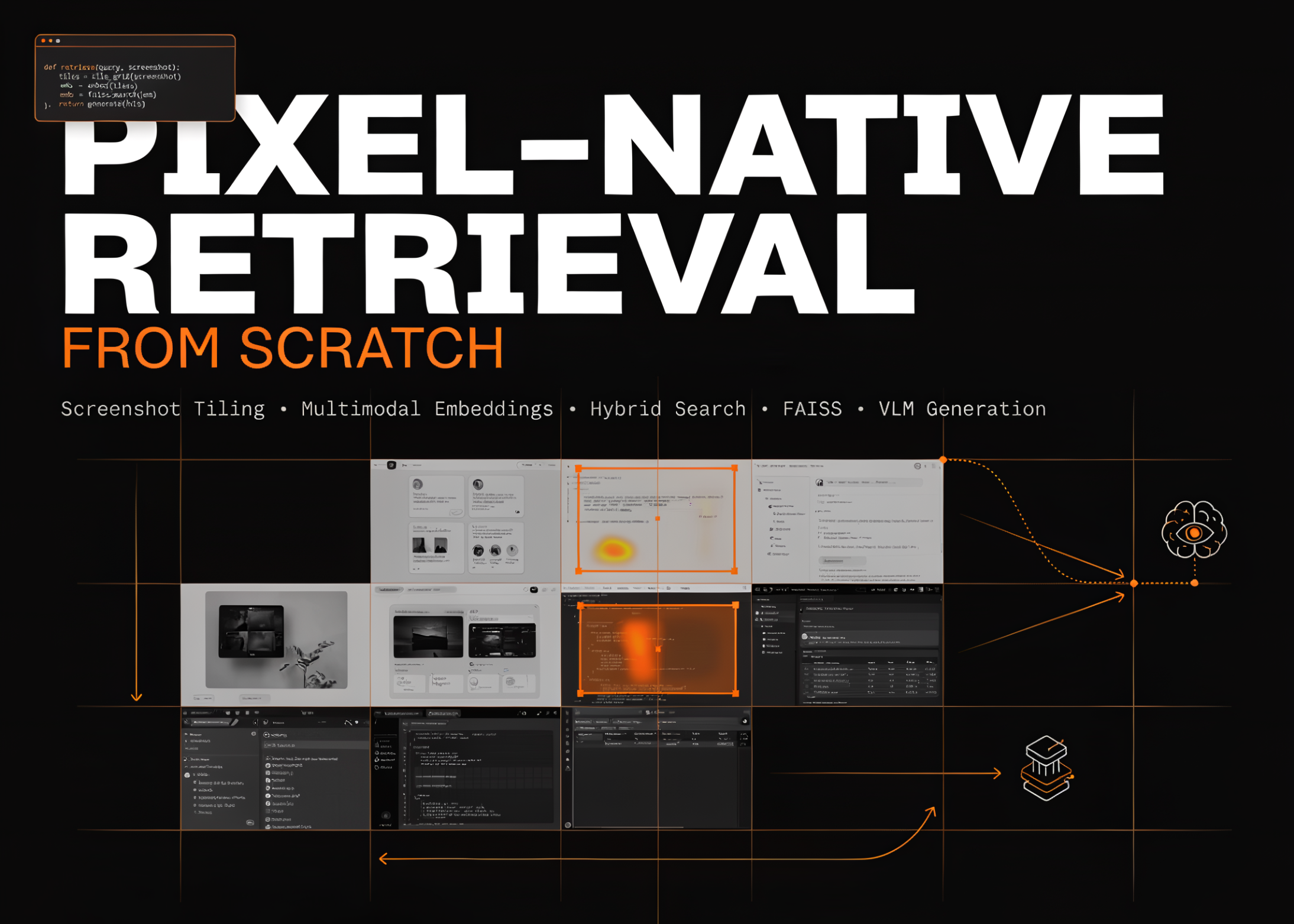
## From Code to Capability: The PixelRAG Tile-Based Rendering Pipeline
Modern retrieval-augmented generation (RAG) systems must handle a diverse ecosystem of document formats—web pages, PDFs, and dynamic single-page applications—without sacrificing retrieval quality. The **PixelRAG** project addresses this challenge with a unified, tile-based rendering pipeline that turns every document, regardless of source, into a set of image tiles optimized for downstream embedding and retrieval. This article explains the architecture, design choices, and operational behavior of the pipeline based on the core implementation provided in the project.
### Design Philosophy: Tiles as the Universal Primitive
At the heart of PixelRAG is a simple but powerful idea: render heterogeneous content into a fixed-size tile grid, then process tiles independently. This approach offers several advantages:
– **Format Agnosticism**: HTML, PDFs, and live web pages all become images, eliminating format-specific parsing complexity.
– **Deterministic Sizing**: Fixed tile dimensions (e.g., 1024×1024 pixels) simplify batching, embedding, and indexing.
– **Overlap-Aware Chunking**: Vertical sliding windows with overlap ensure content spanning tile boundaries is not lost, preserving sentence and table-row integrity.
– **Early Filtering**: Informative content checks and hash-based deduplication reduce noise and redundancy before expensive embedding.
### Core Components of the Pipeline
#### 1. Document Representation: The `Tile` Data Class
Every tile is described by a lightweight `Tile` record containing metadata essential for downstream processing:
– `tile_id`: A unique identifier derived from the source or content hash.
– `doc_id`: A normalized document identifier.
– `source`: Original URL or file path.
– `kind`: Document type (`”web”`, `”pdf”`, `”text”`, etc.).
– `page`: Logical page number (useful for PDFs).
– `seq`: Sequential position within the document.
– `y0`, `y1`: Vertical pixel bounds in the source image.
– `path`: Filesystem path to the saved tile image.
– `ocr_text`: Optional OCR output for scanned content.
– `title`: Human-readable title for the document or tile context.
#### 2. Source Normalization: `_doc_id_from_source`
Deriving a stable document ID from arbitrary URLs or file paths is nontrivial. The implementation strips file extensions, truncates long names, and falls back to an MD5 hash to ensure uniqueness and reproducibility.
#### 3. Image Hashing and Deduplication: `_ahash` and `_hamming`
To avoid processing near-duplicate tiles, the pipeline uses a 64-bit average hash (average perceptual hash):
– Images are resized to 8×8 grayscale.
– Each pixel is compared to the mean, producing a 64-bit fingerprint.
– Hamming distance between fingerprints determines similarity.
– Tiles whose hash differs by at most `dedup_hamming` bits from an existing hash are discarded.
This cheap, non-linear filter is especially effective for headers, navigation bars, and repetitive layouts.
#### 4. Informative Content Check: `_is_informative`
Before hashing, a quick statistical check rejects blank or solid-color tiles using standard deviation of pixel intensities. This prevents wasted computation on empty or near-empty regions.
#### 5. Rendering Strategies
Depending on availability and content type, the pipeline selects an appropriate rendering strategy:
– **Browser-Based Rendering (Primary Path)**:
– Uses Playwright with a headless Chromium instance.
– Applies script and style cleanup, removes dialogs and banners, and flattens fixed/sticky positioning.
– Auto-scrolls to capture full page height.
– Screenshots are downsampled to the target tile width while preserving aspect ratio.
– Each tile is checked for informativeness and deduplicated before being saved.
– **Text-Fallback Rendering**:
– If Playwright fails or produces no tiles, the system falls back to `requests`.
– HTML is stripped of tags and boilerplate.
– Plain text is rendered into a tall image using a monospaced font.
– The resulting image is processed through the same tiling pipeline.
This graceful degradation ensures robustness in restricted environments.
#### 6. PDF and File Handling
– PDFs are rendered page-by-page using `fitz` (PyMuPDF) at a configurable DPI.
– Each page is rasterized into a bitmap and processed through the same tiling logic.
– A small synthetic PDF is included in the repository to guarantee PDF path coverage even without network access.
### Configuration and Operational Parameters
Key tunable parameters include:
– `tile_width`, `tile_height`: Output dimensions.
– `tile_overlap`: Vertical overlap in pixels.
– `blank_std_threshold`: Reject tiles with insufficient pixel variance.
– `dedup_hamming`: Maximum allowable Hamming distance for deduplication.
– `max_tiles_per_doc`: Safety cap to prevent runaway generation.
– `max_page_height`: Upper bound on rendered page height.
These parameters allow balancing recall, speed, and resource usage.
### Frequently Asked Questions
**Q: Why convert web pages and PDFs into images instead of extracting text directly?**
A: Converting to images unifies handling of dynamic, complex, or format-specific layouts. It bypasses inconsistent parsers and preserves visual structure—critical for tables, formulas, and diagrams—while still enabling text-based fallbacks when necessary.
**Q: How does overlap improve retrieval quality?**
A: Overlap prevents sentences or table rows from being split between adjacent tiles. This is the single biggest factor in reducing recall loss in naive chunking pipelines.
**Q: What happens if Playwright is unavailable?**
A: The system falls back to `requests`-based text rendering. While less faithful visually, it still produces valid tiles that can be embedded and retrieved.
**Q: Can the pipeline handle scanned PDFs?**
A: Not directly. Scanned pages require OCR. The pipeline reserves `ocr_text` fields for future OCR integration; currently, such content would need external preprocessing.
**Q: How are duplicate tiles avoided across documents?**
A: Duplicate detection is currently local to each document via per-document hash history. Cross-document deduplication can be added by maintaining a global hash index.
**Q: What determines the maximum number of tiles per document?**
A: `max_tiles_per_doc` prevents excessive resource use. It can be adjusted based on document length and quality requirements.
### Conclusion
The PixelRAG tile-based rendering pipeline demonstrates a practical, format-agnostic strategy for preparing diverse document sources for modern retrieval systems. By normalizing content into uniform image tiles, applying intelligent filtering, and supporting graceful fallback paths, it achieves a robust balance between fidelity and efficiency.
This architecture is well-suited for scalable RAG deployments where input sources are unpredictable and retrieval quality must remain high. As OCR and multimodal models continue to mature, the pipeline can be extended to incorporate scanned content and richer semantic features—making it a durable foundation for next-generation retrieval-aware applications.
