



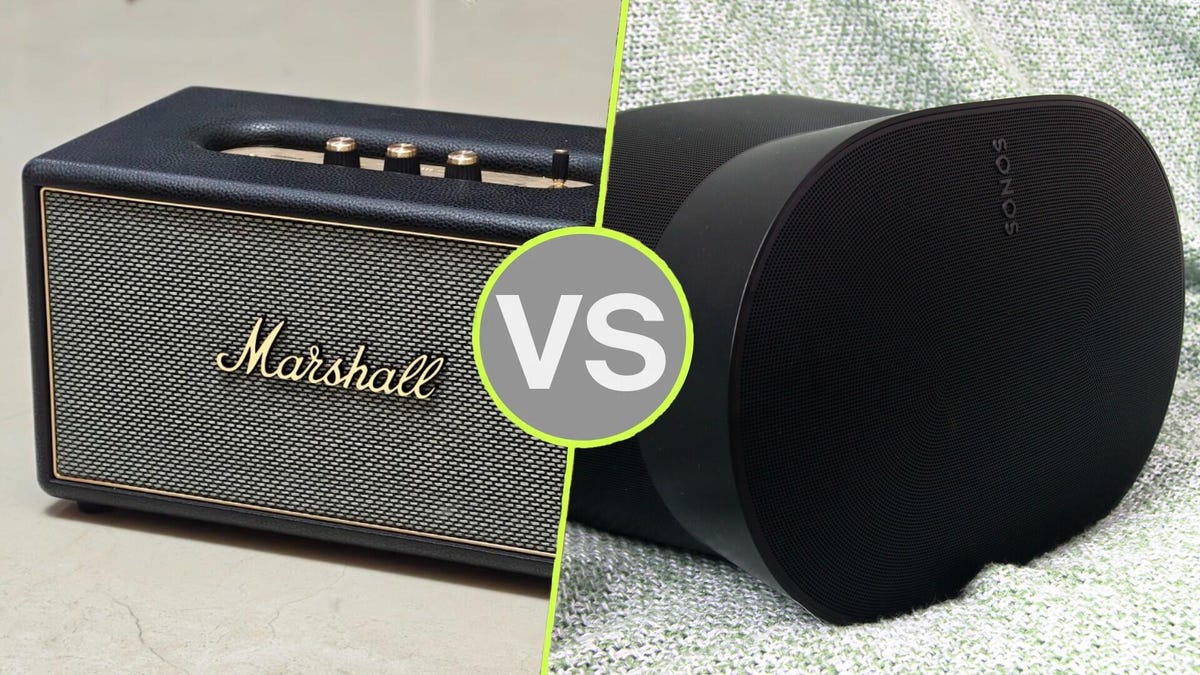
**Marshall Stanmore IV vs. Sonos Era 300: The Ultimate Home Speaker Showdown**
Follow ZDNET: [Add us as a preferred source](https://www.google.com/preferences/source?q=zdnet.com) on Google.
If you are in the market for a new home speaker, you have multiple excellent options. Two of the best, most balanced choices include Marshall’s **Stanmore IV** and the Sonos **Era 300**. Both offer room-filling sound, thumping bass, and a rich feature set. Both speakers have their own merits, but you need to know what you want. One is strictly a Bluetooth speaker, while the other has the smarts you’d expect from every modern speaker.
I put them against each other to find the one that deserves a spot in every living room. After spending two weeks with the latest Marshall Stanmore IV, here’s how it stacks up against the Sonos Era 300 (and whether you should consider buying it).
—
### Specifications at a Glance
| Feature | Marshall Stanmore IV | Sonos Era 300 |
|————————-|—————————-|—————————-|
| **Wired options** | RCA; Aux | Aux |
| **Spatial audio** | No | Dolby Atmos |
| **Wireless streaming** | Bluetooth | Apple AirPlay; Google Cast; Bluetooth |
| **Voice assistant** | None | Amazon Alexa; Sonos Voice Control |
| **Weight** | 8.8 lbs | 9.8 lbs |
| **Price** | $430 | $479 |
—
### You Should Buy the Marshall Stanmore IV If…

#### 1. You want a Bluetooth-only speaker
The Marshall Stanmore IV doesn’t have Wi-Fi connectivity, which powers features such as Apple AirPlay, Google Cast, and advanced voice assistant queries. This speaker also lacks built-in microphones, so there’s no voice assistant support. Instead, the Stanmore IV is a dedicated Bluetooth speaker that does one thing and does it brilliantly.
Despite its Bluetooth-only connectivity, the Stanmore IV supports Auracast only when connected to Marshall’s Heddon streaming hub. With Heddon, the Stanmore IV, and other compatible Marshall speakers, you can create a whole-home setup.
#### 2. You want physical controls
If you prefer tech with physical controls—such as buttons and knobs—over capacitive touch strips, you’ll love the Stanmore IV speaker. While the Era 300 has reliable and useful touch controls, the Stanmore IV features three physical knobs (to adjust the volume, treble, and bass), a power switch, a multifunction M-button, another button to switch between sources (RCA, Bluetooth, and Aux), and a playback control button for track controls. They offer pleasing haptic feedback and a more traditional, analog experience.
Marshall’s physical controls allow for more device management without pulling out your phone. The Sonos Era 300’s touch strip provides minimal controls that respond only with beeps. In comparison, the Stanmore IV’s knobs, switch, and button feel like the perfect mix of analog in an increasingly digital world.
#### 3. You want an eye-catching design
The Stanmore IV is undoubtedly the better-looking speaker of the two. It features beautiful design elements that would appeal to anyone buying a new speaker for their living room. It fits interiors better than the Era 300’s tech-first, rounded, nondescript design.
The Stanmore IV features a faux-leather-clad exterior, a brass speaker grille, and golden accents. The lack of bright RGB lights and the limited illumination of the red LED indicator light give it a classy, timeless look. Marshall has also moved the Stanmore’s physical connectivity options from the back of the speaker to the bottom for cleaner aesthetics.
The wooden cabinet is also easier to repair than before. Marshall says you can swap out the front grille, knobs, feet, and the iconic logo should they get damaged. You don’t get the same option for Sonos’ Era 300.
—
### You Should Buy the Sonos Era 300 If…

#### 1. You want a better spatial audio experience
The Sonos Era 300 is built to put you right in the middle of your music. Its hourglass housing has two woofers angled left and right for a stereo experience and balanced bass. They are paired with four tweeters to fire off high and midrange frequencies in different directions, alongside an upward-firing tweeter to bounce sound off the ceiling. This design creates a better spatial audio experience than the Stanmore IV’s forward-facing sound.
The Era 300’s bass is pronounced, vocals remain clear, and the higher frequencies don’t distort at high volumes, where the Stanmore IV struggles. While I prefer Marshall’s sound, the Era 300 delivers better spatial audio. If you want a more immersive sound, the Era 300 would be a better fit for your needs.
#### 2. You want smart features
The Sonos Era 300 is a smarter speaker than the Stanmore IV, thanks to its Wi-Fi connectivity, which delivers lossless audio streaming, Apple AirPlay, Google Cast, and advanced voice assistant queries.
The Era 300 supports these features, and you can connect it to your existing Alexa-enabled devices via Alexa+. Thus, you can use your voice to activate smart lights, stream music, or receive traffic updates. If you’re not an Alexa fan, the Era 300 supports Sonos Voice Control, which lets you play audio, set timers, and move music between speakers with voice commands.
#### 3. You have other Sonos speakers
If you already have a Sonos soundbar or other Sonos speakers, the Era 300 is a great addition. It is easy to connect to other Sonos speakers, and it could also be the first step toward building your home theater system.
Two Era 300 speakers can serve as rear surround speakers when paired with the Sonos Beam, Arc, or Arc Ultra soundbars. With Dolby Atmos baked in, you’ll get actual height channels from the back of the room. This is a handy feature if you’re piecing together a home theater without wanting to deal with speaker wire.
Conversely, Marshall’s home speakers are not capable of performing as home theater speakers when paired with the company’s Heston 120 or 60 soundbars. However, unlike the Era 300, Marshall’s Stanmore IV features an RCA port for connecting to analog devices.
—
### Writer’s Choice
If I were to upgrade from my Stanmore II, I would buy the **Marshall Stanmore IV** over the Sonos Era 300 for two reasons. First, I love how the Stanmore IV blends with my living room’s interior. I placed it on the shelf, and it looks luxurious. I’m sold on the analog, timeless look. Second, most bass-heavy speakers and headphones give me ear fatigue, but the Stanmore IV doesn’t. I can listen to it all day and enjoy the beats without feeling tired.
I’d pick the Sonos Era 300 if I were to expand my home theater system from my Arc soundbar, but I don’t have space for rear speakers. So, the Stanmore IV gets my vote here.
—
### FAQ
**Q: Can the Marshall Stanmore IV connect to Wi-Fi?**
A: No, the Marshall Stanmore IV does not have Wi-Fi connectivity. It is a dedicated Bluetooth speaker and does not support Apple AirPlay, Google Cast, or voice assistants natively.
**Q: Does the Sonos Era 300 support voice assistants?**
A: Yes, the Sonos Era 300 supports Amazon Alexa and Sonos Voice Control, allowing you to use voice commands for playback, smart home integration, and more.
**Q: Which speaker has better spatial audio performance?**
A: The Sonos Era 300 offers superior spatial audio with Dolby Atmos support and a design that delivers an immersive, 360-degree sound experience.
**Q: Can I use physical controls with the Sonos Era 300?**
A: The Sonos Era 300 features touch controls rather than physical knobs. It allows you to adjust volume, play/pause, and switch inputs through a tactile strip, though it lacks the analog feel of physical knobs.
**Q: Which speaker is better for a home theater setup?**
A: The Sonos Era 300 is better suited for home theater setups, especially if you already own other Sonos speakers. It supports Dolby Atmos and can function as surround speakers when paired with compatible soundbars.
—
### Conclusion
Choosing between the Marshall Stanmore IV and the Sonos Era 300 ultimately depends on your priorities. If you value a dedicated Bluetooth speaker with physical controls, a timeless design, and a rich analog experience, the Stanmore IV is the ideal choice. On the other hand, if you seek smart features, spatial audio excellence, and seamless integration with a multi-speaker ecosystem, the Sonos Era 300 stands out. Both are excellent options, but understanding your listening habits and home setup will help you make the best decision.
