



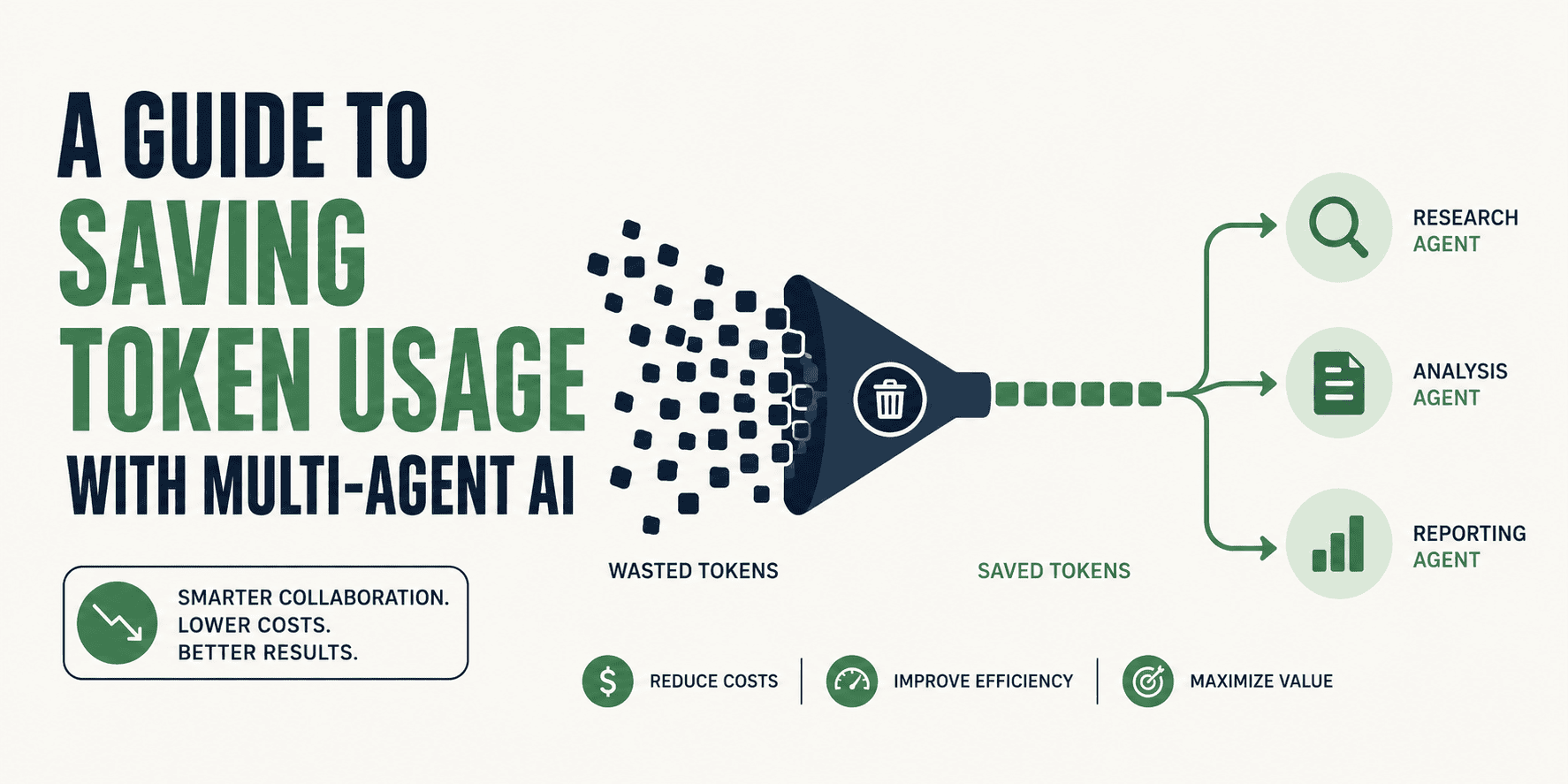
**Optimizing Multi-Agent AI: Strategies to Slash Token Usage and Costs**
When multiple **AI agents** collaborate to handle complex workflows, the cumulative token consumption can quickly spiral. Tokens— the basic units of text the model processes— build up from system prompts, memory logs, tool descriptions, and instruction sets. This bloat can slow down execution and inflate computing costs. The good news? You don’t need to sacrifice capability for efficiency. With smart strategies, you can scale your multi-agent systems while keeping token usage and costs in check. Here are four proven techniques to optimize your AI pipelines.
—
### 1. Static Instruction Caching (Prefix-Match Caching)
Repetition is expensive. Large Language Models (LLMs) often re-read identical system instructions at every turn, wasting compute and tokens. **Prefix caching** solves this by storing key–value pairs of static instructions.
When an agent receives a prompt, it checks for a cached “bookmark” of the relevant policy or role instructions. Subsequent queries skip reprocessing the full manual and jump straight to the new content. The result? Faster response times and lower token overhead.
—
### 2. Semantic Caching: Intent-Based Recall
Why answer the same question twice in different words? **Semantic caching** uses embeddings—vector representations of text—to identify repeated user intents.
For example, “How do I reset my router?” and “What’s the process to restart my Wi‑Fi box?” produce highly similar embeddings. The system can match these to prior responses, sometimes bypassing the LLM entirely. This not only saves tokens but also improves latency.
—
### 3. Just-in-Time Tooling (Lazy Loading)
It’s tempting to give agents access to every tool, API schema, and database at once. But flooding the context window with reference material bloats prompts and burns tokens.
**Just-in-time tooling** flips the script: maintain a lightweight directory of capabilities, then fetch detailed tool instructions only when needed. This keeps prompts lean and focused, reducing unnecessary token consumption.
—
### 4. Task Escalation and Cost-Efficient Model Routing
Not every task requires a heavy model. Effective multi-agent systems act as intelligent triage:
– **Simple tasks** (e.g., formatting, summarization, classification) are handled by lightweight, low-cost, or even local models.
– **Complex tasks** (deep reasoning, multi-step orchestration) are routed to larger, more capable models.
This tiered routing dramatically cuts token usage and operational costs without compromising performance on demanding jobs.
—
### Real-World Example: Combining Semantic Caching and Routing
Below is a simplified implementation combining semantic caching with model routing. It uses a Sentence Transformer to generate embeddings and mocks calls to different agent types. Replace the mock functions with actual lightweight or heavy models in production.
“`python
import numpy as np
from sentence_transformers import SentenceTransformer
# Load a free, local embedding model
embedder = SentenceTransformer(‘all-MiniLM-L6-v2’)
# In-memory semantic cache
semantic_cache = {}
SIMILARITY_THRESHOLD = 0.90
def cosine_similarity(vec1, vec2):
return np.dot(vec1, vec2) / (np.linalg.norm(vec1) * np.linalg.norm(vec2))
def route_and_respond(user_query):
query_vector = embedder.encode(user_query)
# Semantic caching check
for cached_vector, past_response in semantic_cache.values():
if cosine_similarity(query_vector, cached_vector) >= SIMILARITY_THRESHOLD:
return f”[Served from Cache] {past_response}”
# Model routing based on query complexity
if “summarize” in user_query.lower() or len(user_query) < 100:
response = call_free_local_agent(user_query)
else:
response = call_heavy_reasoning_agent(user_query)# Cache the new response
semantic_cache[user_query] = (query_vector, response)
return response# Mock agent functions
def call_free_local_agent(prompt):
return "Action completed by local, zero-cost model."def call_heavy_reasoning_agent(prompt):
return "Action completed by complex orchestration agent."# Example usage
print(route_and_respond("Summarize today's server logs"))
```This pattern demonstrates how lightweight infrastructure and smart routing can deliver scalable, cost-effective AI workflows.---### Frequently Asked Questions (FAQ)**Q1: What are tokens, and why do they matter?**
Tokens are the basic text units an LLM processes. More tokens mean higher computational cost, slower inference, and larger context requirements. Optimizing token use improves performance and reduces expenses.**Q2: How does semantic caching differ from prefix caching?**
Prefix caching stores exact or partial instruction prefixes to avoid re-reading static prompts. Semantic caching uses embeddings to match intent across phrasing variations, enabling broader reuse and sometimes bypassing the model entirely.**Q3: Can these techniques work together?**
Absolutely. Combining strategies—like semantic caching with model routing, or just-in-time tooling with static caching—creates compounding efficiency gains.**Q4: Do these methods require expensive infrastructure?**
Not necessarily. Tools like Sentence Transformers and free local models (e.g., Llama via Ollama) make these optimizations accessible even without high-end hardware or costly APIs.**Q5: Which strategy should I start with?**
Begin with **semantic caching** or **model routing**, as they offer the highest impact with relatively low implementation complexity. Gradually incorporate **prefix caching** and **just-in-time tooling** as your system scales.---### ConclusionOptimizing token usage in multi-agent AI systems is essential for balancing performance, speed, and cost. By applying strategies like **static instruction caching**, **semantic caching**, **just-in-time tooling**, and **intelligent model routing**, developers can build scalable, efficient AI workflows without over-provisioning resources.Whether you’re deploying a single agent or a full multi-agent ecosystem, these techniques provide practical, immediate benefits. As AI architectures grow more complex, thoughtful token management will only become more critical—and more rewarding.**Iván Palomares Carrascosa** is a leader, writer, speaker, and advisor in AI, machine learning, deep learning, and LLMs. He trains and guides others in harnessing AI effectively in the real world.
