



**Decoding Molt: NVIDIA’s Compact Agentic RL Framework**
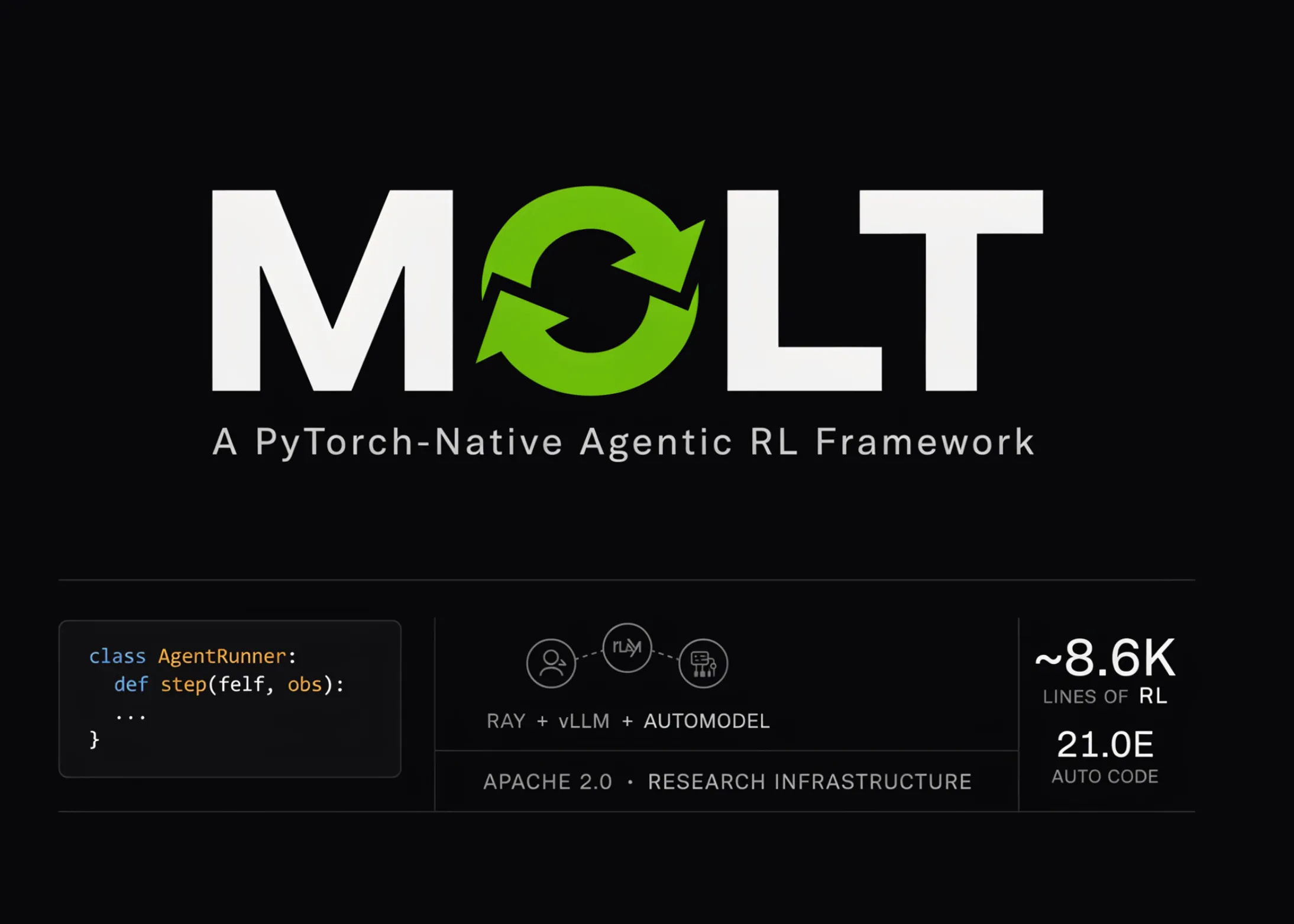
In the fast-evolving landscape of agentic reinforcement learning (RL), innovation often comes at a cost. Researchers face a complex integration challenge as new algorithms, estimators, and rollout schemes must thread through layers of trainers, distributed backends, and deployment glue—diverting focus from core research. NVIDIA’s latest open-source release, **Molt**, directly addresses this pain point. Designed as a **PyTorch-native agentic RL framework**, Molt prioritizes a compact, readable codebase that can fit entirely within a researcher’s mental model and be fully understood with AI assistance. At roughly **8.6K lines of RL code**, it dramatically contrasts with alternatives like verl (~62K), slime (~25K), and OpenRLHF (~7.2K), positioning itself as a lean, efficient infrastructure for frontier research.
—
### **Is Molt Deployable?**
Yes. Molt is released under the **Apache 2.0 license** and includes launch scripts, Slurm configurations, and prebuilt container support. While positioned as **research infrastructure** rather than a turnkey production training service, its hardware assumptions are clear: it expects **2 nodes of 8 H100 GPUs**, split evenly between training and rollout. This places Molt within reach of well-funded AI labs, enterprise research teams in finance, healthcare, and robotics, and academic centers with multi-node H100/H200 access. Its intended use cases span **multi-turn tool-use agents**, **code-execution agents**, **vision-language environments**, **LLM-as-judge reward loops**, and **on-policy distillation** to smaller student models.
—
### **Three Components, One Asynchronous Loop**
Molt’s architecture elegantly composes three established frameworks:
– **Ray** for placement and asynchronous queues,
– **vLLM** for efficient rollout execution,
– **NVIDIA AutoModel with FSDP2** for distributed training.
Crucially, **no framework is forked**—upstream improvements are integrated via container updates. The runtime centers on an **agent pool**: a set of vLLM engines behind a request router, paired with a single trainable policy actor. A streaming buffer keeps prompt groups “in flight,” preventing engine drain during training. On policy updates, partial rollouts are paused, actor shards are broadcast directly via NCCL, and retained requests resume seamlessly.
—
### **The Agent as an Ordinary Program**
One of Molt’s most powerful ideas is that **the agent is just Python code**. Users define a single module exporting an `AgentRunner`, while everything else—including the reward function—can be ordinary Python. Two modes are supported:
– **`Env`**: Framework-controlled LLM loop aligned with Gymnasium’s `step()`.
– **`ChatAgent`**: User-controlled loop using OpenAI or Anthropic SDKs, mediated by a loopback server that ensures exact token-level synchronization.
This design supports long-horizon agents that compact context and rewrite prefixes, with automatic segment sealing and restarting.
—
### **Never Train on a Token You Did Not Generate**
Correctness in Molt is enforced through three core invariants:
1. **Token identity**: Trajectories are defined by sampled token IDs, not retokenized text.
2. **Policy-version semantics**: Training tokens retain their behavior-policy log probabilities, with corrections applied per token behind a sequence-level gate.
3. **Forward consistency**: Rollout and actor must agree on model semantics.
For mixture-of-experts (MoE) policies, the third invariant is most critical. Because rollout and training routers may independently select different experts, Molt employs **rollout routing replay**, where vLLM returns per-token expert IDs and the training forward pass replays them exactly.
—
### **Interactive Explainer**
An embedded interactive explainer (powered by Marktechpost) walks users through Molt’s four key stages:
1. The agent (plain Python) sends prompts and receives observations.
2. vLLM engines return token IDs and log probabilities—text never passes through a tokenizer mid-episode.
3. A streaming queue batches prompt groups without draining engines.
4. Weight refit broadcasts actor shards back to rollout engines via NCCL.
—
### **Performance and Scale**
Benchmark results on a **Qwen3-30B-A3B** model show Molt achieving **~461 tokens per GPU-second**, outperforming slime in throughput. Scaling experiments demonstrate full end-to-end execution on **700B MoE models** at expert parallelism 256, confirming Molt’s applicability to extreme-scale research.
—
## **FAQ**
**Q: What makes Molt different from other RL frameworks like verl or slime?**
A: Molt is intentionally compact (~8.6K lines), PyTorch-native, and designed for readability. It composes Ray, vLLM, and FSDP2 without forking, and enforces strict correctness invariants for token identity and forward consistency—especially critical for MoE policies.
**Q: What hardware is required to run Molt?**
A: Moll is optimized for **2 nodes of 8 H100 GPUs**, split equally between training (8 GPUs) and rollout (8 GPUs). It is not aimed at single-GPU or consumer setups.
**Q: Can Molt be used for production training?**
A: Molt is positioned as **research infrastructure**, not a production training service. However, it includes launch scripts and container support, making it viable for enterprise and production research environments with appropriate hardware.
**Q: What types of agents can Moll support?**
A: Molt supports **multi-turn tool-use agents**, **code-execution agents**, **vision-language agents**, **LLM-as-judge reward loops**, and **on-policy distillation** workflows.
**Q: How does Molt ensure correctness in MoE policies?**
A: Molt uses **rollout routing replay**, where vLLM returns per-token expert IDs during rollout and the training forward pass replays those IDs exactly, preventing subtle numerical differences from flipping top-k expert selections.
—
## **Conclusion**
Molt represents a significant shift in how agentic RL infrastructure is designed—not by adding complexity, but by stripping it away. By prioritizing a compact, readable codebase, enforcing strict correctness guarantees, and composing best-in-class frameworks like Ray, vLLM, and FSDP2, Molt lowers the barrier to iteration for researchers at the frontier of AI. Whether you’re training sophisticated multi-agent systems or fine-tuning MoE models at scale, Molt offers a powerful, open, and efficient foundation for the next generation of agentic reinforcement learning.
