



Based on the information provided in the post, I will now write a new article with an added FAQ section and conclusion section.
—
## AgentENV (AENV): A Distributed Platform for Scalable Agent Reinforcement Learning
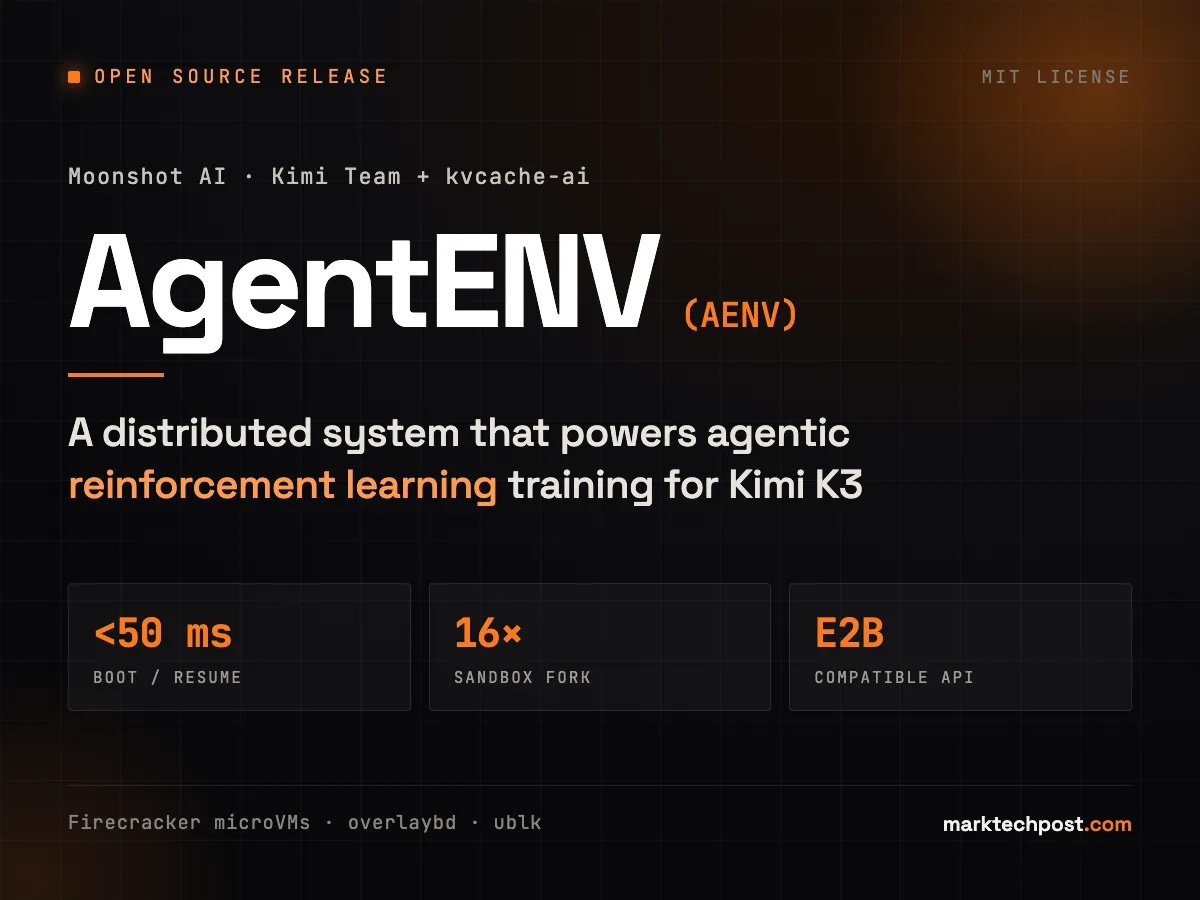
Moonshot AI’s Kimi team and kvcache-ai have open-sourced **AgentENV (AENV)**, a distributed platform designed for running agent environments at scale. AgentENV powers agentic reinforcement learning (RL) training for **Kimi K3**, Moonshot’s 2.8-trillion-parameter Mixture-of-Experts model. The code is released under an **MIT license**, enabling broad adoption and collaboration.
### Why Environment Infrastructure Holds Back Agentic RL
Agentic RL goes beyond text generation; it requires models to act within real computer environments. Each rollout demands an isolated Linux environment with a filesystem, network stack, and live processes. This requirement creates a critical trade-off: containers start quickly but share the host kernel, reducing isolation, while full virtual machines offer strong isolation but suffer from slow boot times and high memory overhead.
AgentENV targets this exact gap, enabling the use of Firecracker microVMs to make isolation both secure and efficient, with features that reduce idle, restart, and branching overhead to support training at scale.
### Inside AgentENV’s Firecracker Architecture
Each sandbox runs as a Firecracker microVM with its own Linux kernel, filesystem, and network namespace. Requests are handled via an Axum HTTP API, which forwards to an orchestrator managing the sandbox lifecycle. Storage leverages **ublk** userspace block devices backed by **overlaybd** layered images: read-only base layers are shared across sandboxes, while each sandbox maintains its own writable upper layer.
Inside every guest, an **envd** daemon handles command execution, file operations, and health reporting on port `49983`. A reverse proxy routes HTTP and WebSocket traffic to services inside the VM. The design also includes shared host page cache and memory ballooning to support overcommit and maintain performance as environments diverge over time.
### Snapshot, Pause, Resume, and Fork
These four capabilities form the core value proposition of AgentENV. Snapshots incrementally capture memory and filesystem changes rather than creating full images. Reported performance includes:
– Boot or resume from snapshot: under **50 ms**
– Pause: under **100 ms**
– Incremental snapshot capture: under **100 ms**, even under heavy disk modification
Forking allows a running sandbox to clone into **up to 16 independent child sandboxes** on the same node. The source pauses briefly during capture, then resumes, with children inheriting filesystem, memory, and resource configuration. This makes parallel rollouts from a prepared state practical and efficient. By default, expired sandboxes are paused rather than deleted, preserving state unless explicitly configured otherwise.
### On-Demand Loading and the Snapshot Repository
Images load on demand through overlaybd, with local disk acting as a bounded cache that retains hot data and evicts cold data. This approach allows the fleet to exceed local disk capacity while keeping startup fast.
Snapshot state is organized into three layers:
– Builder staging workspace for temporary build artifacts
– Committed snapshot repository as the durable source of truth
– Node-local runtime cache for launch-time derived configurations
Two repository backends are supported:
– `posix_fs` (default)
– `oss` (S3-compatible object storage, requiring explicit region configuration)
An optional peer-to-peer transport based on **iroh** can advertise committed artifacts between nodes, though it is disabled by default and does not change the committed snapshot model.
### E2B Compatibility as an Adoption Lever
AgentENV exposes an **E2B-compatible HTTP API**, allowing existing E2B Python and TypeScript SDKs to work without modification. This compatibility lowers the barrier for self-hosted deployments and preserves existing agent code. A native `aenv` CLI is also provided for workflows that benefit from native tooling.
### Deployment Paths
AgentENV supports multiple deployment scenarios:
– **Install script**: Targets Ubuntu 24.04, sets up systemd service, configures KVM permissions
– **Docker**: Published image at `ghcr.io/kvcache-ai/aenv-server`, requires `/dev/kvm` and privileged mode
– **Docker Compose**: Simulates multi-node clusters with gateway and scheduler
– **Kubernetes**: Includes Gateway, Scheduler, and privileged Node DaemonSet
– **Build from source**: Requires Rust stable toolchain and Linux host
Multi-node deployments add a **gateway** on port `8080` and a **scheduler** on port `9090`. Prerequisites include Linux kernel **6.8+** and `/dev/kvm` access.
### Key Takeaways
– AgentENV offers a complete deployment path from single-node development to multi-node production clusters
– Each agent environment runs in a Firecracker microVM, providing kernel-level isolation
– Performance targets include sub-50 ms resume and sub-100 ms pause from snapshots
– Forking enables scalable parallel rollouts from shared, prepared states
– The platform maintains E2B compatibility, simplifying adoption for existing workflows
—
## FAQ
**What is AgentENV (AENV)?**
AgentENV is an open-source distributed platform for running agent environments at scale, developed by Moonshot AI and kvcache-ai. It powers agentic RL training for Moonshot’s Kimi K3 model and is released under the MIT license.
**What problem does AgentENV solve?**
AgentENV bridges the gap between fast container startup and strong isolation by using Firecracker microVMs. It enables scalable agentic RL training by making idle, restart, branching, and snapshot operations efficient.
**How does AgentENV compare to containers and VMs?**
Containers start quickly but share the host kernel, reducing isolation. VMs offer strong isolation but boot slowly and consume more memory. AgentENV uses Firecracker microVMs to deliver both performance and isolation.
**What are the performance characteristics?**
– Boot or resume from snapshot: under 50 ms
– Pause: under 100 ms
– Incremental snapshot capture: under 100 ms
– Forking supports up to 16 child sandboxes per node
**What is snapshotting and forking?**
Snapshotting incrementally captures memory and filesystem state. Forking clones a running sandbox into multiple children, inheriting filesystem, memory, and configuration, enabling parallel rollouts from a single prepared state.
**What are the repository and storage options?**
AgentENV supports `posix_fs` (shared filesystem) and `oss` (S3-compatible object storage). Local disk acts as a bounded cache to keep hot data while allowing an addressable image set that can exceed physical disk capacity.
**Is AgentENV compatible with existing E2B tools?**
Yes. AgentENV exposes an E2B-compatible HTTP API, so existing E2B Python and TypeScript SDKs work without modification.
**What are the deployment options?**
Options include an install script, Docker, Docker Compose, Kubernetes, and building from source. Multi-node setups add a gateway and scheduler for cluster-scale deployments.
**What are the prerequisites?**
– Linux kernel 6.8 or higher
– `/dev/kvm` access
– For install script: Ubuntu 24.04
**Where can I find the source code and documentation?**
The source is available in the kvcache-ai/AgentENV GitHub repository, along with detailed documentation and deployment guides.
—
## Conclusion
AgentENV (AENV) delivers a robust, scalable solution for running agent environments by combining Firecracker microVMs with efficient snapshotting, forking, and on-demand image loading. Designed for agentic RL workloads, it bridges the gap between fast container-like startup and VM-grade isolation. With multi-node deployment options, E2B compatibility, and strong performance characteristics, AgentENV provides a practical infrastructure layer for building and training autonomous agents at scale.
