



**ABBEL: Teaching LLMs to Update Beliefs for Efficient Long-Horizon Interaction**
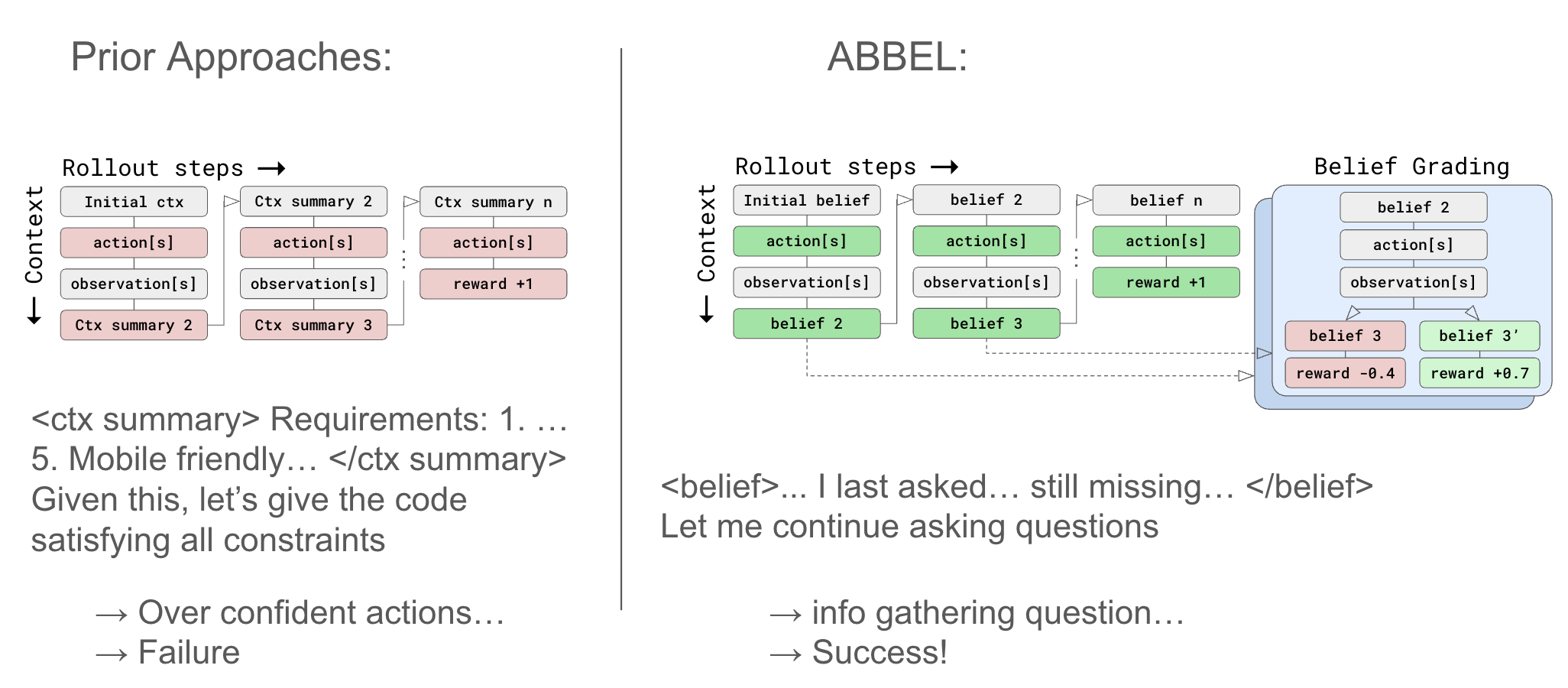
As language models are increasingly deployed to assist with complex, multi-step tasks—such as software development, collaborative coding, and extended problem-solving—their context windows face severe scalability limits. Large Language Models (LLMs) traditionally rely on recursive summarization to compress long interaction histories, but this approach often degrades performance, especially in domains where high-quality human feedback is scarce. A new framework called **ABBEL** (Agent Beliefs Built via Exploration and Learning) tackles this challenge by treating summaries as explicit, updatable belief states rather than raw history compression.
—
## Motivation: The Cost of Recursive Summarization
Recursive summarization has become the de facto strategy for enabling long-horizon interactions with LLMs. Systems like Cursor’s Composer 2.5 and competitive coding models rely on periodically condensing interaction histories into compact summaries. While effective in theory, this method incurs a significant performance cost in practice. Even when benchmarks appear promising, real-world deployments—particularly human-in-the-loop coding environments—often reject compressed-context approaches.
The core issue lies in learning efficiency: summarizing context repeatedly adds complexity to an already difficult training objective. Collecting high-quality human demonstrations for interactive settings is expensive, making it harder to train models that generalize across long tasks. As a result, models that rely on summarization struggle to close the performance gap with full-context baselines.
—
## ABBEL: Acting Through Belief Bottlenecks
ABBEL reframes long-horizon interaction around **belief states**—compact, natural-language summaries that represent the agent’s current understanding of the task. Instead of simply compressing history, ABBEL:
– Treats belief updates as a supervised learning problem.
– Uses **belief grading**—an auxiliary reinforcement learning signal—to evaluate how well a belief captures relevant information.
– Allows the model to focus on what truly matters for decision-making rather than preserving every detail.
### Belief Grading
Belief grading evaluates how informative a belief state is by testing its ability to reconstruct recent observations using the current model. This autoencoder-style objective rewards beliefs that retain actionable information while discarding noise. By integrating this grading signal into training, ABBEL encourages the model to maintain coherent, usable representations of its environment over time.
—
## What Do We Gain by Grading Beliefs?
### Collaborative Coding on CollabBench
In assistive coding environments, where a human collaborator provides feedback over multiple turns, ABBEL with belief grading significantly closes the performance gap with full-context models. Compared to standard summarization approaches:
– Performance improves by up to 50%.
– Training converges in roughly half the steps.
– Memory usage drops dramatically due to compact context representations.
### Combination Lock
When domain knowledge is encoded into the belief grading function—such as tracking statistics that must remain consistent over time—ABBEL either matches or exceeds the performance of full-context models. This demonstrates that structured, belief-based reasoning can be more efficient than raw context retention.
### Multi-Objective Question Answering
ABBEL also shows benefits in multi-objective settings, where managing competing goals increases context pressure. Introducing a **Peak Belief Length Penalty** reduces memory usage with minimal accuracy loss, outperforming prior recursive summarization methods that struggle under such constraints.
—
## Comparison with Alternative Approaches
Context compression methods offer computational efficiency but often sacrifice interpretability and human usability. Prompt-based summarization and memory pruning rely heavily on domain expertise and do not enable the model to learn what to remember. External memory systems complement ABBEL by providing additional storage, but they still benefit from better context generation—which ABBEL helps enable.
—
## What’s Next for Better Memory?
Belief states open the door to more sophisticated interaction mechanisms:
– Using belief evolution to guide exploration.
– Transmitting beliefs between agents for improved coordination.
– Modifying beliefs directly to exert control over agent behavior.
Future systems will likely combine **working memory** (beliefs), **short-term memory**, and **long-term memory** (e.g., weights, adapters, or continuous contexts) to build more robust and flexible agents.
—
## FAQ
**What is ABBEL?**
ABBEL is a framework for improving long-horizon interaction with LLMs by representing and updating the model’s understanding as natural-language belief states. Instead of storing full interaction histories, ABBEL uses a compressed belief that is explicitly graded and updated.
**What problem does ABBEL solve?**
Traditional context summarization hurts learning efficiency and performance in long tasks, especially where high-quality data is scarce. ABBEL addresses this by supervising the *content* of summaries rather than just their form.
**What is belief grading?**
Belief grading is an auxiliary objective that evaluates how well a belief state allows the model to reconstruct recent observations. It acts as a reward signal in reinforcement learning, encouraging the model to retain useful information.
**Does ABBEL require human simulators?**
Not necessarily. While human simulators are challenging to train, ABBEL’s belief-grading approach works well with limited or imperfect interaction data, making it suitable for real-world applications.
**Can ABBEL outperform full-context models?**
Yes. In certain structured environments—especially when domain knowledge is incorporated into belief grading—ABBEL can match or exceed the performance of models that rely on full context.
—
## Conclusion
ABBEL represents a shift from passive context compression to active belief management for long-horizon LLM interaction. By isolating and supervising the information content of summaries, ABBEL improves learning efficiency, reduces memory usage, and closes performance gaps with full-context baselines. This framework highlights the value of explicit internal representations and opens promising directions for more controllable, interpretable, and scalable AI assistants.
