



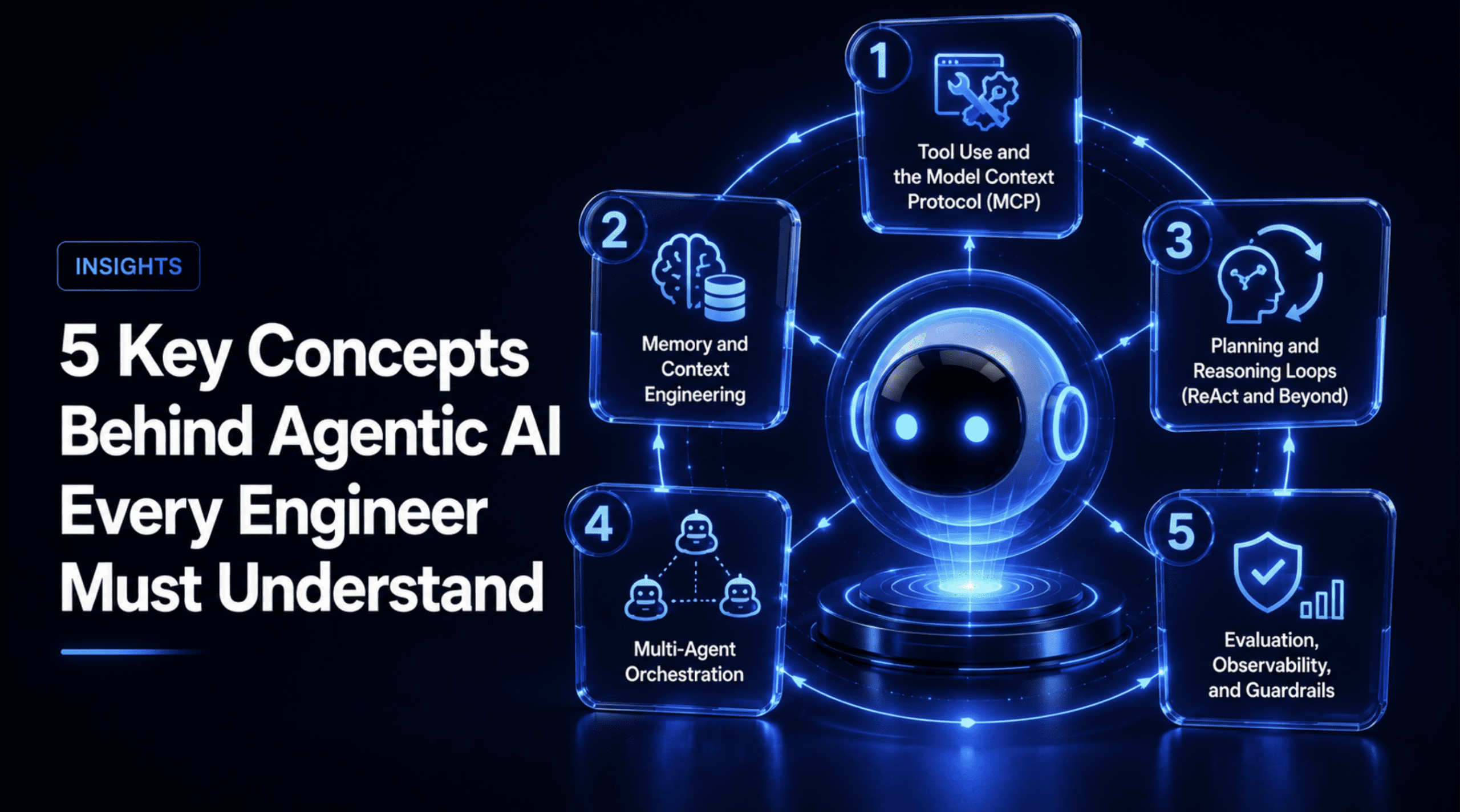
**Understanding Agentic AI: The Five Key Concepts Every Engineer Should Know**
In the world of artificial intelligence, the promise of agentic AI has moved from theoretical curiosity to a central pillar of engineering roadmaps. But what exactly is an agent, and why is building one so challenging? This article breaks down the essential concepts you need to master.
### Introduction
Imagine asking a chatbot to find a hotel in London. It will give you a list of options and let you do the rest. Now imagine asking an agent. It checks availability, compares prices across sites, books the room, and emails you the confirmation. This distinction—between “telling you something” and “doing something on your behalf”—is the essence of agentic AI.
The term has evolved from a niche research topic to a critical component of modern engineering roadmaps. However, the hype often masks the complexity. According to industry estimates, roughly 88% of AI agents never make it to production. The failure usually isn’t due to the underlying model but rather a misunderstanding of the core engineering principles required to build robust agentic systems.
This article explores five fundamental concepts that hold agentic systems together: tool use, memory, planning, orchestration, and evaluation. Understanding these is the first step toward building agents that can function reliably in the real world.
—
### 1. Tool Use and the Model Context Protocol (MCP)
A large language model (LLM) by itself can only generate text. To interact with the outside world—checking a database, calling an API, or sending an email—it needs a bridge. This bridge is what we call “tool use.”
For years, building this bridge meant creating custom integrations for every model-tool combination, leading to a tangled web of brittle connections. The rise of the **Model Context Protocol (MCP)** has changed this landscape. Introduced by Anthropic in late 2024, MCP provides a standardized way for models to discover and use tools. By March 2026, its adoption had surged, with millions of downloads, as it transformed from a proprietary protocol into a shared industry standard under the Linux Foundation.
MCP works by allowing models to query a server’s capabilities and then invoke its tools using a consistent JSON-RPC pattern. This means engineers can focus on building agent logic instead of writing custom integrations for Slack, Notion, GitHub, or databases. While not free—MCP adds some token overhead—it is invaluable for multi-tenant systems or when non-engineers need to configure tool use. Still, for high-throughput applications where every token counts, some teams may opt for simpler, direct integrations.
—
### 2. Memory and Context Engineering
LLMs are stateless by default—they have no inherent memory of past interactions. For agents operating over long periods or across multiple sessions, this limitation is fatal. Memory has evolved from a makeshift afterthought to a core architectural component.
Modern memory systems extract and store key facts in a vector database during a conversation. In subsequent sessions, the system retrieves and injects only the relevant information into the model’s context. Tools like **Mem0**, **Zep**, and **Letta** have become popular choices, each offering different strengths. For example, Mem0 excels at personalization, while Zep’s temporal knowledge graph is better suited for tracking changes over time.
This shift has also popularized the term **”context engineering,”** emphasizing that context quality—not just quantity—determines agent performance. Simply increasing a model’s context window won’t help if the retrieval strategy is poor. Effective memory systems ensure that agents “remember” users, sessions, and past actions seamlessly.
—
### 3. Planning and Reasoning Loops
What distinguishes an agent from a chatbot is its ability to plan, act, observe, and iterate. This loop, popularized by the **ReAct** framework from Google and Princeton, forms the backbone of agentic reasoning. The model alternates between a “thought,” an “action,” and an “observation,” refining its approach until it reaches a conclusion.
Modern implementations have expanded this concept into what’s called **context engineering**, designing information environments that support reliable multi-step reasoning. Frameworks now include mechanisms for task decomposition, self-correction, and retry logic when tool calls fail. However, these loops also introduce risks—unbounded token usage, rate-limit errors, and goal drift. Production systems must monitor and budget these loops carefully to prevent runaway costs or unexpected behavior.
—
### 4. Multi-Agent Orchestration
A single agent has limits—particularly when overwhelmed with context. The solution, now standard in 2026, is **multi-agent orchestration**. Instead of one agent carrying the entire burden, work is split among specialized agents, each with its own focused context.
This follows a pattern of an **orchestrator** agent coordinating **sub-agents** in parallel. Frameworks like **LangGraph**, **CrewAI**, and **AutoGen** dominate this space, offering varying levels of control, ease of use, and production readiness. The choice depends on whether a team needs fine-grained control or rapid prototyping.
Equally important is the ability for agents built on different frameworks to communicate. The **Agent2Agent (A2A) protocol**, now under the Linux Foundation, standardizes how agents discover and collaborate with one another. While MCP focuses on agent-tool interactions, A2A enables agent-to-agent cooperation, creating a complementary ecosystem for complex workflows.
—
### 5. Evaluation, Observability, and Guardrails
The final—and often most overlooked—concept is evaluation. The difference between a project that fails and one that delivers a 171% ROI often comes down to engineering discipline. Two key practices are essential: **tracing** and **evaluation**.
Tracing provides visibility into an agent’s actions, tool calls, and reasoning steps, helping debug issues in production. Tools like **LangSmith** are commonly used for this purpose. Evaluation, on the other hand, measures whether an agent’s output is correct and useful. Frameworks now support structured rubrics and automated scoring across multiple dimensions.
Beyond technical performance, safety checks are increasingly built into agent lifecycles. Organizations define validation checkpoints for input, reasoning, tool execution, and output, turning governance into a systematic process rather than ad-hoc fixes. As Gartner predicts, the inability to control costs, demonstrate value, and manage risk will drive many agentic projects to failure—unless robust evaluation and observability are in place.
—
### FAQ
**Q: What is the main difference between a chatbot and an agent?**
A: A chatbot provides information, while an agent can perform actions on your behalf, such as booking a hotel or sending an email. This capability comes from the agent’s use of tools, memory, and planning loops.
**Q: What is the Model Context Protocol (MCP), and why is it important?**
A: MCP is a standardized protocol that allows LLMs to interact with external tools in a consistent way. It reduces the need for custom integrations and enables agents to plug into a wide range of services securely and efficiently.
**Q: Do I need multi-agent orchestration for every project?**
A: Not necessarily. For simple, narrow tasks, a single agent with proper tool access and memory may suffice. Multi-agent systems shine when tasks become complex, large-scale, or require specialized roles.
**Q: Why is evaluation more important than having the best model?**
A: Evaluation determines whether an agent’s output is correct, relevant, and safe. Even the most advanced models can produce unreliable results without structured evaluation, tracing, and guardrails.
**Q: How can I get started with building agentic systems?**
A: Start with a well-scoped problem, use MCP for tool access, add a basic memory layer, and implement tracing and evaluation from the beginning. Once a single agent proves reliable, consider orchestration for larger-scale challenges.
—
### Conclusion
Agentic AI is not about picking the flashiest framework or model—it’s about understanding how tool use, memory, planning, orchestration, and evaluation work together as a system. The engineers who grasp this interconnectedness are the ones delivering production-ready agents.
If you’re just starting out, begin small, focus on fundamentals, and scale complexity only when necessary. Remember, the goal isn’t to mimic human conversation but to build systems that reliably perform real work. Done right, agentic AI can move from a promising concept to a transformative business advantage.
