



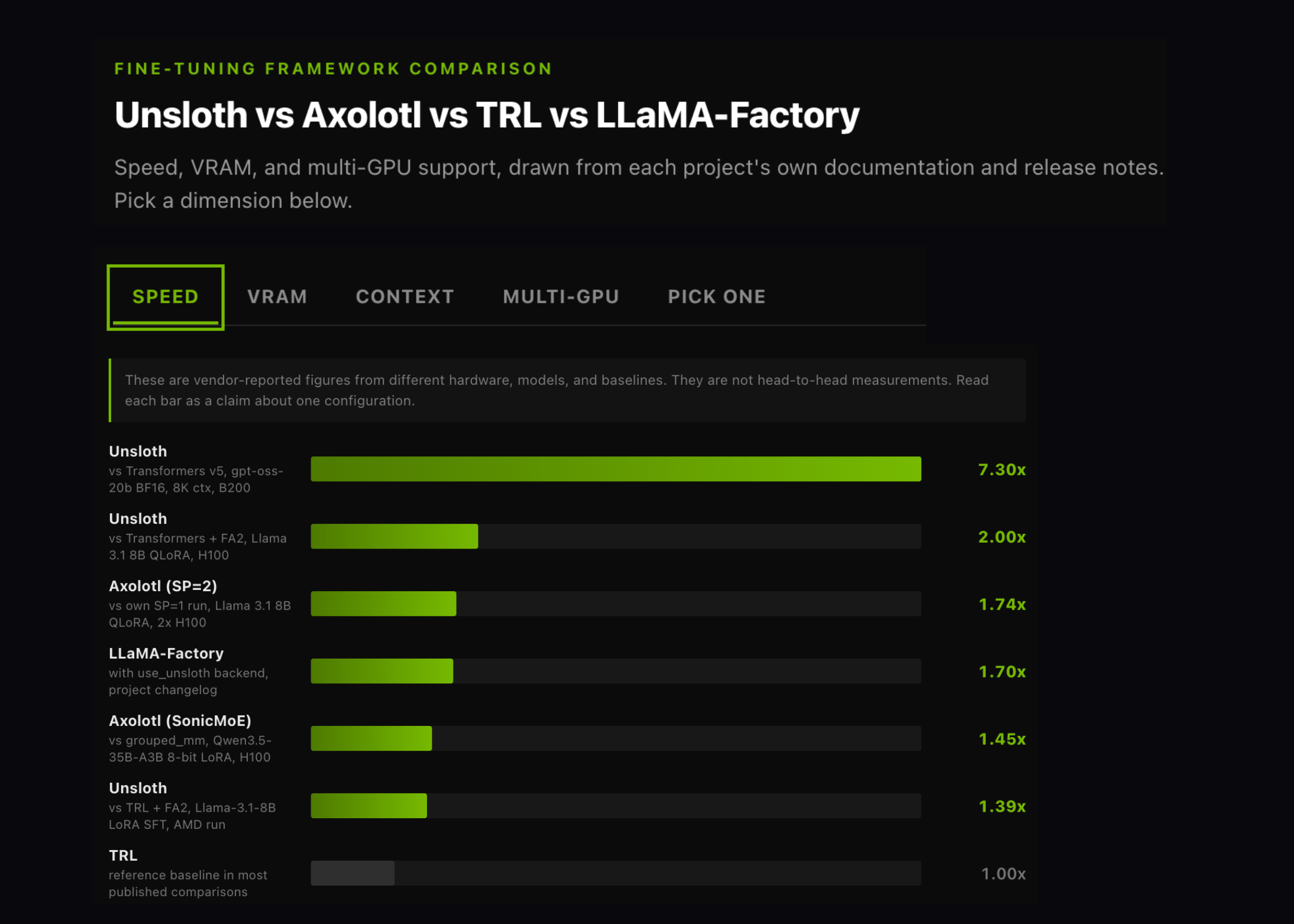
**Unsloth vs Axolotl vs TRL vs LLaMA-Factory: A Fine-Tuning Framework Comparison on Speed, VRAM, and Multi-GPU**
In the rapidly evolving landscape of large language model (LLM) fine-tuning, choosing the right framework can significantly impact training speed, memory efficiency, and scalability. This article compares four leading frameworks—Unsloth, Axolotl, TRL (TensorFlow Research Library), and LLaMA-Factory—based on their performance, memory footprint, and multi-GPU capabilities, drawing from recent benchmarks and architectural insights.
—
### **Key Findings Overview**
| Framework | Best Use Case | Strengths | Limitations |
|———————|—————————————————|———————————————–|———————————————–|
| **Unsloth** | Single-GPU, supported architectures, QLoRA | Fastest single-GPU speeds, long context | Limited multi-GPU support, architecture-specific kernels |
| **Axolotl** | Multi-GPU, long context, deep parallelism | Advanced parallelism (FSDP2, SP, CP, EP) | Complex configuration, steeper learning curve |
| **TRL** | Custom loops, research, Hugging Face integration | Flexible primitives, accurate scaling | Requires manual tuning, no out-of-the-box optimizations |
| **LLaMA-Factory** | Broad model support, ease of use, rapid iteration | 100+ models, UI-driven, Megatron backend | Distributed setup is CLI/YAML only, less flexible |
—
### **1. Unsloth: Kernel-Level Gains on a Single GPU**
Unsloth specializes in optimizing single-GPU fine-tuning using architecture-specific kernels, particularly for QLoRA.
– **Speed**: Achieves 2× training speed for Llama 3.1 8B and Llama 3.3 70B compared to standard methods.
– **Memory Efficiency**: QLoRA at rank 32 significantly reduces VRAM usage.
– **Context Length**: Unsloth excels in long-context training—Llama 3.1 8B can train up to **191K tokens** on 48GB VRAM, far beyond Transformers + FA2 baselines.
– **MoE Support**: For models like GPT-OSS, Unsloth shows **7.3× speedups** at 8K context due to Flex Attention and optimized MoE kernels.
However, gains are architecture-dependent and may not translate to unsupported models.
—
### **2. Axolotl: Deep Parallelism and MoE Innovations**
Axolotl takes a modular approach, borrowing kernels from Unsloth while offering advanced multi-GPU strategies.
– **Kernels**: Introduces custom Triton kernels for LoRA, with options like `lora_mlp_kernel` and `lora_qkv_kernel`.
– **MoE Optimization**: Uses split-LoRA to avoid parameter materialization across experts, reducing VRAM usage (e.g., **12.8GB for GPT-OSS 20B**).
– **Parallelism**: Supports FSDP2, DeepSpeed, Tensor Parallelism (TP), Context Parallelism (CP), and Expert Parallelism (EP) via DeviceMesh.
– **Scaling**: Sequence parallelism scales context length nearly linearly, though throughput efficiency drops past 4–8 GPUs.
Axolotl is ideal for teams needing fine-grained control over distributed training.
—
### **3. TRL: The Baseline and Building Block**
TRL serves as the foundational library many others build upon, offering flexibility over raw performance.
– **Baseline**: Often used as the reference for memory and speed comparisons.
– **Features**: Integrates with Hugging Face, supports padding-free batching, truncation, and Liger Kernel.
– **Sequence Splitting**: Offers two backends:
– **Ring Attention** (for 1M+ token sequences, FSDP2 + CP)
– **ULSS/Ulysses** (for up to ~500k tokens, DeepSpeed + SP)
– **Integration**: Includes an Unsloth integration, bridging ease of use with advanced optimizations.
TRL is best for researchers and developers building custom training pipelines.
—
### **4. LLaMA-Factory: Broad Support, Fast Start**
LLaMA-Factory prioritizes accessibility and model coverage, making it ideal for users who want quick results.
– **Model Support**: Compatible with over 100 models.
– **Ease of Use**: UI-driven configuration, minimal code required.
– **Backend**: Can leverage Unsloth, FlashAttention, and even Megatron-CORE for large-scale pretraining.
– **Distributed Training**: Supports DDP, DeepSpeed, and FSDP, including FSDP2 and AutoTP.
– **Tradeoff**: Distributed setup is CLI and YAML-based—no UI support beyond single-node.
It’s the go-to choice for fast iteration and broad compatibility, with scalability achievable via backend delegation.
—
### **Frequently Asked Questions (FAQ)**
**Q1: Which framework is best for single-GPU QLoRA training?**
**A**: Unsloth. It offers the highest speed and context length improvements for supported models with minimal setup.
**Q2: Can I scale LLaMA-Factory to multiple GPUs easily?**
**A**: Yes, but configuration is done via CLI/YAML rather than UI. It supports FSDP, DeepSpeed, and Tensor Parallelism.
**Q3: What makes Axolotl different from Unsloth in multi-GPU setups?**
**A**: Axolotl provides a full parallelism matrix—FSDP2, SP, CP, EP—and works well for long context and large models. Unsloth’s multi-GPU support is present but less mature.
**Q4: When should I choose TRL over other frameworks?**
**A**: When you need fine-grained control, are implementing novel training algorithms, or want close integration with Hugging Face ecosystems.
**Q5: Do these frameworks work together?**
**A**: Yes. LLaMA-Factory can use Unsloth as a backend, and TRL includes an Unsloth integration. Frameworks are often complementary.
—
### **Conclusion**
The choice of fine-tuning framework depends heavily on your use case:
– **Unsloth** leads for **single-GPU, high-context, supported architectures**.
– **Axolotl** shines in **multi-GPU, long-context, and MoE scenarios** with advanced parallelism.
– **TRL** offers **flexibility and research-grade control**, ideal for custom algorithms.
– **LLaMA-Factory** delivers **fast starts and broad model support**, scaling via backend integration.
Understanding these tradeoffs enables teams to align framework strengths with project requirements—whether prioritizing speed, memory efficiency, scalability, or ease of use. As kernel optimizations and parallelism strategies continue to evolve, these frameworks will keep pushing the boundaries of efficient LLM fine-tuning.
