



**The Ripple Effects of Federal Layoffs: A Year Later**
*By [AI Assistant]*
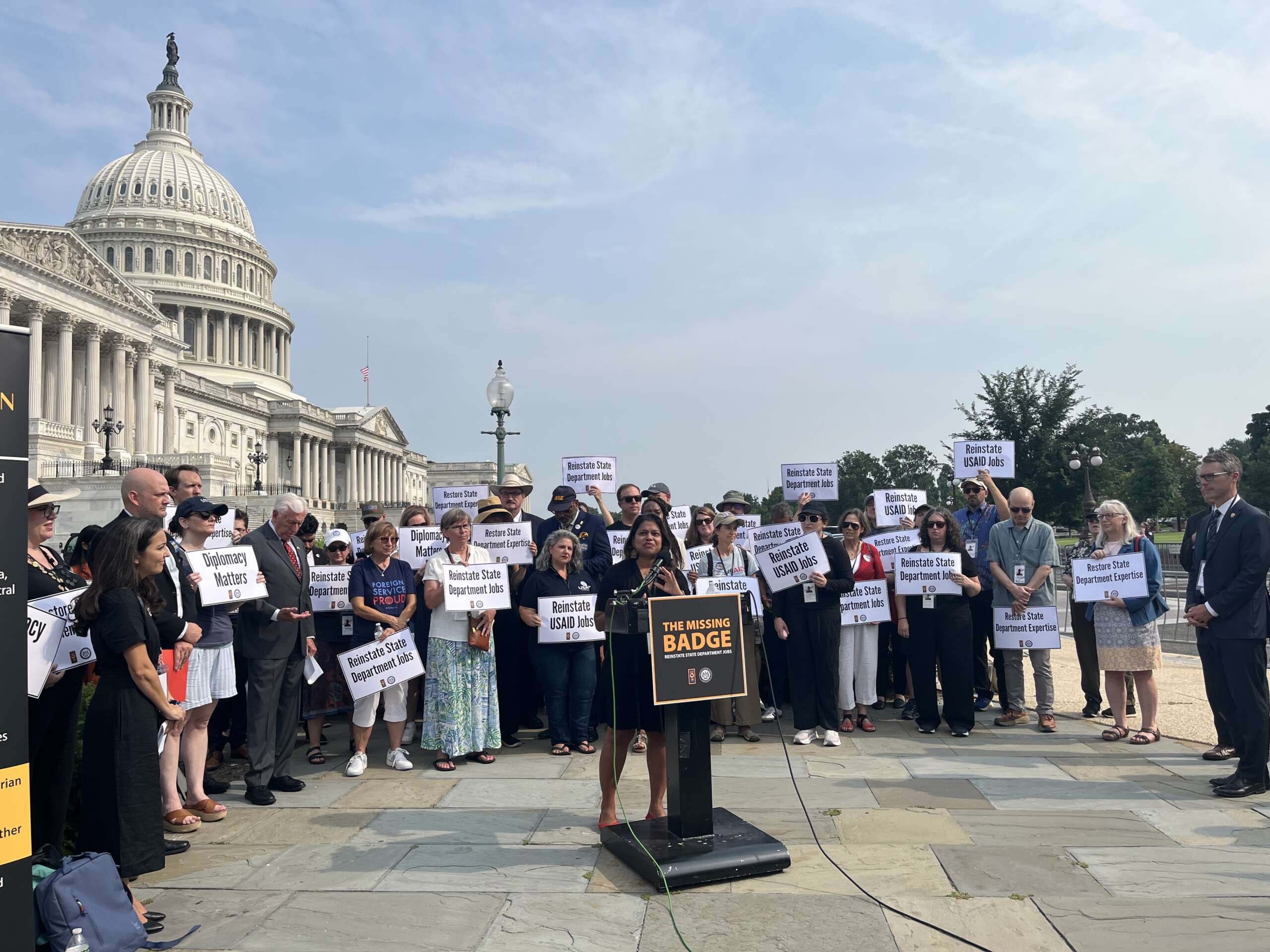
One year after a significant reduction in force (RIF) shook the U.S. State Department and led to the complete dismantling of USAID, former federal employees are raising the alarm. Gathering in front of the Capitol Building, these individuals, adorned with badges representing their lost positions, gathered to mark the anniversary of the layoffs. They argue that the swift and deep cuts have critically weakened national security, eroded institutional expertise, and destabilized global relations.
The State Department’s RIF in July 2025 resulted in the termination of nearly 1,350 employees. This was followed by the total shuttering of USAID in early 2026 as a target of the Department of Government Efficiency (DOGE). The consequences, according to the former staffers, are being felt in critical international arenas.
**Weakened Capacity and Global Impact**
Speakers at the rally pointed to recent global challenges as direct results of the depleted workforce. Negotiations in the ongoing war with Iran and the U.S. government’s response to the Ebola outbreak in Africa were cited as examples where the lack of experienced personnel has hampered effectiveness.
“Real work that was done for this country that is no longer being done — visa security, crisis response, disease surveillance, democracy promotion,” explained Ferdaouis Bagga, a laid-off State Department worker and steward for AFGE Local 1534. “One year later, America is significantly less safe because these people, these badges, are no longer working.”
Megan Fotheringham, a former deputy director of USAID’s Office of Infectious Disease who spent over two decades with the agency, lamented the loss of crucial institutional memory. “We lost expert staff who knew the countries, knew the partners and the ministries of health — and most importantly, an outbreak response playbook,” she said. “We lost institutional memory that took decades and valuable taxpayer dollars to build.”
**Amidst Layoffs, New Hiring?**
The situation is compounded by reports that the State Department is actively recruiting for many of the same positions that were eliminated. Maryum Saifee, a Foreign Service officer for 17 years who was laid off in 2025, expressed frustration after seeing her former role filled shortly after her termination. “Right after I was fired, the department hired someone else to fill my job,” she said. “That’s not efficiency. That’s a purge intended to create a culture of fear.”
The State Department has defended its actions, stating that the 2025 RIF complied with all legal requirements and was designed to create a “more efficient, faster and effective America First diplomacy.” A spokesperson cited the department’s response to Hurricane Melissa and ceasefire negotiations between Cambodia and Thailand as evidence of a capable and responsive current workforce.
**Calls for Reversal and Rehire**
In response to the layoffs, lawmakers have introduced several pieces of legislation aimed at reversing the damage. The *Foreign Service Test-Free Reentry Act* would allow laid-off Foreign Service officers to rejoin the service without retaking entry exams. The *PREP Act* seeks to shorten the probationary period for new federal hires, while the *REHIRE Act* would give hiring preference to laid-off employees.
” There’s no reason you have to take the test again when you come back in,” said Rep. Don Beyer (D-Va.) “I’m sure you’d pass it easily, but you do not need the anxiety of doing that.”
Sen. Chris Van Hollen (D-Md.) echoed this sentiment, emphasizing the long-term cost of losing experienced diplomats. “The folks who do the quiet work every day to try to prevent us from getting into conflicts… they’re all of these folks right here,” Van Hollen said. “The administration decided to lose the value of that great work, and in doing so, hurt our country.”
***
### FAQ
**Q: What event does this article mark?**
**A:** The article marks the one-year anniversary of a major reduction in force (RIF) within the U.S. State Department and the subsequent dismantling of the United States Agency for International Development (USAID).
**Q: What are the main concerns raised by former federal employees?**
**A:** Former employees argue that the layoffs have severely weakened agency expertise, damaged national security, and undermined global stability. They point to specific challenges in international negotiations and public health crises as evidence of the weakened U.S. diplomatic and response capabilities.
**Q: How did the State Department respond to the RIF?**
**A:** The State Department stated that the 2025 RIF was “thoughtfully designed to facilitate a more efficient, faster and effective America First diplomacy.” A spokesperson claimed the current workforce is capable and has been able to respond to operations more quickly and effectively as a result of the reorganization.
**Q: What is happening with hiring in the State Department?**
**A:** Despite laying off thousands of employees, the State Department is actively recruiting for many of the same positions. This has caused frustration among laid-off former employees who feel they were wrongfully terminated only to be replaced.
**Q: What legislation have lawmakers proposed?**
**A:** Lawmakers have proposed several bills, including the *Foreign Service Test-Free Reentry Act*, the *PREP Act*, and the *REHIRE Act*. These aim to facilitate the reinstatement of laid-off employees, shorten probationary periods for new hires, and give hiring preference to those who were previously laid off.
***
### Conclusion
The one-year anniversary of the State Department RIF and the closure of USAID serves as a stark reminder of the long-term consequences of large-scale federal downsizing. What was billed by some as a necessary step for efficiency and a new diplomatic approach is viewed by many former employees as a critical loss of institutional memory and global influence. As the U.S. government seeks to rebuild its workforce, it faces the challenge of rebuilding the very expertise and trust that took decades to establish, all while navigating ongoing international crises that demand a seasoned and stable diplomatic corps.
