



## AI Models and MCP: New Botnet Targets Exposed Services for Cloud Credentials and Model Access
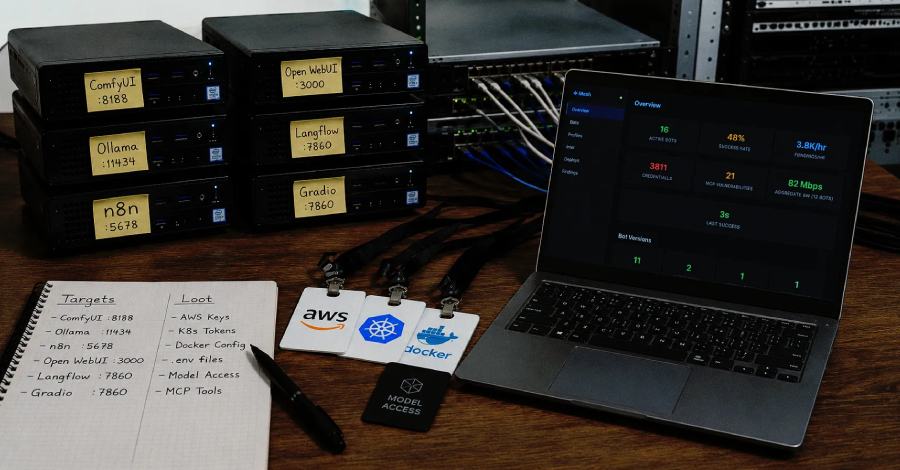
An emerging Go-based botnet, codenamed **NadMesh**, is actively scanning the internet for misconfigured AI application stacks—specifically exposed ComfyUI, Ollama, n8n, Open WebUI, Langflow, and Gradio instances—to harvest cloud credentials, Kubernetes access, and model control interfaces. The discovery, detailed by QiAnXin’s XLab, shows that AI tooling and adjacent infrastructure have become a high-value attack surface for operators looking to pivot into cloud environments and orchestration platforms.
### Botnet Behavior and Objectives
NadMesh is designed to identify and exploit environments where AI services are exposed without proper authentication. Once deployed, it runs a checklist of exploitation vectors, prioritizing MCP (Model Context Protocol) tools that allow command execution, followed by Kubernetes, Docker API, and Redis targets. The botnet collects environment variables, Kubernetes service account tokens, AWS configuration files, and other cloud identity artifacts to build a profile of credentials and access paths.
The operator behind NadMesh appears to be tracking success through an internal dashboard that reports metrics such as total deploys, active bots, and harvested credentials—though these figures sometimes contradict each other. Network sensor data from XLab indicates that the number of unique source IPs associated with NadMesh activity surged into the hundreds per day during July, suggesting rapid scaling.
### Key Exploitation Vectors
According to XLab’s analysis, the majority of observed exploit traffic targets Docker and Jenkins:
– **Docker Engine API remote code execution** accounts for over 30% of observed attacks.
– **Jenkins script console execution** represents another 22%.
– Weak Telnet passwords and vulnerable Redis instances also contribute to the botnet’s foothold strategy.
MCP command execution, while still minor in observed traffic, is notable because it directly aligns with the botnet’s goal of leveraging AI tooling pipelines. The MCP protocol’s optional authentication model means many deployments remain exposed, and NadMesh is scanning specifically for the `execute_command` tool to trigger remote actions.
### Scanning and Evasion Techniques
NadMesh uses adaptive scanning rules, resampling high-value targets every five minutes and flagging IPs that respond positively for more frequent follow-up checks. Hosts that fail to respond after repeated attempts are labeled suspected honeypots and blacklisted, while new random subnets are generated to continue the search. The botnet employs multiple concurrent build versions, obfuscation via Garble, UPX packing, and random padding to avoid signature-based detection.
### Indicators of Compromise and Persistence
Persistence mechanisms include multiple redundant methods, such as cron jobs, hidden files in shared memory or temporary directories, and obfuscated payloads. Removing a single component is not sufficient to eradicate the botnet, as remaining pieces can restore the compromised environment. Revocation of all exposed credentials is essential before rotation.
The primary command-and-control indicators observed by defenders include:
– A C2 address at **209.99.186[.]235**
– A domain **cdnorigin[.]net**
– A known sample SHA1 hash **31c69b3e12936abca770d430066f379ec1d997ec**
### Frequently Asked Questions
**What is NadMesh?**
NadMesh is a Go-based botnet designed to scan for exposed AI service infrastructure and harvest cloud credentials, Kubernetes privileges, and model access.
**Which services does NadMesh target?**
It focuses on exposed ComfyUI, Ollama, n8n, Open WebUI, Langflow, and Gradio instances, along with Docker, Jenkins, Redis, and Telnet services.
**How does NadMesh spread?**
It scans for misconfigured services, exploits exposed APIs, and leverages weak authentication to gain initial access, then uses multiple persistence mechanisms to maintain control.
**What kind of data does NadMesh steal?**
It collects AWS keys, Kubernetes service account tokens, environment variables, Docker config files, and other cloud identity material.
**How can I protect my environment from NadMesh?**
Ensure AI services and admin interfaces are behind authentication, not exposed directly to the internet. Restrict access to Docker, Jenkins, Redis, and Telnet. Rotate credentials immediately if exposure is suspected.
### Conclusion
The rise of NadMesh highlights how AI infrastructure and orchestration tools have become strategic targets for credential theft and lateral movement. Exposed services that enable rapid deployment—such as ComfyUI, Ollama, and MCP endpoints—present an attractive attack surface for operators seeking cloud access and model manipulation capabilities. Securing these environments requires strict access controls, removal of unnecessary public exposure, and proactive credential management. As AI workflows become more integrated into production infrastructure, treating AI tooling with the same security rigor as traditional enterprise services will be essential to reduce the risk of compromise.
