



**Cybersecurity Weekly Recap: Threats, Exploits, and Defensive Lessons**
*Authored by Ravie Lakshmanan • July 16, 2026*
This week in cybersecurity revealed a pattern: seemingly harmless tools, routines, and configurations became the entry points for sophisticated attacks. From fake game utilities to trojanized installers, from OAuth phishing to infrastructure hijacking, the common thread was trust abused at handoff points. Here’s a digest of the major incidents, technical techniques, and takeaways from industry reports.
—
### Key Incidents and Attack Trends
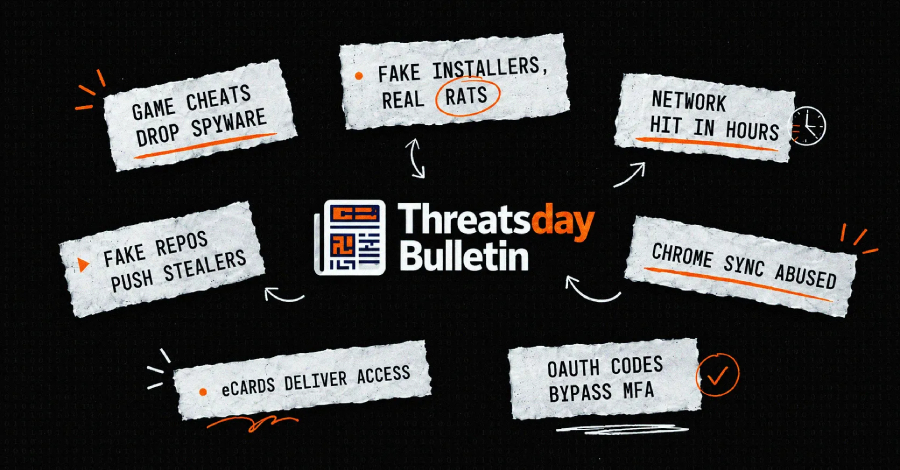
**1. Game Cheats and Stealers via .NET Packages**
Malicious NuGet packages masqueraded as game utilities, bots, and panels. These acted as first-stage downloaders, fetching second-stage payloads (`pepesoft.exe`) from GitHub and Hugging Face. The payloads used AWS-style keys, Google Sheets for C2, hardware binding, and optional BitTorrent fallbacks, with some exposing Telegram bot commands for remote control.
**2. Fake Installers and RATs**
A Russian-speaking actor delivered Starland RAT and WLDR agent (a PowerShell C2 implant) via trojanized installers for tools like MobaXterm, WebEx, Zoom, and DBeaver. ClickFix lures dropped HTA scripts that launched the malicious installers. The same infrastructure has been linked to CastleStealer, Remcos, and recently, ClickLock Stealer targeting browsers, crypto wallets, and passwords.
**3. Ransomware Hit South Asian IT Services**
A Rust-based ransomware family named Spirals compromised an internet-facing IIS server, deployed a web shell, performed reconnaissance, disabled defenses, and dumped SAM credentials before deploying ransomware across the network within 24 hours. The ransom note threatened data publication and directed victims to a Tor portal.
**4. KEV Catalog Updates**
CISA added two actively exploited vulnerabilities to its Known Exploited Vulnerabilities catalog:
– CVE-2026-46817 (Oracle E-Business Suite privilege management flaw)
– CVE-2023-4346 (KNX Association protocol authorization bypass)
Federal agencies must patch by July 18 and July 29, 2026, respectively.
**5. Coordinated Vulnerability Disclosure Guidance**
CISA, NSA, JPCERT/CC, NCSC-NL, and NCSC-UK released joint guidance for secure, transparent coordinated vulnerability disclosure (CVD) programs to improve vendor–researcher collaboration and risk management.
**6. Massive Fraud Operations Disrupted**
Dutch authorities arrested the alleged mastermind behind a 700-person scam network operating 20 call centers that posed as financial advisors to conduct investment fraud. Simultaneously, Spanish police dismantled a cybercrime ring that stole and laundered €140 million via fake investment platforms, CEO fraud, invoice fraud, and mule accounts.
**7. Windows Bind Links Evade EDR**
Bitdefender Labs demonstrated three techniques abusing Windows file-system virtualization (bindflt.sys) to redirect paths and bypass endpoint detection and response tools, as well as AMSI and AppLocker. Microsoft assessed these as low severity due to the required administrator access.
**8. 290 Fake GitHub Repositories Spread Infostealer**
Over 290 GitHub repos impersonated trusted security and software vendors to distribute a Windows infostealer linked to BoryptGrab. The attacker focused on in-memory theft and exfiltration without establishing persistence.
**9. $62M Cybercrime Indictment**
Three Russian nationals and two bulletproof hosting companies were indicted for cybercrimes causing tens of millions in losses. Sanctions followed from the U.S., U.K., Australia, and the EU.
**10. Chrome Sync Turned Spyware**
A legitimate Chrome sync feature was abused by stalkers: by adding a Google account to a victim’s phone and enabling sync, the attacker could silently copy browsing history, bookmarks, autofill data, and saved passwords to their own account.
**11. eCard Phishing Campaign with RMM Abuse**
The SeasonalInvite campaign used fake e-card pages to deliver remote monitoring and management tools (ConnectWise ScreenConnect, LogMeIn Resolve, Kaseya, O&O Syspectr). The infrastructure included thousands of gate pages, likely generated by an LLM, targeting both Windows and macOS users.
**12. OAuth Phishing and MFA Bypass**
Jalisco, a device code phishing toolkit, generates fresh OAuth codes in real time to defeat time-based MFA controls. When paired with OmegaLord—a credential harvester capturing phone numbers alongside passwords—it enables account takeover and persistence in Microsoft 365 environments.
**13. Threat Server Mapping in Eastern Europe**
Hunt.io reported over 3,900 threat activities across 302 infrastructure providers. Keitaro led threat activity enablement, while Infrastructure linked to the exploitation of a critical Oracle PeopleSoft zero-day (CVE-2026-35273) attributed to ShinyHunters.
**14. Dual-Monetization Malware Campaign**
A loader using the Factory-v3 framework delivered both Vidar stealer and XMRig cryptominer. Vidar harvested credentials and cookies; XMRig mined Monero. The campaign used malvertising to distribute cracked software, with operators monetizing stolen data and hijacked CPU cycles simultaneously.
—
### Recurring Lessons
– Trust is often granted in bulk—at the repo, installer, account, and service level. Each handoff must be verified.
– Old vulnerabilities remain valuable; patching “boring” flaws is critical.
– Legitimate convenience features (e.g., Chrome sync) can become powerful surveillance tools when access is compromised.
– Sophisticated adversaries increasingly combine multiple monetization streams (stealing credentials + cryptojacking).
– Infrastructure abuse—from GitHub to Eastern European hosting—highlights the need for takedown coordination and better provider oversight.
—
### FAQ
**Q: How can developers protect against malicious package injections like the NuGet game cheat incidents?**
A: Use trusted sources only, enable package provenance and signature verification, limit permissions for build systems, and monitor for anomalous packages in your organization.
**Q: What basic hygiene helps prevent fake installer/RAT compromises?**
A: Verify installer checksums, use application whitelisting, restrict execution paths, avoid running installers from email or chat links, and employ EDR solutions that detect living-off-the-land techniques.
**Q: Why are bind link attacks considered low severity by Microsoft yet still dangerous?**
A: They require local administrator access, but once an attacker is at that level, they can manipulate Windows file virtualization to evade detection. Defense in depth at the admin boundary is key.
**Q: How does Chrome sync become spyware, and can it be prevented?**
A: If an attacker briefly has your phone and adds their Google account with sync enabled, they can receive a copy of your browsing data. Prevent this by never lending your device, using separate profiles for shared devices, and disabling sync for sensitive accounts.
**Q: What is the most effective defense against OAuth phishing and MFA interception?**
A: Phishing-resistant MFA (e.g., FIDO2/WebAuthn), conditional access policies, user training, and monitoring for anomalous device enrollments in identity platforms.
—
### Conclusion
This week’s recap underscores a clear message: security is broken at the seams. Attackers don’t need zero-days when misconfigured defaults, abused trust, and overlooked handoffs provide ample leverage. Organizations must shift from perimeter thinking to verifying every step—packages, processes, protocols, and people. Patching the “boring” stuff, enforcing strict vendor and contributor vetting, and hardening identity and access controls remain the most effective ways to reduce risk. In a landscape crowded with lures and layered monetization, vigilance and minimal-trust hygiene are the real differentiators.
