



## From Prompts to Workflows: How to Prepare Your Work for AI
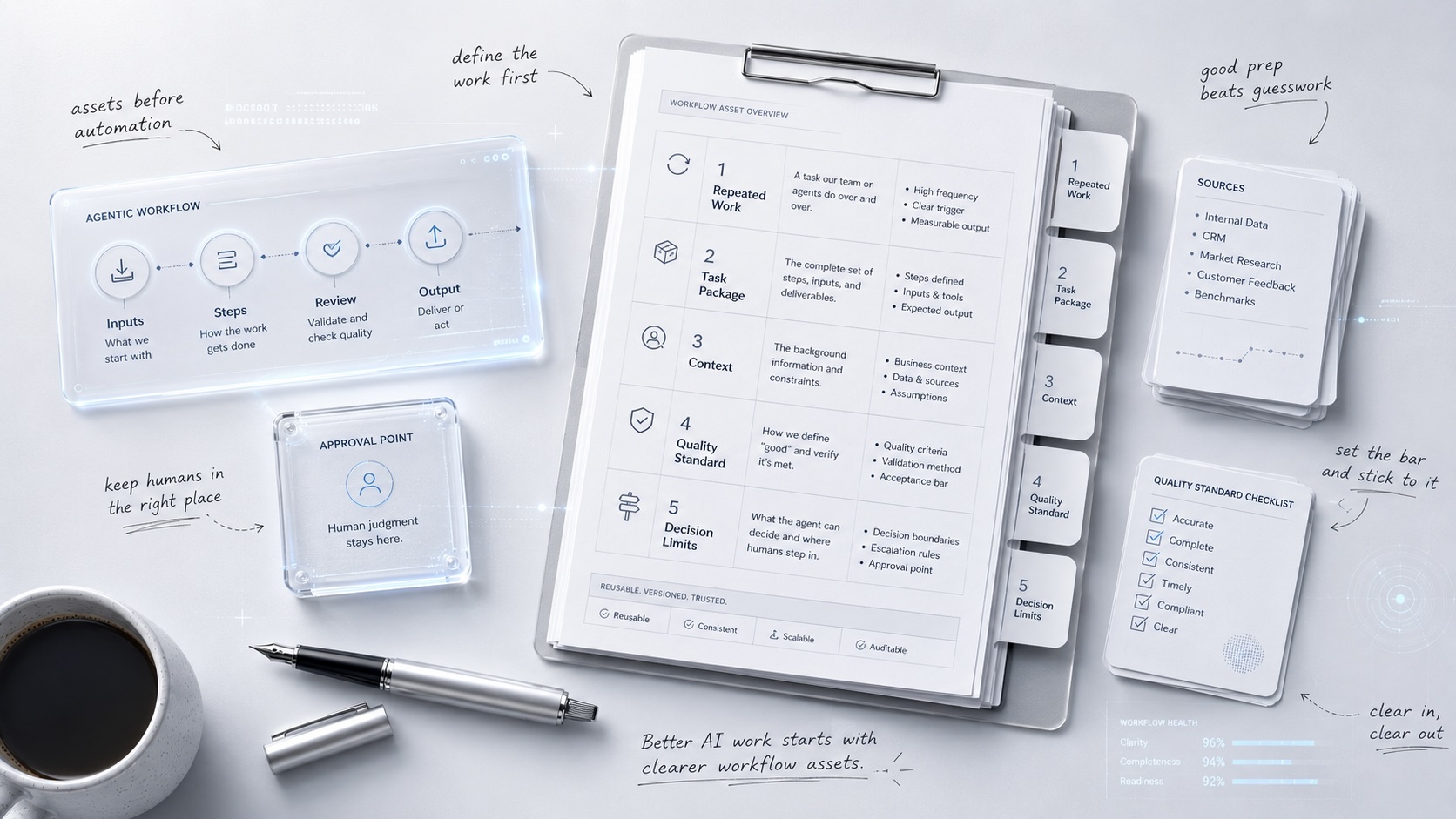
The promise of AI often leads teams straight to prompts and agents. Yet, as many discover, scaling AI beyond isolated demos requires something more foundational. The critical insight is that successful AI integration starts not with the technology, but with the work itself. Before delegating tasks to AI, teams must clearly define the work that can be automated. This means outlining the task, providing the necessary business context, establishing what good work looks like, and determining when AI can act autonomously and when it needs human oversight. The following five reusable assets provide a practical framework for structuring your processes so that AI can be integrated consistently and with confidence.
### 1. The Repeated Work Asset
The first step is identifying the right candidate for automation. Not every task is suitable for AI. You should look for activities that occur regularly, follow a predictable pattern, consume meaningful time, rely on consistent inputs, or carry significant value or risk. Examples include weekly reports, monthly business reviews, customer proposals, contract reviews, product launch packages, or quarterly planning processes.
By creating a simple inventory of how you and your team spend your time, you can classify tasks based on frequency, effort, risk, and value. This exercise helps determine whether a task is better suited for a one-time AI conversation, a reusable workflow, or should remain firmly human-led. The goal is to move beyond ad-hoc experiments and target the processes where AI can have the most significant and consistent impact.
### 2. The Task Asset
A common mistake is to give AI a vague topic and let it fill in the gaps. Phrases like “analyze the data” or “prepare the presentation” leave too much to inference, often resulting in confident but incorrect outputs. The Task Asset is designed to eliminate this ambiguity by turning a general request into a precise set of instructions.
This asset defines the objective, business purpose, audience, decision criteria, materials, authoritative sources, constraints, and expected output format. It explicitly states what a good result looks like and sets clear acceptance criteria. By documenting when the AI must stop and ask for human help, you create a reliable blueprint that AI can execute against, reducing the risk of errors and ensuring the output is actionable.
### 3. The Context Asset
Context is the bridge between isolated tasks and long-term workflow efficiency. AI struggles with outdated information and varying priorities, which is why teams often find themselves re-explaining their work in every conversation. A Context Asset solves this by serving as a single, living document that captures the essentials of your project.
It should include your role, current objectives, target audience, trusted data sources, preferred output style, and critical business rules. The key is to keep it concise and current, separating stable information from temporary details. By maintaining an up-to-date context document, you avoid redundant explanations and ensure that AI has the necessary background to perform tasks correctly the first time.
### 4. The Acceptance Test Asset
You cannot evaluate success without knowing what failure looks like. The Acceptance Test Asset is designed to define quality by using real-world examples. This involves collecting both accepted and rejected outputs from your team’s history to establish a clear quality standard.
By analyzing these examples, you can identify common errors, determine how to detect factual inaccuracies or fabrication, and spot signs of outdated information. The asset forces you to define specific passing criteria for normal cases, missing information, conflicting data, and edge cases. It also highlights situations that require human judgment, ensuring that AI handles what it can while complex decisions are escalated appropriately.
### 5. The Permission Asset
A human-AI system requires clear boundaries. The Permission Asset defines the division of labor between AI and humans. It categorizes tasks into three groups: what AI can do directly, what AI can prepare as a draft for human review, and what AI should never do alone. This is especially important for irreversible actions, such as deleting files, modifying production systems, or publishing content publicly.
This asset acts as a governance framework, specifying data access, logging requirements, and accountability for final results. By documenting what must be reviewed and approved, you create a safe and auditable workflow. This clarity is essential for building trust and ensuring that AI acts as a tool for empowerment rather than a source of risk.
### Putting the Five Assets to Work
Once these assets are defined, they can be combined into a master prompt that creates a reusable workflow. This workflow outlines the standard input and output, the steps involved, which actions AI can take autonomously, and which require approval. It specifies the evidence to be retained and the risks to resolve before scaling automation. The key is to start small, test the workflow with real examples, and refine it based on the gap between expected and actual output.
### FAQ
**What does it mean to “prepare the workflow” before using AI?**
Preparing the workflow means clearly documenting the task, its purpose, inputs, outputs, and decision rules before handing it off to AI. It involves defining quality standards, context, and permission boundaries so that AI can execute work reliably without constant supervision.
**Why is it counterintuitive to define work before using advanced AI models?**
It feels natural to assume that better models will lead to better results. However, without clear definitions, powerful models can confidently produce large-scale errors. Defining the work first ensures that AI actions align with business goals and quality standards, preventing wasted effort and rework.
**Can these assets be used for any type of AI task?**
Yes. These assets are designed to be model-agnostic. Whether you are using a chatbot, a coding assistant, or a specialized agent, having a clear objective, context, and acceptance criteria ensures consistent and reliable outcomes.
**How do I know if a task is ready for AI automation?**
A task is ready when it is repeatable, has clearly defined inputs and outputs, has an established quality standard, and has been validated through acceptance tests. If the work requires frequent human intervention or has irreversible consequences, the permission asset should clarify whether AI should act only under supervision.
**What if our processes change frequently?**
In dynamic environments, the context asset becomes even more valuable. Treat it as a living document that is updated regularly. Stable information, such as brand guidelines or legal policies, should be separated from temporary details to ensure that AI always works with the most relevant context.
### Conclusion
The transition from fragmented AI experiments to reliable automation begins with redesigning the work, not the technology. By investing in the repeated work, task, context, acceptance test, and permission assets, teams turn abstract strategies into practical, reusable workflows. These assets provide the clarity and structure needed for AI to operate with confidence. Before adding more agents or expanding access, define the work clearly, test it rigorously, and document the standards. Only then can AI move from an experimental novelty to a dependable engine for business value.
