



**Free VPN Apps Are Failing at Security, New Study Finds**
A new study led by researchers from the University of Michigan, the University of New Mexico, and IIT Delhi has revealed serious security flaws in many popular free Android VPN applications. The researchers tested 281 of the most-downloaded free VPN apps from the Google Play Store using a new automated auditing framework called MVPNalyzer. The results indicate that a large number of these apps fail at the basic promises they make to users: ensuring privacy and security.
### The Critical Flaws: Privacy and Security Failures
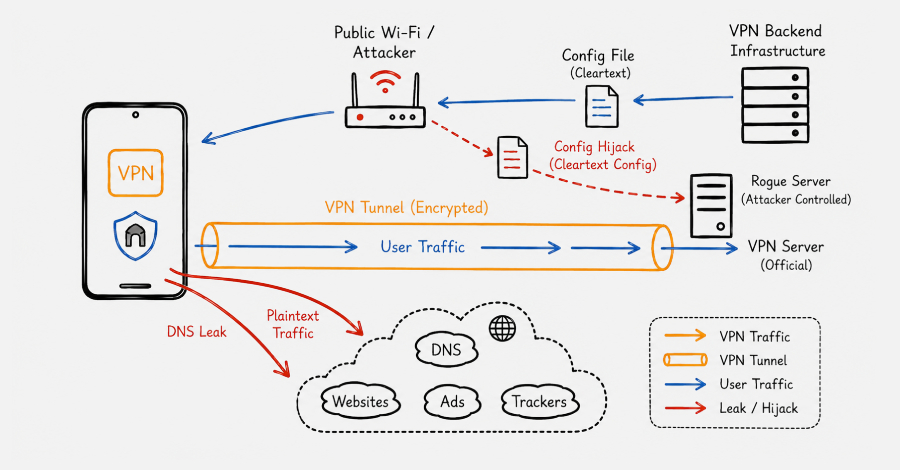
The study found that numerous VPN apps contain fundamental vulnerabilities that put user traffic at risk. The most critical issue identified was **tunnel hijacking**. Five apps were found to send their configuration files in plain text, meaning an attacker on the same network (e.g., public Wi-Fi) could intercept the file and redirect the user’s connection to a server they control. This allows the attacker to view or manipulate all the user’s traffic. The five apps flagged for this high-risk flaw were BambooVPN, VPN Pro, Free VPN, Hexa VPN, and 101 VPN. While some developers have since issued fixes, concerns remain about the patching process.
Beyond configuration leaks, the study found that **29 apps** had traffic-leaking issues. In total:
– 24 apps leaked DNS traffic, exposing the websites users visited.
– 6 apps sent some data completely unencrypted.
– 5 apps sent configuration files in the clear.
– Four apps operated with no encryption at all.
### Hidden Trackers and Deceptive Practices
The research also uncovered concerning privacy practices. Despite being marketed as tools for anonymity, many of these apps engage in tracking themselves. **76 apps** transmitted the device’s Advertising ID to known ad and tracking servers, creating user fingerprints. Furthermore, **246 apps** contacted advertising servers, often alongside sensitive device data like phone models and screen sizes.
Perhaps more alarmingly, **169 apps made no effort to hide their traffic** and could be easily detected and blocked by network operators or governments. This is particularly dangerous for users in regions where VPN usage is restricted, as the apps advertise features like bypassing censorship but provide no technical means to avoid detection.
### Insecure Technical Foundations
A deeper analysis of 108 apps’ OpenVPN configuration files revealed a lack of basic security standards. Only one app followed all security best practices. Major findings include:
– 89% relied on a single authentication method (password or certificate) instead of using both.
– Nearly 20% used weak or outdated encryption methods, such as Blowfish or Triple DES, which are vulnerable to known attacks.
– Some apps disabled encryption entirely by setting the data cipher to “none.”
These weaknesses often stem from a lack of maintenance, allowing apps with severe vulnerabilities to remain popular.
### The Study’s Framework: MVPNalyzer
The system used for this audit, named **MVPNalyzer**, is a mobile counterpart to the researchers’ earlier desktop VPN study, VPNalyzer. It is described as the first framework designed to systematically and repeatedly test Android VPN applications for security flaws. Google has been notified of the findings.
### FAQ
**Q: What is a VPN, and why do people use them?**
A: A VPN (Virtual Private Network) encrypts a user’s internet traffic and routes it through a remote server. This hides the user’s activity from their internet service provider and anyone else on the local network, providing privacy and helping to bypass geographic restrictions.
**Q: How were the apps tested?**
A: Researchers developed the MVPNalyzer framework to automatically test 281 of the most popular free VPN apps on the Google Play Store. The tests checked for traffic leaks, insecure configurations, weak encryption, deceptive advertising practices, and the handling of configuration files.
**Q: Which apps were named as having the most critical vulnerability?**
A: The five apps with the most serious “tunnel hijacking” flaw were:
1. BambooVPN (Package ID: `free.vpn.unblock.proxy.bamboovpn`)
2. VPN Pro (`com.nebulatech.voocvpnpro`)
3. Free VPN (`com.appoxide.freevpn`)
4. Hexa VPN (`com.secure.vpn.proxy`)
5. 101 VPN (`com.shwe.vpn101`)
**Q: Have the developers fixed the issues?**
A. Some progress has been made. The study’s follow-up found that VPN Pro and Hexa VPN no longer send configuration files in plain text. However, the other three highlighted apps (BambooVPN, Free VPN, and 101 VPN) remain vulnerable. Some developers promised fixes that have not yet been delivered.
**Q: Are paid VPNs safe?**
A: The study focuses on free apps, but the researchers caution that trust is the central issue. Users are moving their trust from their internet provider to the app developer. The study suggests that users should favor providers with a reputation for transparency, backed by recent independent security audits, regardless of whether the service is free or paid.
**Q: What can users do to protect themselves?**
A: Users cannot detect these vulnerabilities by simply using the app. The best defense is to be cautious about who you trust. The researchers recommend:
– Choosing paid, reputable services that have undergone independent security audits.
– Being skeptical of free apps covered in ads, as they may have weaker security and poorer privacy practices.
– Treating “Verified” badges from app stores and “no-logs” claims as a starting point, not a guarantee of security.
### Conclusion
The study presents a troubling picture of the free VPN market. While these apps promise enhanced privacy and security, a significant number fail to deliver on that promise. Many suffer from basic coding errors, leave data exposed, or secretly track users. The research highlights a widespread gap between marketing claims and technical reality. As the researchers prepare to release their testing framework to the public, they aim to empower app stores and regulators to enforce better standards, but for now, user caution and informed choice remain the most important defenses.
