



**Claude Science: Anthropic’s AI Workbench for Scientific Research**
This week, Anthropic unveiled **Claude Science**, a new AI-powered application designed specifically for scientists. Available in beta for Pro, Max, Team, and Enterprise plans, Claude Science leverages Anthropic’s existing Claude models rather than introducing a new one. Its primary audience is researchers who typically manage databases, notebooks, and cluster terminals while juggling complex, multi-step investigative workflows.
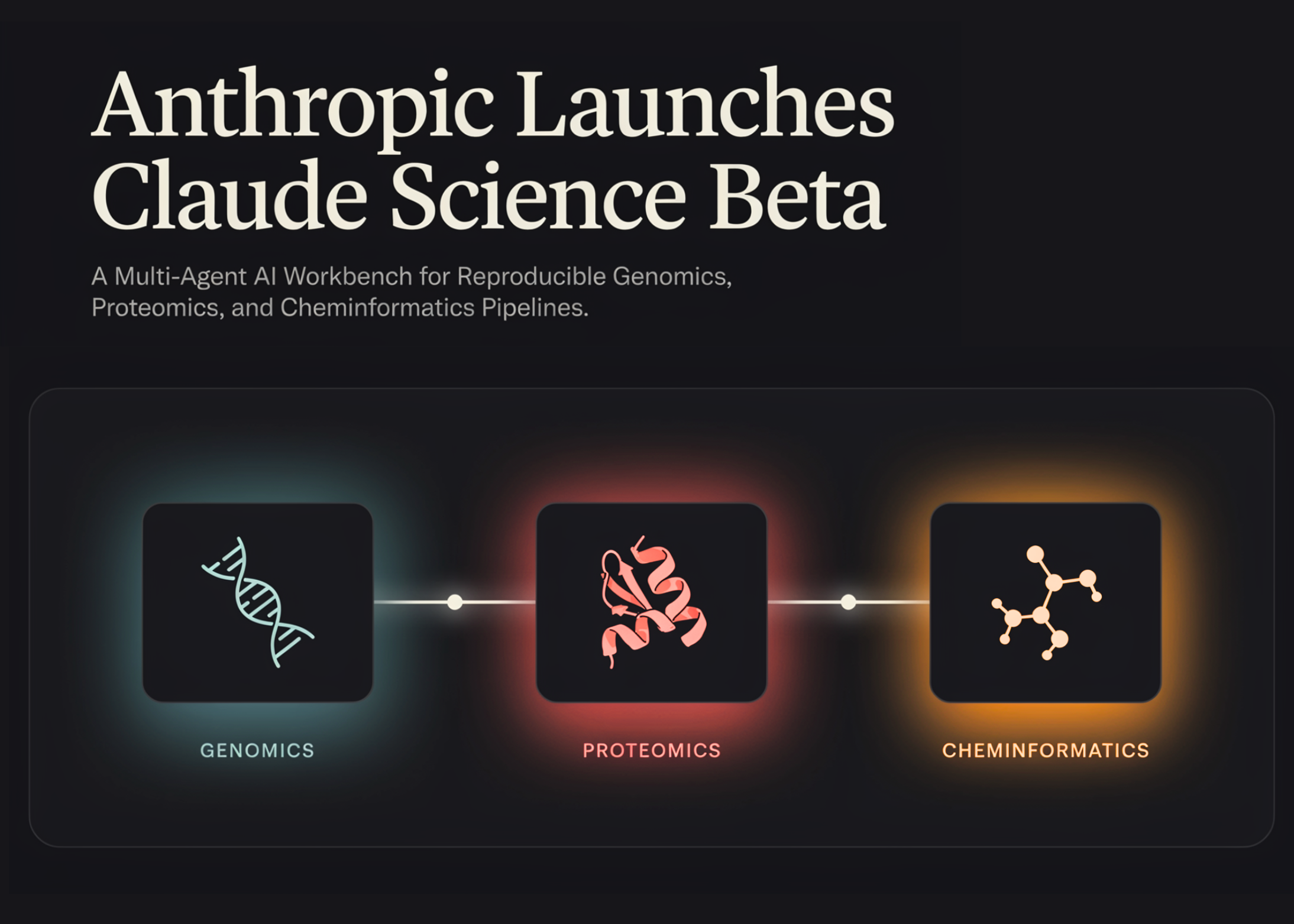
At its core, Claude Science functions as an AI “workbench” that integrates common research tools and software packages. It can analyze literature, execute multi-step research plans, and generate detailed, auditable outputs. The platform allows users to refine figures and manuscripts until they reach publication quality. Users interact with a single generalist coordinating agent via natural language, which in turn coordinates over 60 pre-configured specialist skills. These skills span domains such as genomics, single-cell research, proteomics, structural biology, and cheminformatics.
Claude Science is designed to run locally on macOS or Linux, or remotely via SSH or HPC login nodes. Critically, every output includes a complete, auditable history of how it was produced, enhancing transparency and reproducibility.
### Multi-Agent Architecture and Review
The system employs a multi-agent framework. A generalist coordinator receives plain-language requests and spins up additional agents as needed. A dedicated reviewer agent monitors the pipeline as it runs, checking citations, verifying numerical references, ensuring figure consistency with underlying code, and performing self-corrections in real time.
### Reproducibility and Provenance
Scientific visualization is a key focus. Claude Science can generate figures, manuscripts, and code simultaneously, natively rendering 3D protein structures, genome browser tracks, and chemical structures. Each figure is tied to its exact code, environment, a plain-language description, and full message history, making validation and long-term reproducibility significantly easier. Users can even edit figures using plain-language instructions—such as switching an axis to log scale—and the system will update its own code accordingly.
### Compute Scaling
For large-scale analyses, Claude Science can draft a compute plan, request user approval, and automatically submit jobs to existing infrastructure—including HPC clusters via SSH or cloud environments such as Modal. The system can scale from a single GPU to hundreds of GPUs as needed, while memory context allows large datasets to be loaded only once. Sensitive data can remain on-site, with only necessary context sent to the AI.
### Domain Coverage and BioNeMo Integration
Scientific knowledge is often scattered across hundreds of specialized sources. In biology, these include UniProt, PDB, Ensembl, Reactome, ClinVar, ChEMBL, GEO, journals, and preprint servers. Specialist agents can query and synthesize across these sources. Claude Science also incorporates NVIDIA BioNeMo Agent Toolkit, which connects GPU-accelerated capabilities such as Evo 2 (genomics foundation model), Boltz-2 (biomolecular interaction prediction), and OpenFold3 (protein structure prediction).
### Real-World Use Cases
Early beta users have applied Claude Science to:
– **Target nomination**: Manifold Bio used it to assess tissue-targeting therapeutics, evaluating surface expression, trafficking, and safety to rank candidates.
– **Long-form literature review**: Allen Institute researcher Jérôme Lecoq created a pipeline of about 20 custom skills to review thousands of papers and auto-generate multi-page reports, reducing a task that once took years down to months.
– **Genomic epidemiology**: UCSF’s Stephen Francis used it to accelerate germline analysis for glioma research to roughly one-tenth of previous timeframes.
### Comparison with Other Tools
Compared to general AI assistants and code-focused tools like Claude Code, Claude Science offers end-to-end scientific pipelines, access to 60+ scientific databases, and built-in reproducibility features.
### Extending Claude Science
The app can be extended via Model Context Protocol (MCP) connectors and reusable skills, which persist across sessions. This allows research teams to integrate lab-specific tools and workflows while maintaining continuity.
### Key Takeaways
– Designed for scientific research on macOS and Linux using existing Claude models.
– Coordinating agent delegates tasks; reviewer agent ensures accuracy and reproducibility.
– Outputs include full provenance and can be edited with natural language.
– Supports local, HPC, and cloud compute environments.
– Includes 60+ scientific database integrations and NVIDIA BioNeMo tools.
Claude Science represents Anthropic’s latest effort to embed AI deeply into the scientific research lifecycle, combining orchestration, verification, and domain expertise into a single, extensible platform.
—
**Original article:** Anthropic. “Introducing Claude Science: An AI Workbench for Scientific Research.” *Anthropic Blog*, 2025, https://www.anthropic.com/news/claude-science.
