



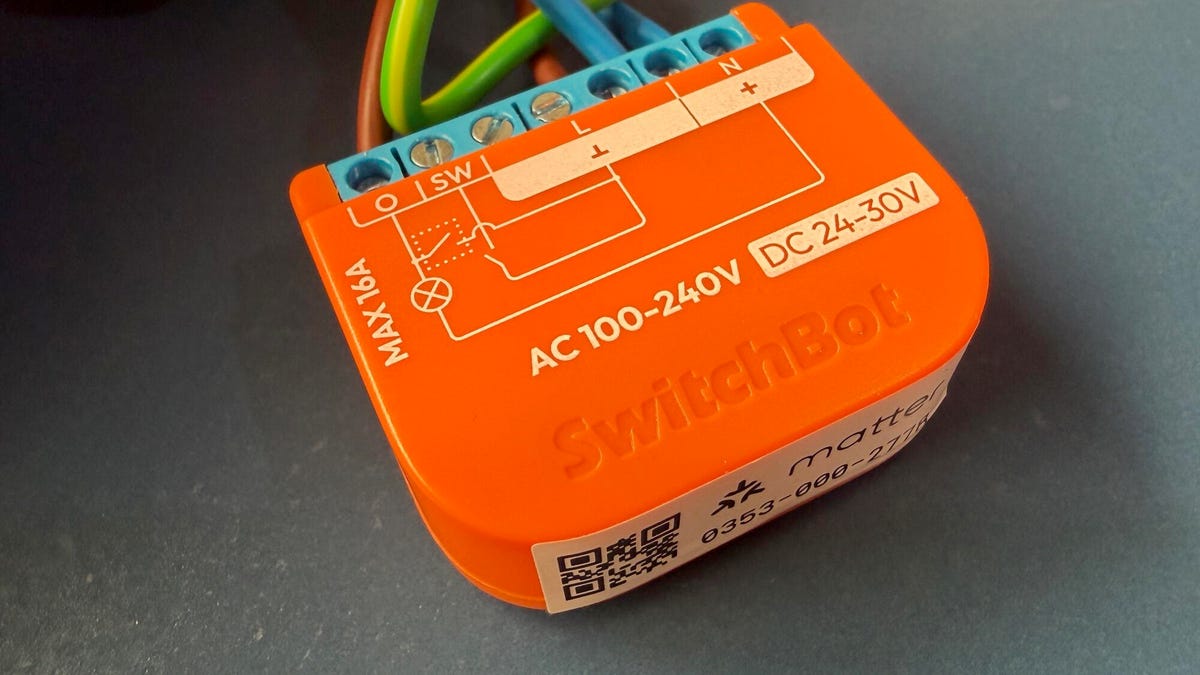
SwitchBot Relay 1PM switch
pros and cons
- Compact design fits neatly behind a switch or socket.
- Simple to install and configure.
- App is rich in functionality.
- Installation can be finicky.
- Must be mounted inside an enclosure to minimize electric shock risk.
Follow ZDNET: Add us as a preferred source on Google.
Has anyone ever scolded you for forgetting to turn off the lights? Even with the widespread adoption of LED bulbs, it’s still wise to switch them off when not in use. While a single bulb might only cost roughly a dollar per month if left on around the clock (based on a 6-watt bulb and an electricity rate of $0.20 per kWh), consider how many bulbs you have throughout your house. The costs accumulate quickly.
Also: How I slashed my electricity bill using IFTTT automation – in 4 easy steps
However, some devices consume far more energy than you’d expect, and if they’re inconvenient to toggle on and off—or appear to be doing nothing in standby mode—people tend to leave them running.
Take, for example, a large commercial coffee machine in a café.
Small but mighty
What you need is a SwitchBot Relay 1PM switch. This compact switch, controlled via Bluetooth and Wi-Fi, lets you automate your switches and lights, transforming ordinary household appliances into smart devices. Don’t be deceived by its diminutive dimensions—just 1.6 x 1.4 x 0.6 inches and weighing only 0.9 oz—because it’s loaded with impressive capabilities.
Also: Your old iPad or Android tablet can become your new smart home control panel – here’s how
This device supports AC inputs ranging from 100 V to 240 V at both 50 and 60 Hz (making it suitable for use worldwide) with a capacity of up to 16 A. Additionally, it handles DC power from 24 V to 30 V, making it ideal for low-voltage applications.
Impressive technical specifications on this SwitchBot switch.
Adrian Kingsley-Hughes/ZDNET
Since manually pressing buttons and flipping switches is a thing of the past, this device integrates seamlessly with various automation platforms, including Alexa, Siri, Google Assistant, IFTTT, and SmartThings. It’s also compatible with Matter. If you already have a smart home setup, this SwitchBot Relay will slot right in!
Already running a smart home ecosystem? The SwitchBot Relay will integrate effortlessly!
Adrian Kingsley-Hughes/ZDNET
The product includes clear installation instructions, but if you’re unsure at any point, it’s best to consult a qualified electrician—safety should always come first. The unit is meant to be installed inside an enclosure, such as behind a switch or outlet faceplate, which explains its compact form factor. It should never be left exposed, as the terminal screws carry mains voltage and could deliver a severe, potentially lethal shock. Keep it out of reach of people, children, and pets.
Also: 10 handy smart home devices that simplify daily life (and most are on sale)
Also note that the device offers no water resistance whatsoever, so handle it with the same caution as any other electrical plug, socket, or switch in your home.
Ideal for home automation
The SwitchBot app is loaded with a wide array of features.
At the most basic level, you can turn devices on and off and set schedules for automatic operation. Going further, you can customize the device’s behavior after a power outage—choose whether it turns on, off, or resumes its last state. There’s also a missed-touch prevention feature that prompts you to confirm before the switch is activated.
This is a thoughtful addition that helps prevent accidentally shutting off something important (though I wouldn’t recommend connecting life-critical equipment, such as medical devices, to this switch!).
Also: I automated the most unexpected electronics in my home – here are 5 brilliant outcomes
There’s also an NFC option that lets you link a SwitchBot tag to the relay and control it with a simple tap of your phone.
The SwitchBot app is well-designed and feature-rich.
Adrian Kingsley-Hughes/ZDNET
Then there’s power monitoring, available as both a real-time readout and historical usage data. This is where you discover just how much energy your devices are guzzling. There’s nothing quite like seeing the actual power consumption numbers to motivate people to change their habits. You can analyze usage in detail and, like me, export the data to crunch the numbers in your preferred spreadsheet application.
Burning through energy
Which brings me back to the coffee machine—a La Spaziale S5, a powerhouse that can draw up to 4,500 W at peak load. Over the course of a workday, it can easily consume 20 kWh of electricity.
Also: I tested Amazon’s top-selling smart switch for my home, and they’re genuinely useful
That’s a significant amount, but it’s doing its job, and it’s being paid to do its job.
The La Spaziale S5 coffee machine operates intensively and draws substantial power.
Adrian Kingsley-Hughes/ZDNET
But what happens when it’s in standby mode? The owners assumed that minimal activity meant minimal power consumption. I had my doubts. I suspected that it was consuming significant energy during the 16 or so hours it remained powered on but idle.
I happened to have several SwitchBot Relay 1PM switches available, so I slid the coffee machine a few inches from the wall, squeezed my head and arms into the tight space to wire the relay into the circuit, linked it to the Wi-Fi network, and let it run for several days (ensuring no one powered it off during testing!).
Also: Your smart plug is seriously underutilized: 7 ways I’ve programmed mine to automate my home
Oh wow, this appliance was a power hog. After analyzing the data collected over several days, the results were alarming. The S5 guzzled a staggering 8 kWh during idle periods — roughly 0.5 kW every hour. That figure seemed off, so I tested and retested, but the results held steady. Electricity prices in the UK are already higher than in the US, and business rates are even steeper, so this translated to over $1,500 wasted annually.
This number nagged at me so much that I had to investigate the coffee machine itself. Appliances aren’t really my area of expertise, but I was certain something was malfunctioning.
And I was right — there was a small water leak on the low-pressure side of the machine. It wasn’t large enough to form a visible puddle (the warmth of the machine caused quick evaporation), but it meant the water tank was constantly being replenished with cold water. As a result, the machine was perpetually working to heat it. Repairing this leak brought standby consumption down to under 0.25 kW per hour.
That’s a remarkable saving — even without powering off the machine entirely!
ZDNET’s buying advice
Now, I’m not suggesting that most households have a power-hungry appliance like this one, but at only $15, a SwitchBot Relay doesn’t need to save much to pay for itself within about a year.
The reality is that you’ll likely end up buying more than one switch, along with a variety of other smart devices (after all, who wouldn’t want at least one FingerBot?), so think of this as your first step into what will inevitably become a rewarding home automation journey.
