



Stay updated with ZDNET: Add us as a preferred source on Google.
ZDNET’s key takeaways
- Solar savings depend heavily on location.
- Solar panels can cause burns, shock, or death.
- Plug-in solar needs a battery during power cuts.
Renewable energy is often clouded by a sea of myths and misinformation. Strong opinions are everywhere, and they tend to clash. But these myths aren’t helping anyone who’s trying to decide whether solar is worth it, or who has already invested and wants to maximize their setup.
Also: Considering plug-in solar? My expert recommendation after installing the DIY energy system at home
Let’s bust some myths. I’ve spent years working with portable solar generators and panels. I’ve tested everything from small 100-watt portable units to arrays generating thousands of watts. I’ve also used simple yet effective plug-in solar systems that trim a bit off the monthly electricity bill. I know this topic well, and I’ll give it to you straight.
Myth 1 (and 2): Solar panels will save you a fortune / won’t save you a penny
One of the most common debates about solar revolves around the potential savings. Some claim solar will not only save money but generate hundreds or even thousands of dollars. Others insist it’ll never pay for itself and is a complete waste.
My Jackery solar generator powering devices in Scotland.
Adrian Kingsley-Hughes/ZDNET
To estimate how much a solar system might save, you need to know three things:
- The capacity of your solar array (in watts)
- The number of peak sunlight hours (PSH) at your location
- The cost of electricity where you live
Let’s use Utah as an example, where plug-in solar is legal. This means homeowners can directly connect microinverter solar systems up to 1,200 W into standard electrical outlets. Assume you install the maximum 1,200 W, properly positioned south-facing, with no shading from trees or buildings.
Also: Is plug-in solar legal in your state? How to verify before installing one at home
To determine your peak sunlight hours, you can find a general estimate here, or more detailed monthly data here to calculate an average. For Utah, the annual estimate is about 6.5 hours per day, while the monthly average is closer to 5.5 hours. Let’s take the middle ground at 6 hours.
For electricity costs, Utah residents pay roughly $0.14 per kWh.
Using the array size (1,200 W) and PSH (6 hours), and accounting for about 23% loss due to inefficiency, shading, and dust on panels (known as the derating factor), the calculation is:
6 x 1,200 x 0.77 = approximately 5.5 kWh per day over the year.
Applying the electricity rate, that’s about $0.77 worth of power daily, or roughly $281 annually. EcoFlow offers a system called the STREAM, which includes solar panels and a battery to store excess energy for $1,600. That system should pay for itself within roughly five and a half years.
Also: My portable wind turbine vs. solar panels — after two years of testing
Regions with different PSH and electricity costs will show different results. California, with 7.5 hours of peak sunlight and electricity at up to $0.36 per kWh, could generate around $910 annually. In contrast, Alaska, with as little as 2 hours of peak sunlight and electricity at $0.27 per kWh, would yield only about $182 per year.
More sunshine means more power and a faster return on your investment.
Myth 3: Solar panels are harmless
This is a point where I must strongly urge caution. Real, serious caution.
Electricity is dangerous, and mishandling it can cause immediate injury or death. Combined with widespread misinformation about electrical safety, this creates a confusing landscape. Phrases like “it’s the amps, not the volts that kill” are completely misleading (1 amp from a 110-volt outlet can be lethal, yet you can safely touch the terminals of a 12-volt car battery capable of delivering 1,000 amps).
Solar panels are unusual because they generate electricity any time they’re exposed to daylight.
Also: Years of emergency preparedness showed me how to weatherproof my solar generators
According to OSHA, any voltage at 50 volts (AC or DC) or above is “a generally recognized threshold for dangerous electric shock.”
Portable folding panels like the Bluetti 350W are near this threshold at 46.5 volts open-circuit. Connect panels together in series, even portable ones, and you can easily exceed that limit. Larger rooftop installations with rigid panels can produce hundreds of volts.
More than enough to be instantly fatal.
Also: The solar backup power station I rely on after years of testing — and what makes it so effective
DC voltage can also cause severe burns, painful entry and exit wounds, and tissue damage. Years ago, I received a small DC burn on the back of my hand from a malfunctioning piece of equipment. It was incredibly painful, became infected, and took weeks to heal — consider this a warning.
I’ve also experienced a sharp shock from disconnecting damp MC4 connectors on a solar panel. I was standing on the ground, so nothing serious happened, but it could’ve been a very different story if I had been on a ladder or in another vulnerable position.
MC4 connectors are very safe — unless they’re broken, damaged, or exposed to moisture!
Adrian Kingsley-Hughes/ZDNET
The greatest danger comes from damaged panels, especially faulty connectors or wiring. But I’d recommend covering or flipping over even small panels, or waiting until morning, evening, or nighttime to handle any work — just to stay safe.
Myth 4: Solar panels don’t last long
That’s simply not true.
The panels included with the EcoFlow STREAM system come with a 10-year warranty and, with proper care, should deliver 20 to 25 years of reliable service.
Also: Is solar power a smart investment? Here’s how I’m extending my panels’ life and boosting my savings
That’s more than enough time to recoup your initial investment.
Myth 5: Solar panels are useless on overcast days
Solar panels produce electricity whenever sunlight reaches them. While output decreases significantly during cloudy conditions, it doesn’t drop to zero—you’re still capturing energy.
Myth 6: Plug-in solar is banned everywhere
In the US, five states have already legalized plug-in solar: Utah, Colorado, Maine, Maryland, and Virginia. These states permit systems with panels ranging from 1,200 W to 1,920 W to connect directly to a home’s electrical system without requiring permits.
A plug-in solar microinverter manufactured by EcoFlow.
Adrian Kingsley-Hughes/ZDNET
Four additional states—New York, Vermont, New Hampshire, and Connecticut—have enacted legislation, though it’s still pending gubernatorial approval (or potential veto). Nine more states are developing regulations, while progress has stalled in 11 states and been rejected in five others.
Also: Don’t make these 8 solar errors that slash your energy output by 50% – I found out through trial and error
Internationally, regulations vary widely, with legality determined by regional laws.
Myth 7: Plug-in solar keeps running during outages
Without a battery for energy storage, plug-in solar systems automatically shut off during power outages as a safety precaution.
Myth 8: Plug-in solar wipes out electricity costs
Plug-in solar is built to cover part of your base load—the continuous energy your home draws throughout the day, such as refrigerators, device chargers, and Wi-Fi routers. Even with the largest solar setup and optimal peak sunlight hours, these systems shut down at night when there’s no sunlight.
Also: How I increased my portable solar panels’ output by up to 30% – 11 tips from experts
To completely eliminate electricity bills, you’d need an extensive solar array paired with a battery system to store energy for nighttime and overcast days.
Myth 9: Solar generators are just for crisis situations
Although they’re excellent for emergencies, many people also use them for camping or to reduce daily electricity costs by offsetting some grid usage. The batteries are also ideal for storing energy during low-rate off-peak periods and using it during high-rate peak times.
Myth 10: Solar panels must face south (in the Northern Hemisphere)
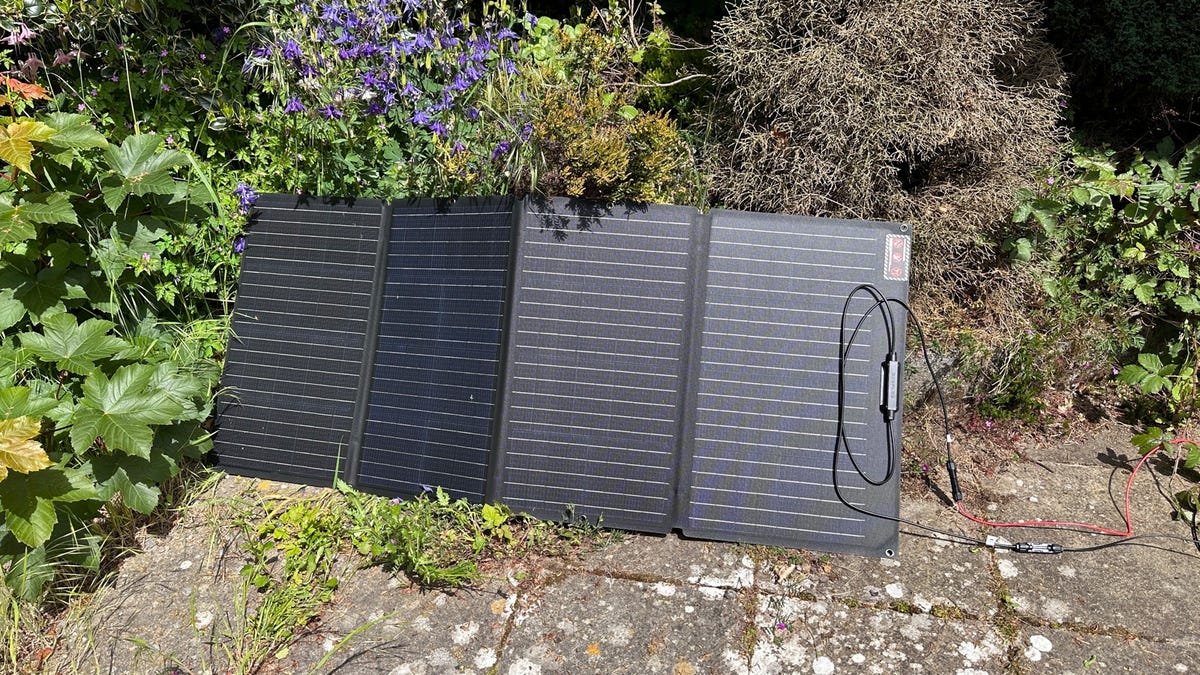
While positioning panels toward the sun is ideal (meaning due south for fixed installations in the Northern Hemisphere), panels facing east, west, or even north will still function. They won’t perform as efficiently as south-facing panels, but they’ll still generate electricity.
Orienting your panels southward is recommended when feasible.
Adrian Kingsley-Hughes/ZDNET
Whether it’s worthwhile depends on your location. Areas with high peak sunlight hours are more practical. In my location in the UK, which averages 2.5 to 3.5 peak sunlight hours daily, north-facing panels aren’t practical, but even here, panels not facing due south still produce a reasonable amount of power (roughly 30% less than south-facing panels, though aiming them as close to south as possible is advisable).
Myth 11: Solar generator batteries have a short lifespan
My oldest solar generator (a Jackery model) is approximately 8 years old, and both the unit and its solar panels continue to function. This system uses older lithium-ion batteries rather than the newer, more durable lithium-iron phosphate (LiFePO4) batteries.
A unit like the Bluetti Elite 400 should serve you well for many years.
Adrian Kingsley-Hughes/ZDNET
Contemporary solar generators such as the Bluetti Elite 400, Jackery Solar Generator 5000 Plus, and EcoFlow Delta Pro Ultra all include a five-year warranty and use batteries designed to withstand daily charging and discharging for ten years. I can personally confirm the durability of these systems—I own several that have endured five or more years of intensive—and often careless—use.
Myth 12: Solar panels require constant maintenance and break easily
Solar panels—whether fixed, rigid models or portable, folding versions—are extremely durable. Rigid panels can be damaged by large hailstones, and flexible panels shouldn’t be bent incorrectly, but otherwise, they require minimal upkeep.
Also: Years of emergency preparedness taught me how to protect my solar generators from storms
The key maintenance task is keeping panels clean. Even a thin layer of dust can reduce output by 5%, while pollen, which adheres more stubbornly, can decrease it by up to 15%.
That doesn’t mean panels are indestructible. Hail and even micrometeorites can cause damage.
