



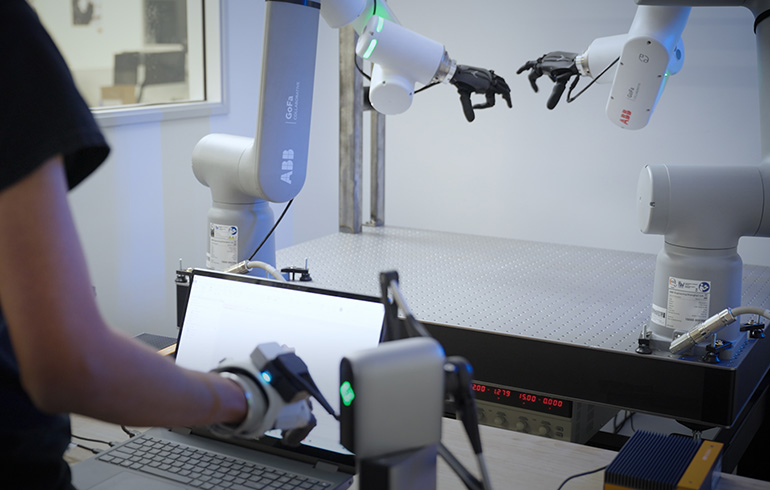
GoFa helps test PSYONIC’s Ability Hand for robotics, combining touch sensing, compliant design, and human-derived training data. Source: ABB Robotics
ABB Robotics LLC announced today that it is partnering with PSYONIC to push the boundaries of dexterous robotic manipulation by leveraging real-world data collected from human prosthetic users. The two companies are pairing ABB’s GoFa force- and power-limited collaborative robot with PSYONIC’s Ability Hand to investigate how touch and motion data can be used to train robots to carry out tasks that have traditionally been hard to automate.
ABB Robotics noted that manipulation sits at the heart of its “Autonomous Versatile Robotics” (AVR) vision — a future in which robots can perceive, think, move, and precisely handle objects in ever-changing environments. The company added that the capacity to learn from real-world interactions and reliably apply those lessons will also drive progress in physical AI. ABB Robotics was sold by ABB Group to SoftBank for $5.3 billion in October 2025.
“Human dexterity and the intuitive grasp of how to handle different objects is one of the hardest things to replicate in industrial-grade robotics, yet it’s an essential requirement for truly autonomous and versatile robots,” said Marc Segura, president of ABB Robotics.
“As we build the next generation of physical AI, robots will learn and understand the world the way we do,” he continued. “This partnership with PSYONIC will help bridge the long-standing gap between human and robot dexterity, unlocking new opportunities across a broad range of industries.”
 Submit your session idea for the 2026 RoboBusiness
PSYONIC sees prosthetic and industrial needs converging
Founded in 2015, PSYONIC initially created its Ability Hand as a prosthetic device. The hand integrates myoelectric control, touch sensing, and compliant mechanics into a lightweight, multi-jointed design. Its built-in pressure sensors and vibration feedback system allow users to sense contact, grip force, and release, while the flexible fingers naturally adapt to irregular and deformable objects.
“Our prosthetic hand has already received FDA approval, and we currently have more than 300 patients using it,” Dr. Adeel Akhtar, founder and CEO of PSYONIC, told The Robot Report. “It’s covered by Medicare in the U.S., and when we launched nationwide, Meta was among our first customers. We started out more focused on the prosthetics side and less on robotics, but over the past year, that balance has shifted dramatically because physical AI has been exploding.”
Akhtar pointed out that suction grippers and parallel jaw grippers come with notable drawbacks — for instance, they often require a tool changer, which can introduce delays, potential failures, and time-consuming upkeep. With deformable objects like clothing and workcells designed around human workers, a five-fingered hand made practical sense for both industrial and service applications.
“When we first approached ABB, we recognized clear parallels,” Akhtar noted. “Many of the challenges we addressed on the prosthetics side — durability, reliability, tactile feedback for high-mix, low-volume tasks — are identical to what industrial users face. At home, that might mean washing dishes or folding laundry; in the workplace, it could be pick-and-place operations or restocking shelves.”
San Diego-based PSYONIC aims to deliver the complete technology stack, spanning from human-generated training data all the way through to the robotic hand itself, powered by models built on that data, according to Akhtar.
“Dexterous manipulation is ultimately as much a data problem as it is a hardware problem,” Akhtar said. “By deploying the same Ability Hand on both people and robots, we can capture high-fidelity real-world data on movement, contact, and grip force, and then use that information to train robotic systems far more effectively.”
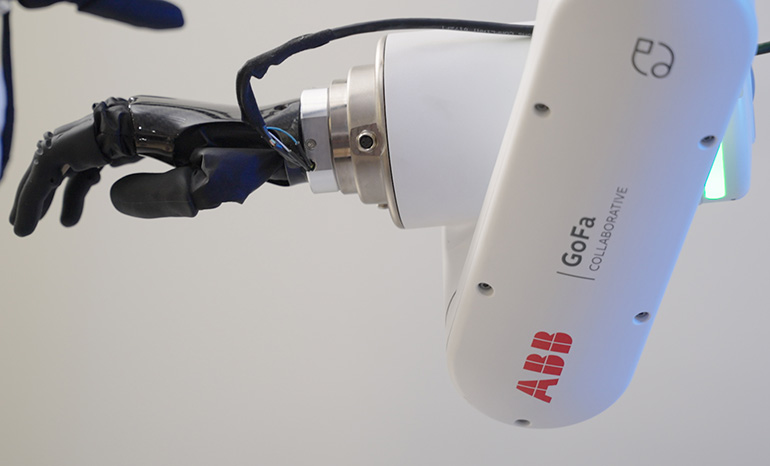
Dexterity is central to Autonomous Versatile Robotics, ABB ‘s vision for robots that can sense, reason, move and handle objects with precision. Source: ABB Robotics
Integrated manipulation delivers richer training data
According to the International Federation of Robotics (IFR), improved grasping capabilities and tighter digital integration could cut engineering time by as much as 30%. PSYONIC is collaborating closely with ABB Robotics’ R&D team to explore how touch-enabled manipulation can support next-generation robotics applications.
The GoFa collaborative robot enables precise measurement of grip force, finger positioning, and movement — all critical factors for translating human-derived manipulation data into dependable robot performance across complex, variable tasks, the company explained.
“A great deal of training today relies on teleoperation, gloves, VR setups, or video analysis, but these methods only provide positional data,” Akhtar explained. “If you’re picking up a coffee mug, for example, you’re not really thinking about where each finger is placed. Our human users instinctively know exactly how much pressure to apply to an object because they can feel the touch sensors through the hand.”
“And then by capturing that tactile data and synchronizing it with multimodal inputs — say, Meta Ray-Ban cameras — we can actually get the complete picture of how much pressure, finger speeds, and torques are needed to maintain a secure grip so the mug doesn’t slip,” he said. “If you’re holding something like a raspberry, this is how gently you need to move your fingers so you don’t crush it, right? And that’s the kind of information we can readily obtain from our human prosthetic users.”
PSYONIC is working with ABB and NVIDIA’s Isaac Lab and GR00T to train vision-language-action (VLA) and world
models. The company discovered that models require less data when they are trained on high-quality, multimodal data compared to teleoperation or video analysis, Akhtar explained.
“GoFa serves as an ideal testbed to demonstrate how we can convert data from human users into instructions for robots to perform tasks such as operating a torque wrench on a car engine,” he noted. “ABB is currently collaborating with industrial partners who stand to benefit from the algorithms and AI we develop based on human users performing these same tasks. Higher production volumes in robotics can help make robotic limbs more accessible.”
ABB Robotics and PSYONIC begin with three target industries
ABB Robotics stated that its partnership with PSYONIC aligns with its broader strategy of collaborating with ecosystem partners to break down persistent obstacles to automation. The two companies plan to assess how human-generated data, AI, and collaborative robots can manage variable, delicate, or intricate items for applications where traditional gripping technologies have failed to deliver a worthwhile return on investment.
“Over the next six to 12 months, we’re evaluating how to achieve over 99% reliability,” Akhtar said. “We’re starting with pick-and-place operations in the automotive and warehouse sectors. Another major focus for us is laboratory automation in life sciences — handling beakers and test tubes represents a significant market opportunity.”
Beyond these areas, the companies will investigate applications spanning industries such as aerospace, packaging, and logistics. According to Akhtar, PSYONIC and ABB Robotics are already working closely to refine the human-to-robot data pipeline and ultimately enhance productivity, adaptability, and safety in the workplace.
PSYONIC is also developing the next iteration of its robotic hand. While the company is prioritizing a human-inspired design, the gripper is engineered to be compatible with a wide range of platforms, from cobots and industrial automation systems to wheeled and legged robots, as well as humanoid robots.
At the upcoming Automate event in Chicago next week, PSYONIC will be showcasing at Booth 1690, and ABB Robotics will be located at Booth 1241.
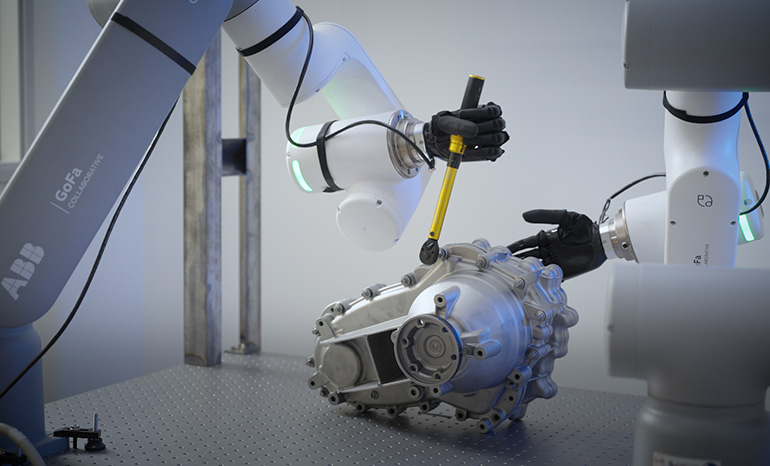
PSYONIC is working with ABB Robotics to explore how touch-enabled manipulation can support next-generation robotics applications. Source: ABB Robotics
