



Seeed Studio SenseCAP T1000-E Tracker Card
Advantages & Disadvantages
- Small yet feature-packed tracking card.
- More than a simple tracker — it includes a complete mesh client internally.
- The companion app reveals extensive functionality, and the card supports flashing with alternative firmware.
- Battery life is limited to roughly two or three days.
- It can be a complex topic with a sometimes steep learning curve.
It relies on a proprietary magnetic charging cable.
Stay updated with ZDNET: Set us as your preferred source on Google.
I’ve mentioned this before, and I’ll happily repeat it: Apple AirTags completely transformed my daily routine. The ability to track down essentials like keys and wallets from anywhere on the planet has spared me countless moments of frustration, stress, and lost time. And the growing ecosystem of third-party trackers means there’s a solution tailored to virtually every use case.
Also: I concealed 4 Bluetooth trackers (including AirTags) to evaluate their dependability — here’s how Android competitors stacked up
However, there’s a significant limitation: all these trackers depend on cellular and Wi-Fi infrastructure. What if you could have trackers that function on their own independent networks, free from reliance on systems built by tech giants? That’s precisely the promise of the Seeed Studio SenseCAP T1000-E tracker card.
So, how does it actually work?
As with most things in tech, there’s plenty I appreciate about the T1000-E, along with a few things that leave me wanting. But before diving deeper, consider this your heads-up: this card might just be the entry point that draws you into the expansive universe of LoRa mesh networking.
LoRa translates to Long Range Radio — it’s a long-range wireless communication protocol capable of forming mesh networks.
Also: I discovered an AirTag alternative that’s twice as rugged and fully compatible with Android devices
What exactly is a mesh network?
It’s an open-source, off-grid, decentralized network architecture designed to operate on compact, energy-efficient devices. It requires no cell towers or internet connection. It’s a fully autonomous, peer-to-peer radio system. If you’re anything like me and enjoy diving headfirst into unconventional tech, you’ll quickly find yourself immersed in mesh transceivers and building solar-powered relay nodes.
Why go through the trouble? Because it’s possible — and that’s reason enough.
Note: Be sure to purchase the T1000-E specifically, and avoid the A or B versions. Only the E model supports peer-to-peer mesh communication; the A and B variants rely on LoRaWAN networks and require dedicated network gateways.
Alright, back to the T1000-E. At its core, it’s a card-sized tracker, much like the others on the market. It’s the size of a standard credit card and about as thick as a small stack of them. Inside sits a 700 mAh battery — enough to keep the device running for a couple of days — along with all the hardware needed for communication and location tracking.
Also: I retired my AirTag within minutes of testing this Bluetooth tracker alternative — here’s the reason
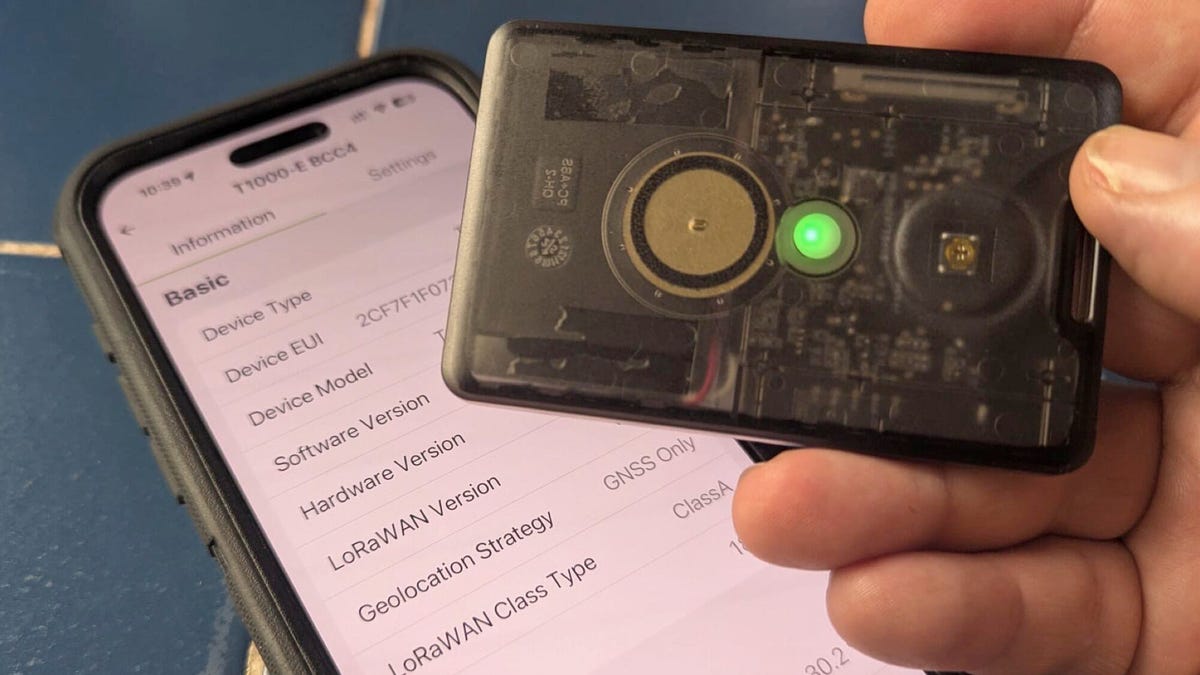
There’s a remarkably loud buzzer, an LED indicator light, and a physical button for powering the device on and off and managing functions like Bluetooth connectivity.
Engineered for extreme conditions
The enclosure carries an IP65 rating for protection against dust and water, making it well-suited for outdoor adventures. I genuinely appreciate this feature, but to reach this level of environmental resistance, the manufacturer chose a magnetic charging pad on the rear that connects via pogo pins.
IP65 certification means dust and moisture pose no threat to the T1000-E.
Adrian Kingsley-Hughes/ZDNET
This design choice means you’ll always need the proprietary cable whenever it’s time to recharge. It also means that if you attempt to charge the card while on the go — say, by connecting it to a portable power bank — there’s a real risk of the connection breaking and charging halting. I’ve come up with workarounds involving rubber bands or hot glue, but I really wish there were a more reliable method for keeping the connector securely attached.
It performs well as a tracker
Out of the box, you’ll need to install the SenseCraft app (iOS/Android) to configure and manage the T1000-E.
Configuring a new T1000-E through the SenseCraft app.
Adrian Kingsley-Hughes/ZDNET
The app is decent, though not exceptional. The instructions can sometimes be unclear; you may occasionally encounter sections written in Chinese, and it also pushes additional products on you (something I find irritating in an app for a product I’ve already purchased). My suggestion: if you run into difficulties, consult the comprehensive support documentation wiki (which includes video guides), or visit the fantastic r/meshtastic community on Reddit.
Also: I disassembled the latest AirTag 2 and uncovered a significant design flaw in Apple’s widely used tracker
If you simply want to use the tracker for what it’s designed for, you’re essentially all set. The app displays a map showing the card’s real-time location, or you can activate beacon mode to broadcast your position to others when you’re out and about.
The card connects to the smartphone app via Bluetooth, but it’s also compatible with LoRaWAN,
Meshtastic, Amazon Sidewalk, and Helium networks.
Also: My new favorite AirTag alternative fits perfectly in my wallet – and is seriously durable
If you’re in a location where people are already using a mesh network, that’s a fantastic, hassle-free solution. You might even choose to set up your own nodes at home or work to expand the network for everyone’s benefit.
I discovered that Amazon Sidewalk is also a highly effective option, particularly in densely populated areas. Given the sheer number of Amazon devices and Ring cameras already in use, there’s a substantial existing network you can tap into.
The app is packed with features, including tracking.
Adrian Kingsley-Hughes/ZDNET
Plenty of choices. And yes, this could be a lifesaver in those doomsday scenarios where the power fails, cellular networks go silent, and the zombies begin to roam.
I’ve carried it in my pocket, my bag, and even strapped to the outside of my backpack, and the GPS receiver performs remarkably well even in challenging conditions. There’s a lanyard hole on the card for easy attachment to your gear.
But there’s more … a lot more!
However, the T1000-E offers much more than just tracking. It’s a fully functional mesh transmitter capable of sending and receiving messages between other devices. To explore this functionality, you’ll need another mesh device (such as another tracker or a mesh transceiver). This is where the deep dive into the world of mesh networking begins.
Also: I slipped this stealthy $15 tracker into my favorite jacket – now it’s an everyday essential
You can also customize the card further. For instance, you can replace the firmware that Seeed Studio pre-installed on the T1000-E with the standard Meshtastic firmware using the online flashing tool.
I installed Meshtastic firmware onto the T1000-E.
Adrian Kingsley-Hughes/ZDNET
You can then use the Meshtastic app (iOS/Android) to manage the card, and I found this experience to be significantly better, especially if you want to unlock the card’s full potential. This goes far beyond what I can cover here, but if you’re looking for a starting point, this video will likely spark your interest.
ZDNET’s buying advice
The Seeed Studio’s SenseCAP T1000-E tracker card typically costs around $50. You might occasionally see it listed for much more, but steer clear of those listings. Usually, if you wait a day or two, the price will drop.
Also: These are the closest things to AirTags for Android users (and better in some ways)
For a dedicated tracking card, that’s a considerable investment, but once you realize it also doubles as a messaging device allowing you to send and receive texts for free, the price starts to feel much more justified. Mesh networks are ideal for off-grid communication and also for places like cruise ships, where the company will charge you a fortune for Wi-Fi.
