



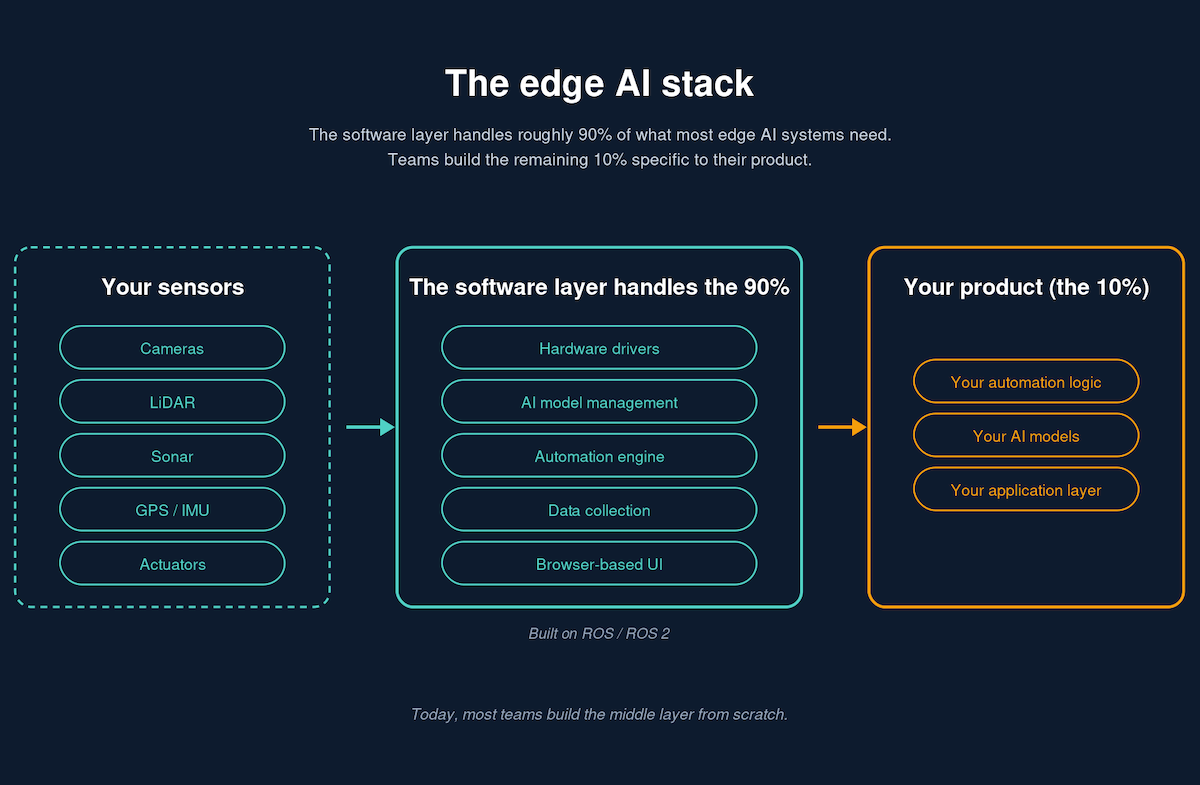
Edge AI software layer diagram. Source: Numurus
Before Windows, only computer scientists and skilled engineers could truly do much with a computer. That all changed because of Windows. Windows provided a user interface, a collection of built-in apps, and the ability to use hardware with plug-and-play ease. An identical transformation is presently taking place in the world of robotics.
I recall when the initial personal computers were released, during my first year as a college student studying to be a robotics engineer. I was so excited. These machines were so fast and powerful, and they had the potential to solve tough mathematical problems and execute complex engineering tasks in a rapid amount of time.
But in those times, PCs were useful to only a small number of expert individuals. Doing anything with a PC required knowledge of command-line operating systems, complex hardware protocols, and the ability to write software from the ground up.
So just like the people I knew, most of the world looked at a PC and saw an expensive machine that wasn’t particularly useful. Everything changed once Windows was introduced, transforming the personal computer from a specialist’s gadget into a tool for the entire world.
There’s a new and surging market today involving edge AI processors. These are specialized chips designed for running AI models within robotic and automated systems. This is happening thanks to companies like NVIDIA, AMD, Qualcomm, and Hailo. Such chips empower systems to instantly process data from sources like cameras and make instant control decisions, completely independent of an internet connection.
They have become fast enough, affordable enough, and energy-efficient enough to handle demanding AI jobs right at the point of use. The hardware has already crossed the crucial threshold. But the number of people who can actually harness that power is still quite low. Even though they usually come with a Linux-based operating system that includes built-in apps and hardware support of a desktop PC, those solutions alone cannot satisfy the real needs of a typical customer.
Robots need to connect to components like cameras, lasers, GPS, and various motors, not with mice and keyboards. They also need software that connects AI models with live sensor data so they can steer motors, not word processors and spreadsheets. Typically, robots don’t have monitors or keyboards, so their control interface must be accessible via a web browser from another computer on the network.
So again, these limitations have meant that only highly specialized engineers and developers are able to tap into the enormous potential these processors make possible. For the vast majority, an edge AI processor remains what a PC was back in 1981: impressive but just not very accessible.
As an engineer working in automation and robotics, I immediately understood how revolutionary these chips could be for overcoming challenges our industry has faced for a long time. I also discovered, from using these processors on robotics and smart sensing projects, how incredibly difficult and time-consuming they are to implement, even for seasoned teams.
So in 2020, my company Numurus decided to change direction. Instead of continuing to focus on robotic smart sensors, we decided to develop a software platform called NEPI (Numurus Edge Platform Interface) that is simple for anyone to use. It provides the complex underlying software that most robots need.
NEPI offers plug-and-play support for devices including cameras, navigation sensors, motors, lighting, and other vital control systems. NEPI also includes automatic AI model management and orchestration. There are built-in applications for various automation tasks, plus a straightforward browser-based user interface that you access from a device connected to the same network.
NEPI is installed and run as a Docker container on top of the chip’s operating system. Anybody can simply download the software and start working in just a few minutes, even without any background in coding. There is also an intuitive system for pulling, deploying, and modifying the open-source code from the NEPI Github repository.
What Windows did for the PC
PCs didn’t become universal thanks to superior hardware. It was the software layer that took care of all the complicated stuff so regular users didn’t have to.
Plug-and-play drivers arrived with Windows. Hook up a printer, and Windows detects it and configures it for you. Same with a mouse. There is no necessity for the user to write any code in order to use hardware they haven’t specifically pre-selected.
Windows also shipped with its own pre-installed software. A word processor, a spreadsheet app, and a file browser were all included. The vast majority of users didn’t have to do any coding; they just needed those tools to be there.
A unified interface tied the screen, keyboard, and mouse together and made it intuitive enough for anyone to pick up without needing to read a manual. Most people could figure it out in just a single afternoon.
Once Windows came along, PCs were no longer exclusive to a niche population. They became mainstream. The hardware itself did not change. The accessibility was what transformed.

Submit your session idea for the 2026 RoboBusiness
What’s needed for edge AI processors to become more useful
Edge AI is poised for that same pivotal moment. The hardware is ready and available. What is still missing is the software layer that takes care of all the complex details so users don’t have to. First, plug-and-play hardware drivers are necessary.
Whenever a team decides to incorporate a sensor, whether it’s sonar, a camera, lidar, an IMU, or a GPS device, they should be able to just plug it in and have the system detect it automatically. They absolutely should not have to create custom drivers themselves.
Comprehensive AI model management is essential. That involves loading models, keeping track of different versions, swapping a model for an updated one, and having a plan to recover if anything goes wrong. Most teams already have a working model; very few want to build the entire runtime environment that supports it.
A library of built-in apps is needed to tackle common real-world use cases like robotics, automation, inspection, sensor data analysis, and responsive actions triggered by events. These core requirements should be available immediately out of the box instead of being rebuilt from scratch with every new project.
An operator-friendly user interface is paramount. This is one area where edge AI presents a unique challenge that the original PCs never had. Instead of a keyboard and screen, edge AI systems are typically installed in robots, drones, boats, or heavy machinery. The UI has to come from somewhere beyond the device itself.
A browser-based interface that is hosted on the device itself is the perfect solution. You just connect a laptop to the network, open a web browser, point it at the device, and the user interface appears instantly, with absolutely no need for custom hardware.
No specialized software is needed. Anyone with a web browser can use the system.
Who gains when edge AI becomes widely available
The history of personal computers is also a story about who was able to use them.
Before Windows existed, computers were tools for programmers, researchers, and those ready to learn coding. After Windows arrived, computers became tools for accountants, writers, students, children, parents, and schools. The user base grew enormously, and the applications built on top of the platform reflected this broader audience.
Edge AI is on the verge of a similar transformation. Right now, edge AI is mostly limited to teams that can afford embedded software specialists. That typically means well-funded robotics startups, established original equipment manufacturers, and defense contractors. Everyone else is shut out, not because of hardware costs but because of the complexity of the software involved.
Once edge AI becomes widely available, the user base will shift. STEM programs can incorporate AI-powered automation without requiring every team member to be an embedded software specialist. Researchers in related fields can prototype AI-enabled hardware without hiring a dedicated embedded team. Startups can launch the first version of their product in weeks rather than a year. OEMs can provide their customers with AI features that customers can configure on their own.
This expansion benefits not only the people who gain new access but the entire industry. The PC ecosystem did not grow because programmers became more efficient. It grew because people who were not programmers gained the ability to use computers. Edge AI is positioned to follow the same trajectory.
Early signs from real-world deployments
The shift is already becoming visible in production environments. Teams developing autonomous surface vessels for maritime threat detection have been able to concentrate on the vessel and its mission rather than constructing their own edge AI infrastructure from the ground up.
Commercial fishing operators leveraging AI-powered sonar have been able to focus on the fisheries knowledge that sets their product apart. Underwater inspection robot manufacturers have integrated AI-driven inspection into their platforms without having to build model deployment pipelines and data-collection systems from scratch. Subsea infrastructure inspection teams have been able to dedicate their efforts to inspection methodology rather than embedded systems engineering.
In every one of these cases, the team did not need to transform itself into an embedded software operation in order to deliver an AI-enabled product. Access was the key enabler. As more platforms in this category ship over the next 12 to 24 months, more teams will have the same opportunity.
For the specialists: The challenge of building everything from scratch
Even for teams that do employ embedded software experts, the equation has changed.
Most robotics teams that have developed an AI-enabled product over the past decade have recreated some version of the same five foundational layers from scratch. Sensor integration. AI deployment runtime. Automation logic. Data pipelines. Operator interfaces. None of these layers are what make a product distinctive. They are the baseline every product must stand on. And until recently, most teams were building that baseline themselves.
The cost of this approach shows up in four areas. Engineering timelines typically stretch six to 12 months before a team ships the first version of their actual product. Fragility arises when custom integration code breaks every time hardware changes. Talent misallocation occurs when senior engineers spend their time maintaining drivers instead of developing differentiated features.
And the most difficult cost to quantify: the products that never get built because the infrastructure investment felt too overwhelming. For teams that possess the expertise, the platform layer is not the only path to building edge AI. But it is the path that lets you ship faster, maintain less custom code, and establish a foundation that does not need to be rebuilt every time a new product idea emerges.
The edge AI transformation is underway
The PC era was not defined by faster hardware. It was defined by the software layer that made faster hardware useful to people who were not specialists.
Edge AI is entering the same transition. The hardware already exists. The software layer that makes it accessible is being developed right now, by a small number of platform teams that have figured out what it needs to look like.
If you are working on anything involving AI at the edge, whether you are a robotics engineer, an OEM, a STEM educator, or a researcher, the question worth asking is not whether the hardware can do what you need. It almost certainly can. The question is whether you want to spend years developing everything from scratch or jump in and start building an automation solution today.
 About the author
 About the author
Jason Seawall is the founder and CEO of Numurus, an edge AI platform company headquartered in Seattle.
He previously founded BlueView Technologies, which was acquired by Teledyne, where he served as vice president of technology overseeing innovation across Teledyne’s marine technology group.
With automated installation scripts, anyone can download and try NEPI in minutes and get robots operational in just a few days, according to Numurus.
