



Follow ZDNET: Add us as a preferred source on Google.
ZDNET key takeaways
- This complimentary app can supercharge your experiments.
- Whatever your phone’s sensors can detect, this app can harness.
- Discover exactly how much data your phone is capable of tracking.
I’m a tech enthusiast through and through, and I indulge that passion daily. But every now and then, I find myself needing scientific instruments that are either prohibitively expensive or simply out of reach.
The silver lining? My Pixel 9 Pro comes equipped with a suite of built-in tools designed for exactly these kinds of tasks. Those tools are the array of sensors that both the operating system and installed applications rely on. These sensors handle everything from detecting surrounding light levels and counting steps to providing navigation cues, rotating the screen, and far more.
Also: This concealed Pixel camera setting makes my photos look incredible — here’s the trick
Now, picture being able to tap into the full scientific potential of your device by directly accessing those sensors. With just one app installation, you’d gain the ability to leverage your phone’s sensors for measuring things like acceleration, sound, color and brightness, velocity, mechanical forces, timing, tilt, and magnetic fields.
Picture the possibilities
Well, researchers at Aachen University have brought this vision to life by developing Phyphox (a shorthand for “physical phone experiments”), an open-source Android application. This no-cost app can pull data from your phone’s accelerometer, gyroscope, microphone, magnetometer, light sensor, and GPS.
If your device includes a barometer, the app can tap into that sensor as well. The app is capable of capturing data in real time, performing analysis on it, and even exporting the results to a file.
Also: I discovered a free Android app that lets you delete photos with a simple left swipe
For instance, I was curious about the angle of the staircase leading up to my office loft. With Phyphox, I confirmed the incline is -32 degrees. I also decided to analyze the audio spectrum in my office to identify the dominant frequency, which turned out to be 93.75 Hz.
The current barometric pressure reads 999.524 hPa. I could also calculate distance using Sonar functionality. And the light level in my office right now is .177 (it’s genuinely dark as I’m writing this). Meanwhile, the brightness emanating from my primary monitor is 3.4.
Wondering how bright a room is?
Screenshot by Jack Wallen/ZDNET
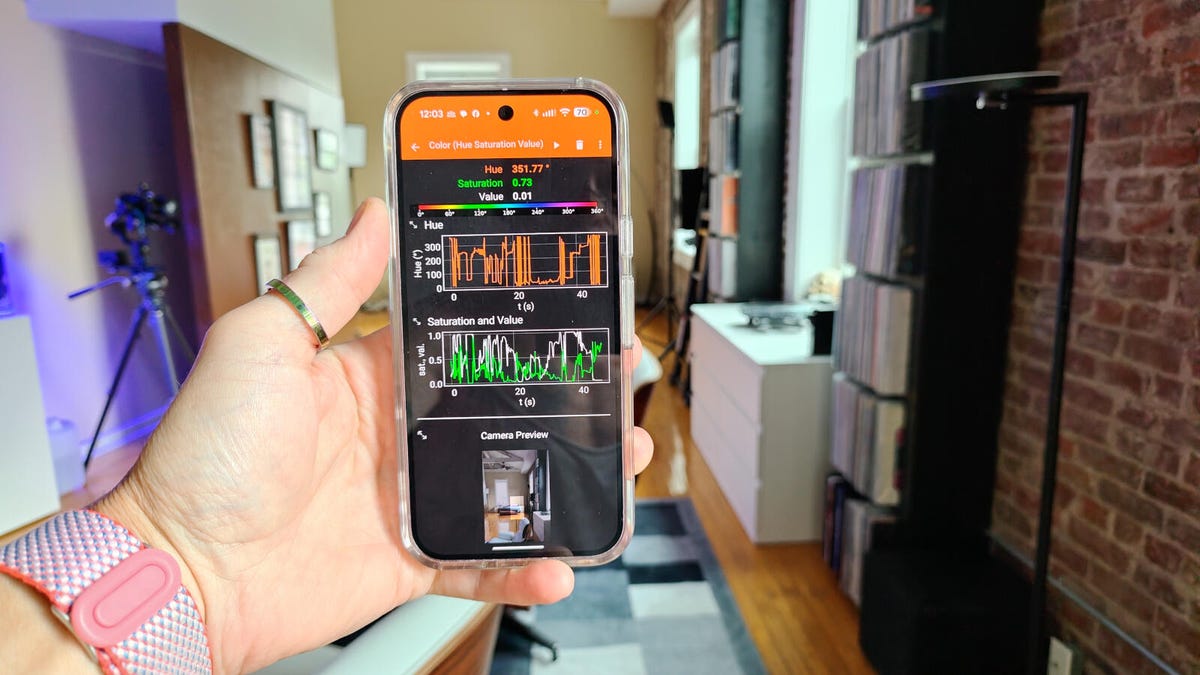
I also realized the app would let me log the Hue, Saturation, and Value of any color. Armed with that data, I could pinpoint the precise shade I wanted for the walls in my new condo.
Need to paint my walls soon.
Screenshot by Jack Wallen/ZDNET
On the hunt for experiments
Honestly, this app is captivating on so many levels, and the range of experiments you can conduct is virtually limitless. Want to gauge the magnetic field strength of your microwave? Phyphox has you covered.
After I installed Phyphox, I found myself actively seeking out new experiments to try. For example, I wanted to compare the magnetic field intensity produced by different devices, so I launched the Magnetometer, initiated the measurement, and held my phone up to various pieces of equipment.
Also: Two new Android 16 security features offer better protection — here’s how to enable them now
I was curious about how the three pickups on my Steinberger guitar compared. Unsurprisingly, the neck and bridge pickups proved significantly stronger than the middle pickup.
I had a hunch which pickups were strongest, but now I have proof.
Screenshot by Jack WallenZDNET
All told, Phyphox offers 35 distinct tests you can run. There are even four different stopwatch modes (acoustic, motion, optical, and proximity), giving you an extraordinary degree of versatility.
Also: This free Android launcher transformed my phone and tablet to look like Windows 11 — here’s how
You can also launch the Audio Spectrum tool to identify the peak frequency, the corresponding musical note, and the cents deviation from those notes (a logarithmic unit used for measuring musical intervals).
An indispensable resource
It would take hours to describe everything Phyphox is capable of, given its vast range of features, and using the app is fairly straightforward (provided you understand what each tool does and what results you’re aiming for).
If you have a passion for experimentation, you’ll absolutely love this app. I wasn’t entirely sure what to expect after installing it, but once I started exploring Phyphox, I found it so compelling that I kept coming back to it again and again.
If you’re someone who enjoys scientific instruments, loves experimenting with different concepts, or simply has a curiosity that ordinary apps can’t fulfill, Phyphox is precisely the tool you’ve been looking for.
Also: How to clear your Android phone cache — the 30-second routine every user should be doing
Take my word for it — you’ll come to see Phyphox as an indispensable resource not just for your experiments, but for so much more.
You can download this free, user-friendly app directly from the Google Play Store. Even if you never use it for formal experimentation, it’s genuinely eye-opening to witness just how much information your phone can gather. That sheer potential alone makes it well worth the (zero) cost of entry.
