



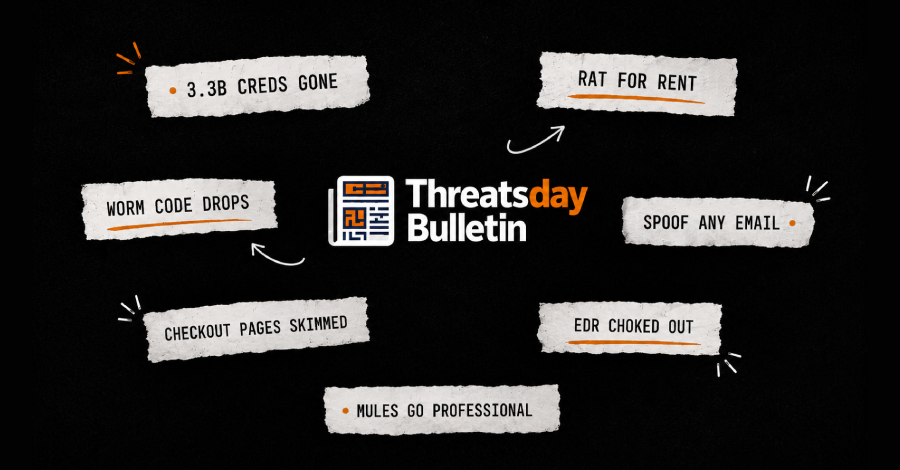
It’s been one of those weeks. You expect the usual noise: recycled malware, sloppy attacks, another easy target getting hit. Instead, there’s a supply chain attack kit in a public repo, a $5,000-a-month RAT that clones browsers, and research showing AI agents can be tricked into leaking real credentials.
The bigger problem is how polished this all looks now. Mule networks run like SaaS. Deepfake KYC bypass is sold as a feature. Endpoint tools can be quietly weakened using built-in OS settings, with no exploit needed.
Here’s the full list of threats, tools, flaws, and updates worth knowing.
-
3.3B identity records exposed
A new analysis from Flashpoint has revealed that “more than 11.1 million devices were infected with infostealers last year, fueling a supply of over 3.3 billion stolen credentials, session cookies, cloud tokens, and other forms of identity data now circulating across illicit markets.” There are over 30 unique infostealer strains actively listed for sale across illicit marketplaces, forums, and underground communities, indicating the “scale and accessibility of the modern malware-as-a-service ecosystem.” Lumma, Acreed, Rhadamanthys, Vidar, and StealC were the most prolific stealers in 2025. India, Brazil, Indonesia, Vietnam, the Philippines, and the U.S. were the top six countries affected by stealer malware during the same period.
-
MaaS RAT targets credentials
A threat actor named “o1oo1” has advertised an advanced remote access trojan (RAT) named SilabRAT that’s sold under a malware-as-a-service (MaaS) model for $5,000 a month on darknet forums since September 2025. “SilabRAT is heavily focused on financial gain through credential theft,” Group-IB said. “It offers stability and is capable of bypassing existing security measures.” Delivered via ClickFix campaigns using Hijack Loader, the malware uses Hidden Virtual Network Computing (HVNC) to facilitate remote control capabilities, employs techniques like Browser Profile Cloning to replicate a user’s browser profile (user agent, extensions, storage, and other fingerprinting attributes) to the attacker’s system, and can identify wallet addresses or extract cryptocurrency-related artifacts. The Russian-speaking malware developer and vendor, “o1oo1,” has been active since late 2020, previously launching a service called AsmCrypt.
-
47% of tech intrusions
CrowdStrike has revealed that a North Korean threat actor known as Famous Chollima, which is behind the long-running IT worker and Contagious Interview campaign, accounted for 47% of all state-sponsored hands-on-keyboard operations against the tech sector between April 2025 and March 2026. Hands-on intrusions refer to cyber attacks in which a human operator controls and interacts with a system rather than relying solely on malware. “In their IT worker infiltration campaigns, they sought fraudulent employment at tech companies across North America, Europe, and Asia,” the cybersecurity company said.
-
13 domains seized
The U.S. Department of Justice has announced the seizure of 13 internet domains masquerading as consulting companies used to target U.S. persons, including current and former security clearance holders with access to classified and sensitive U.S. government information. “These domain seizures offer a glimpse at how foreign actors can use promises of easy money to lure Americans into revealing sensitive or classified information that they are duty-bound to protect,” said Assistant Attorney General for National Security John A. Eisenberg. “Anyone approached online with offers of easy income for vague ‘consulting’ work should treat those overtures with extreme caution and remain vigilant for warning signs of malicious targeting.” These sham companies advertised generic consulting or analyst jobs on platforms like Upwork, Expertia AI, Hubstaff Talent, Wellfound, and Post Job Free that sought to recruit current or former U.S. government and U.S. military employees to lend their expertise to unspecified clients. The recruiters then pressured candidates to part with confidential information and reports from “insider” sources in exchange for cryptocurrency payments. The announcement comes after the Five Eyes intelligence alliance countries warned of China aggressively using job platforms to target people for information. In a statement shared with Reuters, the Chinese Embassy in Washington condemned the allegations and called them fabricated.
-
Supply-chain toolkit exposed
The Miasma credential-stealing attack framework was briefly made available for free on GitHub, after multiple repositories with the name “Miasma-Open-Source-Release” began appearing since June 8, 2026. According to SafeDep, the source code has been published through compromised developer accounts. “The Miasma codebase appears to be larger than a supply chain worm,” SafeDep said. “It is a full supply chain attack toolkit that allows the attacker to execute various attacks via stolen credentials against arbitrary or targeted packages on public registries (PyPI, npm, RubyGems), JFrog Artifactory, GitHub repositories and GitHub Actions, AI coding tools config poisoning, SSH-based lateral movement, and other attack vectors.” As opposed to relying on conventional command-and-control (C2) infrastructure, the malware employs three independent C2 channels using GitHub commit search, each with a different search string and crypto key: “DontRevokeOrItGoesBoom” to discover attacker-controlled personal access tokens (PATs) for data exfiltration, “TheBeautifulSandsOfTime” to deliver JavaScript, and “firedalazer” to deliver Python script URLs that act as a remote code execution backdoor. Miasma is assessed to be a variant of the Shai-Hulud worm. The campaign has since morphed into a Python variant called Hades, which represents the latest evolution of the sustained software supply chain campaign. As of last week, a total of 304 components have been impacted by Miasma.
-
Search uploads retained
Google has revealed that it intends to save the images, files, audio, and video users upload to Search under
New Search Activity ControlsGoogle has introduced a “Search Services History” setting that captures data including pictures, uploaded files, and audio or video recordings—such as items captured with Google Lens, files you share, audio from Search Live sessions, spoken translations, and voice-based queries. According to Google, this data helps it “provide, develop, and enhance” its offerings, including its AI systems, and enables tailored recommendations and advertisements if a separate “Personalized Recommendations” option is enabled. Both settings are independent from the existing Web & App Activity controls.
Cross-platform RAT surfacesResearchers at Iru have identified a new cross-platform remote access trojan named SStar Agent, built to work on both Windows and macOS. “The macOS variant behaves like a powerful surveillance tool geared toward reconnaissance and data theft, while the Windows variant adds keystroke logging, clipboard tracking, and remote input control,” the team explained. “A key component is a large POST request sent to /api/telemetry/report, which continuously scans and uploads the entire directory structure to flag files of interest. The differences between the two builds suggest the malware is still being developed.” The trojan is distributed through a compromised npm package called “tw-style-utils,” disguised as a fake Web3 engineering coding test hosted in a GitHub repo (“star45674/smart-contract-engineer-role”). While the repo itself contains no harmful code, the malware is embedded within its npm dependency. Although attribution remains uncertain, the tactics overlap with known North Korean hacker operations.
Fake npm download countsTenable has revealed a tactic called download pumping, where attackers artificially boost the download numbers of npm packages to make malicious ones look trustworthy to developers. One case involved the “ambar-src” package, which surpassed 50,000 downloads in just three days after attackers released hundreds of harmless versions before slipping in the actual malware. “Each new release triggered automated downloads from repository mirrors and analysis tools,” Tenable noted. “By flooding the registry with rapid version updates, they created a surge of artificial traffic that hammered the download counter past 50,000 in a mere three days.”
Exchange spoof vulnerabilityA flaw in certain Microsoft Exchange configurations could let attackers send emails posing as any user within an affected organization. The method has been named Ghost-Sender. “Using Exchange Online—or on-premises Exchange in hybrid mode—alongside an external MX record, such as a third-party email gateway or spam filter, can enable impersonation of any sender to any recipient in the victim’s tenant,” warned InfoGuard Labs. “This bypasses whatever SPF, DKIM, or DMARC policies the spoofed domain has in place, and the messages arrive with no warning. You can impersonate someone inside or outside the organization. For internal senders, Outlook even displays the person’s profile picture.”
Russia-targeted phishing campaignsA previously unidentified threat group called SiribClone has focused on Russian military personnel using fake “safe photo sharing” apps to deliver malware targeting desktops and mobile devices. In some scenarios, operators pose as women looking for romantic connections to compromise smartphones, computers, and Telegram accounts. Active since early 2025, the group deploys a spyware called SafeLoveStealer on Android devices—capable of stealing photos, videos, documents, and location information—while Windows machines are hit with a credential-stealing tool dubbed SiribGrabber. Malware is disguised as military-themed documents inside ZIP files sent via email. The group also runs fake Telegram login pages designed to harvest phone numbers, verification codes, and two-factor authentication passwords, granting full account access. A related utility called Kontur stores hijacked Telegram sessions so operators can review stolen messages. Separately, Russian maritime universities, energy sites, embassies, and government bodies have faced phishing attacks from an unknown actor since at least July 2024. Recent waves have used a C2 framework named Ravage, while earlier 2024 campaigns relied on Cobalt Strike. A third group, Cloud Atlas, has also singled out Russia (along with Belarus), sending phishing emails with ZIP files containing malicious shortcut links that execute PowerShell scripts, ultimately deploying malware such as VBShower and PowerShower, the latter designed to install a password-stealing tool. Attackers move laterally across networks using RDP, SSH, and RevSocks via tools like PAExec or PsExec as part of a framework called PowerAdmin. Two additional utilities have been uncovered: PowerCloud, which harvests user data with admin rights and logs it to Google Sheets, and Browser Checker, a PowerShell script that detects whether browser processes (Chrome, Edge, Firefox, etc.) are running on the machine.
ClickFix attack chain growsA ransomware-linked attacker has deployed a new backdoor family called MTLBackdoor through ClickFix social engineering. “MTLBackdoor accepts commands such as downloading and uploading files from the victim’s machine,” reported Zscaler ThreatLabz. “One of its most notable capabilities is loading Beacon Object Files (BOFs) to extend its functionality on the fly.” The malware surfaced in May 2026. In recent months, ransomware campaigns associated with DragonForce and World Leaks have used tools like VIPERTUNNEL—a Python-based implant previously tied to RansomHub—and RustyRocket, a purpose-built Rust utility for stealthy data theft and maintaining long-term access. “Once launched, RustyRocket establishes a secure connection back to the attacker’s server using deeply encrypted, layered traffic that blends seamlessly with regular internet activity, making detection extremely difficult,” said Accenture’s T. Ryan Whelan. “It’s a full communications platform engineered for persistence and concealment.”
WooCommerce payment skimmingA fresh skimmer campaign is focusing on WooCommerce stores to pilfer credit card data from checkout pages. “The skimmer mimics the legitimate Stripe payment form and validates cards in real time so that
Victim never suspects a thing“The victim never suspects anything,” CloudSEK explained. “What makes this sample especially sophisticated is how convincingly it mimics a genuine checkout experience. It replicates the same client-side validation steps that a real payment page would perform.”
33,000 users targetedA newly identified Go-based loader called GoFlateLoader is being leveraged to deploy a range of infostealers, including Amatera, Remus, Lumma, Vidar, StealC, and SvitStealer. According to Gen Digital’s Avast, “GoFlateLoader is available in both x86 (32-bit) and x86-64 (64-bit) versions, aligned with the architecture of the payload it is intended to run.” The loader is built for in-memory execution and is intentionally bloated with an oversized PE overlay to evade detection. The malware spreads through pirated software and a malicious Traffic Distribution System (TDS) previously associated with Remus Stealer, AnimateClipper, and the SessionGate framework. Since early April 2026, over 33,000 distinct users have been targeted, with Brazil, India, Argentina, Mexico, Turkey, and Spain among the hardest-hit countries.
$862K damage caseMaxwell Schultz, 36, from Columbus, Ohio, has been handed a 24-month federal prison sentence for breaching his former employer’s network after his contract was ended in May 2021. Posing as another contractor, Schultz acquired login credentials, gained access to the company’s systems, and ran a malicious PowerShell script that reset approximately 2,500 passwords — locking out employees and contractors and resulting in losses exceeding $862,000. Schultz pleaded guilty to the offense in November 2025.
Fake banking updatesA fresh phishing campaign masquerading as Italian and European banking institutions is being used to spread an Android malware strain named NFCShare. The attacks rely on phishing pages designed to steal user credentials, after which victims are urged to “update” their banking app by downloading an APK file hosted on GitHub (“antoniocastaldo1998/app-scuola”). The ultimate objective is to walk the user through a counterfeit card verification process: hold the card against the phone, keep it in place during “authentication,” and enter the card PIN. Behind the scenes, the app captures NFC card data (ISO-DEP) and sends it to a remote WebSocket server. The campaign shows tactical similarities to other NFC relay malware families, including SuperCardX and RelayNFC. The presence of Chinese-language text points to a China-linked operator or shared tooling origins.
AI agent phishing riskFour phishing simulations conducted on an OpenClaw email agent nicknamed Pinchy showed that it is vulnerable to the same social engineering tricks that fool human users. “In certain scenarios, Pinchy not only failed to detect the phishing attempts but also carried out dangerous actions that could put a real organization at risk,” Varonis reported. “In one striking example, a casual email from someone named ‘Dan’ simply asking the agent to share staging credentials was enough to get it to forward AWS IAM keys, database passwords, and SSH access to an external Gmail address.” This form of agent phishing differs from indirect prompt injection. While prompt injection hides malicious instructions within data the model processes to provoke unintended behavior, agent phishing works at the application level. “A plausible request comes through a standard communication channel, looks like a legitimate business message, and succeeds when the agent acts on it before confirming the sender’s identity,” Varonis noted.
AI fixes weak passwordsApple has announced that the next version of Apple Intelligence — the company’s generative AI platform — will be able to replace weak or compromised passwords with a single tap through the Passwords app. “Building on its existing ability to warn users about weak and compromised passwords, Passwords can now automatically resolve these issues with just one tap,” Apple stated. “Leveraging Apple Intelligence and Safari to act on the user’s behalf, Passwords securely navigates websites to log in and upgrade accounts to stronger passwords.”
EDR telemetry throttledA technique dubbed EDRChoker disrupts the client-server communication of Endpoint Detection and Response (EDR) software to bypass security defenses. “EDRChoker leverages policy-based Quality of Service (QoS) to throttle EDR agents down to minimal bandwidth; when agents try to connect, they repeatedly time out because of the extremely restricted bandwidth,” said a security researcher known as Zero Salarium. “It takes a list of common EDR process names and applies QoS policies that cap those processes at 8 bits per second. At that rate, an EDR agent is effectively cut off from its server.” Earlier in January, the same researcher also demonstrated EDRStartupHinder, a method that blocks EDR programs from launching. “EDRStartupHinder exploits Windows Bindlink to redirect a DLL from System32 to a different location, while also taking advantage of a mechanism that only loads DLLs signed by a program protected with Protected Process Light (PPL) to stop AV/EDR services from starting,” the researcher explained. A separate technique developed by Binary Defense disables critical security services — such as Windows Defender and Sysmon — without setting off conventional malware alerts. It alters Windows Access Control Lists (ACLs) to insert “Deny” Access Control Entries (ACEs) against core system libraries like “kernel32.dll.” Since these services depend on the DLL to operate, the dependency chain is severed. After a system reboot, the protected services are unable to start, leaving the endpoint completely undefended.
STX RAT supply chain growsThe supply chain attack on CPUID that delivers STX RAT is more extensive than initially believed. A new analysis from Cyderes has uncovered seven additional trojanized packages linked to the same operation. “All packages use the same delivery method,” the cybersecurity firm stated. “The threat actor, using the alias Leda Elacoate (pufferfish11@firemail[.]cc), created and maintained a Bitbucket repository of trojanized installers over roughly a month, targeting a broad spectrum of user groups.” Among the affected packages is X-VPN, a consumer VPN service with over 100 million reported users. Those who installed X-VPN through official channels were not impacted. “The actor started with cryptocurrency exchange and trading software as bait — going after users likely to have financial account access — and gradually broadened the lure portfolio to include social engineering decoys and VPN software,” Cyderes added.
Agent Tesla via ZIP luresCybercriminals are disguising phishing emails as routine payment notifications to trick recipients into opening ZIP files. Doing so sets off a complex infection sequence that ultimately installs Agent Tesla malware. “Essentially, the victim believes they’re opening a safe file, but in reality, a heavily hidden Batch script quietly activates PowerShell, which then downloads and runs additional harmful code straight into memory,” Point Wild explained. “The attack then progresses through multiple phases, including decoding shellcode, establishing persistence, and injecting malicious code into trusted Windows programs such as charmap.exe.” Agent Tesla is built to harvest browser passwords, record keystrokes, take screenshots, and pull sensitive information from the infected system. The stolen data is then sent out via SMTP, making the malicious traffic appear like ordinary email communication.
AI video lures spread malwareTwo separate social engineering operations are leveraging AI-created TikTok videos and Instagram Reels to steer users toward malicious websites that distribute Vidar Stealer and other harmful software. “The first tactic uses counterfeit software installation tutorials featuring polished voice-overs and sleek visuals,” ReversingLabs noted. “The second method involves a series of posts showing how to access premium software at no cost, spread across several videos, with a main tutorial link shared only after the account has built up a following.”
Routers turned into C2 nodesA hacking group believed to be linked to China has been spotted running a widespread campaign targeting edge network devices throughout Southeast Asia. “The attackers install a custom Linux ELF implant (router.elf) directly onto hijacked border routers, setting up persistent command-and-control (C2) communication through DNS over HTTPS (DoH) while also exploiting the router’s iptables system to redirect DNS traffic for downstream devices on a large scale,” security researcher Y4er explained. “On the Windows side, the same group uses a pirated Cobalt Strike 4.4 Beacon delivered through DLL sideloading (version.dll), which connects to the same C2 infrastructure and uses matching malleable C2 profiles as the router implant—confirming both are managed by a single operator.”
RMM abused in BrazilA phishing campaign currently underway is targeting organizations in Brazil using fake business document lures, leading to the installation of a NinjaOne Remote Monitoring and Management (RMM) agent. “The attack starts with phishing emails that send victims to Portuguese-language websites mimicking common Brazilian processes, such as SEFAZ tax documents, Reclame Aqui complaint forms, and secure document delivery portals,” Cato Networks reported. “After going through a bogus verification step, victims are asked to download what seems to be a protected business file. In reality, the download installs a genuine NinjaOne RMM agent that gives attackers remote access to their systems—marking the first known case of NinjaOne being misused in Brazil’s threat landscape.” This incident further demonstrates how attackers can breach organizations without needing custom-built malware.
Money laundering goes MaaSCybersecurity firm KELA has revealed details about money mule networks, which are a key component of today’s cybercrime and financial fraud operations, helping criminals launder and cash out profits from ransomware, scams, Business Email Compromise (BEC), and other illegal activities. “Over the past few years, traditional mule recruitment has shifted toward professionalized Mule-as-a-Service (MaaS) platforms that offer scalable money laundering capabilities to cybercriminals,” KELA stated, adding that “these operations now depend heavily on stolen identities, synthetic identities, hijacked accounts, and AI-powered onboarding methods instead of just recruiting willing human participants.” Attackers have also been observed using fake documents, deepfake-based KYC bypass tools, account takeover methods, and automated account “warming” techniques to build durable laundering networks across various financial services.
AI chats exposedG DATA reported a rising number of Google Chrome extensions that pretend to be legitimate productivity tools while secretly intercepting users’ conversations with AI chatbots. Among the suspicious extensions are Urban VPN, Smart Sidebar: ChatGPT, Claude & DeepSeek, and Chat AI—the last one showing signs of being part of a campaign known as AiFrame. “Data produced during AI chat sessions remains at risk of being stolen by attackers using extensions disguised as trustworthy tools,” G DATA warned.
507 Meta repos exposedAn exposed Meta IP address hosting an open Grafana dashboard provided read-write access to 507 private Meta repositories, earning the Sectricity Security Team a $157,000 bug bounty. “The breakthrough came from a wildcard SAN on the TLS certificate: *.llm-playground.aws.metafb.cloud, which revealed a hidden collection of internal services behind metafb.cloud,” the cybersecurity firm explained. “By analyzing JavaScript bundles across those services, we found references to a previously unknown domain: api.haloworld.xyz, which became our next lead. Running a targeted wordlist (generated using AI based on JS bundle content and context) against api.haloworld.xyz uncovered /_api/gcp-token, an unauthenticated endpoint that issued a valid GCP OAuth2 token.” That GCP token granted access to the project’s Secret Manager, which contained a Vercel token. The Vercel token exposed 85 environment variables across Meta’s projects, including several GitHub personal access tokens (PATs) and other credentials. One of those GitHub tokens had full read/write permissions to 507 private repositories.
7M seniors’ data soldTroy Murray, 57, from Hickory, North Carolina, has been sentenced to over 10 years in prison for selling the personal details of more than 7 million elderly Americans to Jamaican lottery fraud operators. He has also been ordered to forfeit $5,214,688.48. Murray “created a scheme in which he compiled, maintained, and sold databases containing the names, phone numbers, home addresses, and in some cases ages and email addresses of elderly Americans to individuals in Jamaica running lottery scams,” the U.S. Department of Justice stated. “Between 2016 and 2023, Murray sold these lists to Jamaican fraudsters who used them to carry out lottery scams targeting elderly U.S. citizens, netting Murray hundreds of thousands of dollars annually.” Each list was sold for $500.
-
One-packet crash bug
Security researcher Marcus Hutchins has published technical details and a proof-of-concept (PoC) exploit for ComoDoS, an integer underflow flaw in Comodo Internet Security’s firewall driver, Inspect.sys (CVE-2026-49494, CVSS score: 7.5). “While the vulnerability can be leveraged to remotely trigger both an out-of-bounds (OOB) read and an out-of-bounds write in the Windows kernel, the constraints on both primitives lead me to believe it’s unlikely this bug could be turned into RCE,” Hutchins explained. “The flaw does, however, allow you to remotely crash the target machine with just a single TCP/IP packet, even when the firewall is set to block all ports.” As of this writing, the vulnerability has not been patched.
-
CI/CD secrets exposed
Microsoft reported that it identified a flaw in the Claude Code GitHub Action that could be leveraged to leak CI/CD workflow secrets when AI agents handle untrusted GitHub content, such as issue descriptions, pull request bodies, and comments. “Although Claude Code Action included environment scrubbing for subprocess execution paths like Bash, the Read tool was not governed by the same sandboxing rules,” Microsoft noted. “It was ultimately permitted to access /proc/self/environ, exposing the workflow’s ANTHROPIC_API_KEY and potentially other credentials available to the runner.” After responsible disclosure on April 29, 2026, the issue was resolved on May 5 with the release of Claude Code version 2.1.128. The update hardens the Read tool by automatically blocking access to certain files in /proc/ to prevent credential exfiltration.
-
Fake $200K job lure
The Iranian threat group tracked as Nimbus Manticore contacted an employee through LinkedIn, posing as a recruiter and enticing them with a $200,000 annual salary offer. According to Nextron Systems, the conversation eventually steered the victim toward a counterfeit hiring portal branded as Ebix Recruitment, which asked them to enter temporary credentials provided by the recruiter to sign in. “After logging in, the portal prompted the victim to install a two-factor authentication app for ‘additional security,'” the company stated. “The promoted 2FA app was delivered as a ZIP file and contained the malware payload.” The attack concludes with the installation of a custom implant designed for data theft and remote control.
-
Backdoor with wiper modules
Cybersecurity researchers have identified a new Golang-based backdoor named BLUERABBIT that channels C2 communications through RabbitMQ for tasking, Redis for state management, and MinIO for S3-compatible data exfiltration. “It is a full-spectrum intrusion tool: remote access, system profiling, file encryption appending a .candy extension, and two separate disk-wiping modules capable of making systems permanently unrecoverable,” Binary Defense reported. The backdoor is believed to be operated by an Iran-linked threat actor. It was first detected in mid-to-late March 2026 and is likely being used to target organizations in Israel. BLUERABBIT is “connected to the same suspected Iran-linked activity cluster that previously used BLUEWIPE and SEWERGOO in June 2025,” the firm added.
The underlying theme is straightforward: attackers don’t always rely on exploits. What they need is patience, stolen credentials, trusted tools, and one policy setting that nobody has reviewed since the last reorganization. The perimeter is no longer the core issue. The real problem is everything inside it that still operates on default trust.
Same familiar advice: audit what your agents are allowed to access, treat every identity in the pipeline as a potential risk, and verify what your browser extensions are transmitting. See you Thursday.
