



# Introduction
Launching a new business doesn’t require you to seek venture capital right away. A wide range of funding alternatives exist, and the ideal choice largely hinges on the nature of your venture, the progress you’ve made so far, and how much control you wish to retain. Certain funding methods are non-dilutive, meaning you won’t need to surrender any ownership stake. Others provide access to funding, guidance, and investor connections in return for a share of equity. The optimal funding path may also vary based on your startup’s focus. Are you developing a software company, a consumer product, a deep-tech firm, or are you a student entrepreneur?
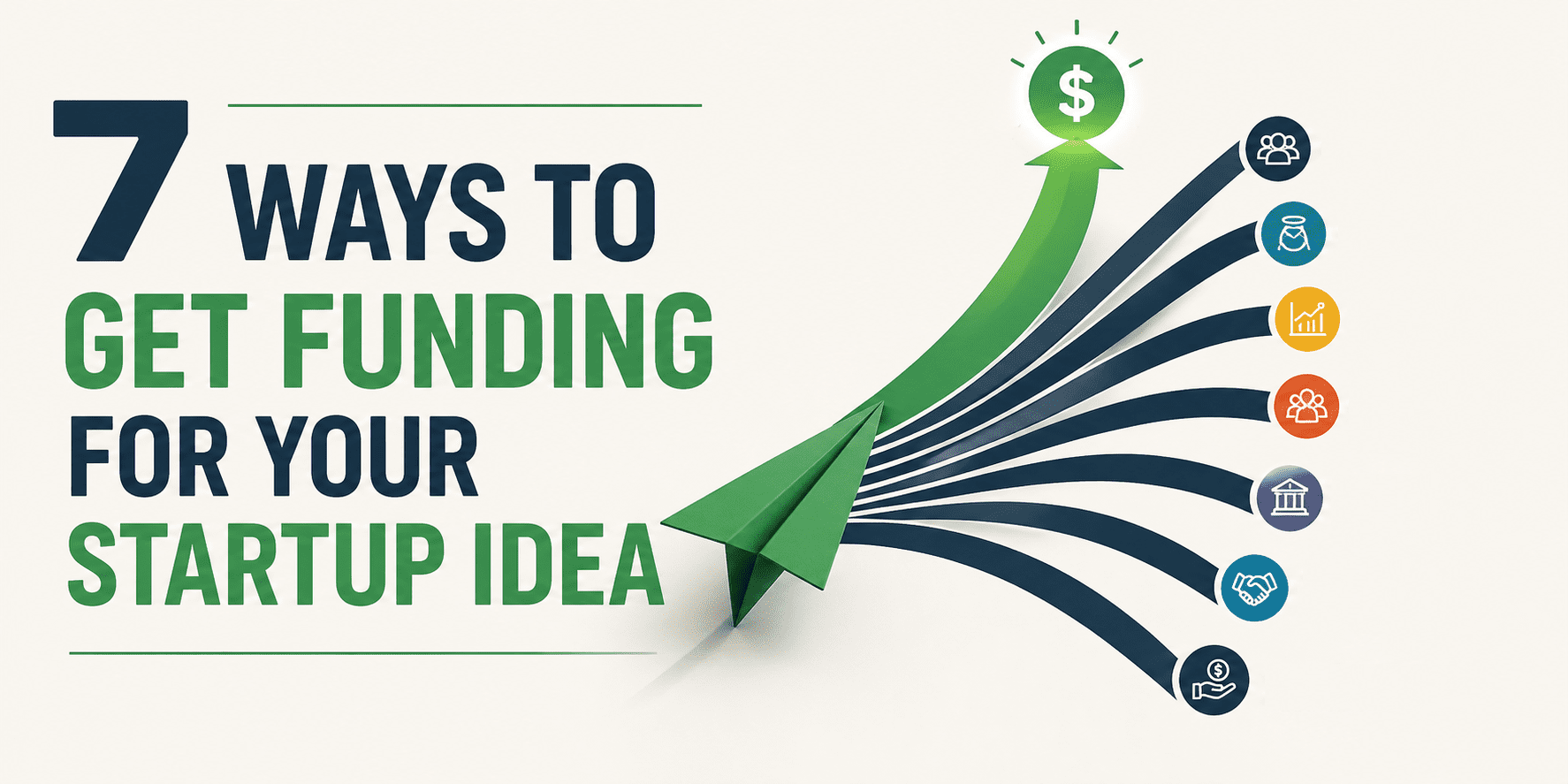
In this guide, we’ll explore 7 top approaches to securing funding for your startup concept. We’ll also discuss the advantages and drawbacks of each method. Let’s dive in.
# 1. Bootstrapping
Bootstrapping essentially means financing your startup on your own. This might involve using personal savings, income from employment, freelance gigs, consulting work, or even early revenue from initial customers. For many entrepreneurs, this is the most straightforward starting point since you don’t need approval from investors and you retain complete ownership. You’re free to develop your vision and progress at your speed. Bootstrapping has also become far more accessible today. AI-powered tools, no-code development platforms, open-source solutions, and complimentary cloud credits have significantly reduced the expense of launching a first version. Begin with something modest, create an initial product iteration, attract some early users or clients, and reinvest that revenue back into the business.
Pros:
- You maintain complete ownership of your company.
- You retain full decision-making authority.
- No pressure from investors.
- You develop strong financial habits from the start.
- You can validate market demand before seeking external funding.
Cons:
- Expansion may happen at a slower pace.
- You bear the financial risk entirely on your own.
- Fewer resources available for recruitment, marketing, or technical infrastructure.
- Can become overwhelming if you’re personally covering all expenses.
# 2. Grants and Non-Dilutive Funding
Grants represent one of the most entrepreneur-friendly avenues for obtaining funding. Typically, you aren’t required to repay the funds, and you won’t need to give up any equity either. They’re particularly valuable for startups operating in fields such as AI, climate technology, education, healthcare, biotech, robotics, or deep tech. The application process is fairly straightforward. You submit an application to a program, and if chosen, you receive financial support to pursue your project. Some grants disburse funds upfront, while others provide reimbursement after you’ve incurred expenses. Therefore, it’s essential to carefully review the conditions before relying on this type of funding.
Pros:
- You preserve all of your equity.
- Repayment is generally not required.
- Ideal for technically complex and research-driven initiatives.
- Enhances credibility when engaging with future investors.
- Can support ventures that are too early-stage for traditional investors.
Cons:
- Preparing applications can be time-consuming.
- Qualification criteria may be restrictive.
- Administrative tasks and reporting obligations can be burdensome.
- Some grants only cover expenses after they’ve been incurred rather than providing advance payment.
# 3. Startup Competitions and Pitch Prizes
Startup competitions offer a solid opportunity to secure initial funding, visibility, and market validation for your concept. These events are frequently organized by academic institutions, innovation hubs, accelerators, and government-supported bodies. Generally, you’ll need to submit an application, a pitch deck, and occasionally a working demo of your product. If you’re selected to advance, you’ll present your startup to a judging panel. Winners may receive cash awards, cloud computing credits, mentorship, workspace, or connections to potential investors. In many instances, the prize money is non-dilutive, meaning no equity needs to be surrendered.
Pros:
- Typically non-dilutive in nature.
- Accessible to very early-stage ventures.
- Excellent opportunity to refine your pitching skills.
- Can open doors to mentors, investors, and prospective customers.
Cons:
- Award amounts are often modest.
- The competition process can be lengthy.
- Winning doesn’t guarantee customer adoption.
- It’s easy to invest excessive time in pitching rather than product development.
# 4. Accelerators and Incubators
Accelerators and incubators assist startups in accelerating growth by offering resources such as mentorship, funding, and connections to investors and fellow entrepreneurs. The primary distinction is straightforward. Accelerators operate on a short, structured timeline, whereas incubators provide a more adaptable, extended engagement. Upon acceptance, you join a cohort of fellow startups and dedicate time to refining your product, pitch, and overall business strategy. Some programs provide funding in exchange for equity, while others don’t require any ownership stake. Y Combinator and Techstars are two well-known examples that also facilitate investor connections and help founders scale more rapidly.
Pros:
- Significant boost to your startup’s credibility.
- Guidance from seasoned mentors.
- Smoother pathways to investor introductions.
- Organized support and structured accountability.
- Particularly beneficial for first-time entrepreneurs.
- Strong community of fellow founders.
Cons:
- Admission is highly competitive.
- Can demand a substantial time investment.
- Some programs require equity in exchange for participation.
# 5. Angel Investors
Angel investors are typically the first external funding source many startups turn to. These are individuals who invest personal funds into early-stage companies, often before venture capitalists are ready to participate. Beyond capital, experienced angels can also assist with networking, recruitment, customer acquisition, and strategic advice drawn from their own entrepreneurial journeys. Angel investors generally participate through SAFEs, convertible notes, or direct equity investments. Investment amounts can vary significantly. Some angels may contribute a few thousand dollars, while others are capable of making substantially larger investments. Most founders connect with angels through personal networks, industry events, accelerator programs, or referrals from other entrepreneurs.
Pros:
- Suitable choice for pre-seed and seed-stage companies.
- Typically faster to secure than VC funding.
- Can offer valuable guidance and networking opportunities.
- More adaptable than institutional investors.
Cons:
- The caliber of angel investors varies widely.
- Some investors contribute only capital without additional support.
- Securing funds from numerous small angels can complicate your cap table.
- You’re still relinquishing a share of future ownership.
# 6. Venture Capital
Venture capital is likely the first funding option that comes to mind when people think about startups. However, the truth isn’t that VC suits every type of business. VC firms seek startups capable of rapid growth with the potential to become very large enterprises. If you’re operating in a sizable market with strong potential for fast scaling, venture capital could be a good fit. They provide funding in exchange for an ownership stake in your company. Investment typically occurs in phases such as pre-seed, seed, Series A, Series B, and subsequent rounds. Early-stage funding is often structured through SAFEs or convertible notes, while later rounds usually involve priced equity rounds.
This is the stage at which a company gets a formal valuation. The process typically involves presenting to potential investors, providing key metrics, responding to due diligence inquiries, and working out terms.
Benefits:
- Provides access to substantial capital.
- Enables much faster scaling of the business.
- Supports hiring and overall growth.
- Well-known investors can enhance credibility.
- Opens doors to investor networks and valuable partnerships.
- Suitable for large markets where speed is critical.
Drawbacks:
- You sacrifice some ownership in the company.
- Investors anticipate rapid, strong growth.
- Raising funds can take several months.
- Suitable for only a small number of businesses.
- Major decisions may no longer be entirely in your hands.
# Crowdfunding (Approach #7)
Crowdfunding allows you to raise money from many people online rather than from a small number of investors. There are two primary types. Reward-based crowdfunding involves supporters contributing in exchange for a product or reward. Equity crowdfunding involves people investing in your business in exchange for a share of ownership. With reward-based campaigns, you set up a page detailing your product, include images or videos, and set a funding target. Supporters typically pre-order the product. With equity crowdfunding, individuals invest through a platform and become partial owners of the business.
Benefits:
- Allows you to test real market demand with actual customers.
- Helps build a community of supporters before your launch.
- Works well for consumer-focused products.
- Can attract media attention and create momentum.
- Reward-based crowdfunding usually does not dilute ownership.
Drawbacks:
- Demands significant marketing effort to succeed.
- Unsuccessful campaigns are visible to everyone.
- Fulfilling product deliveries can be difficult, particularly for physical goods.
- Equity crowdfunding involves legal and regulatory requirements.
- Generally not ideal for most B2B startups.
# Final Thoughts
The reality is that no single funding option is the best fit for every startup. The right choice depends on your current stage and what you aim to achieve next.
- If maintaining control matters most → consider bootstrapping, grants, and competitions.
- If speed is the priority → look into accelerators, angel investors, and venture capital.
- If you are targeting consumers → crowdfunding can also be a valuable tool.
The best funding is not about securing the largest possible cheque. It is the option that helps you advance to the next stage without losing focus or giving up too much ownership. Also, always review the latest regulations before applying, since funding programs are frequently updated.
Kanwal Mehreen is a machine learning engineer and technical writer with a deep passion for data science and the intersection of AI and medicine. She co-authored the ebook “Maximizing Productivity with ChatGPT”. As a 2022 Google Generation Scholar for APAC, she champions diversity and academic excellence. She is also recognized as a Teradata Diversity in Tech Scholar, Mitacs Globalink Research Scholar, and Harvard WeCode Scholar. Kanwal is a passionate advocate for change, having founded FEMCodes to empower women in STEM fields.
