



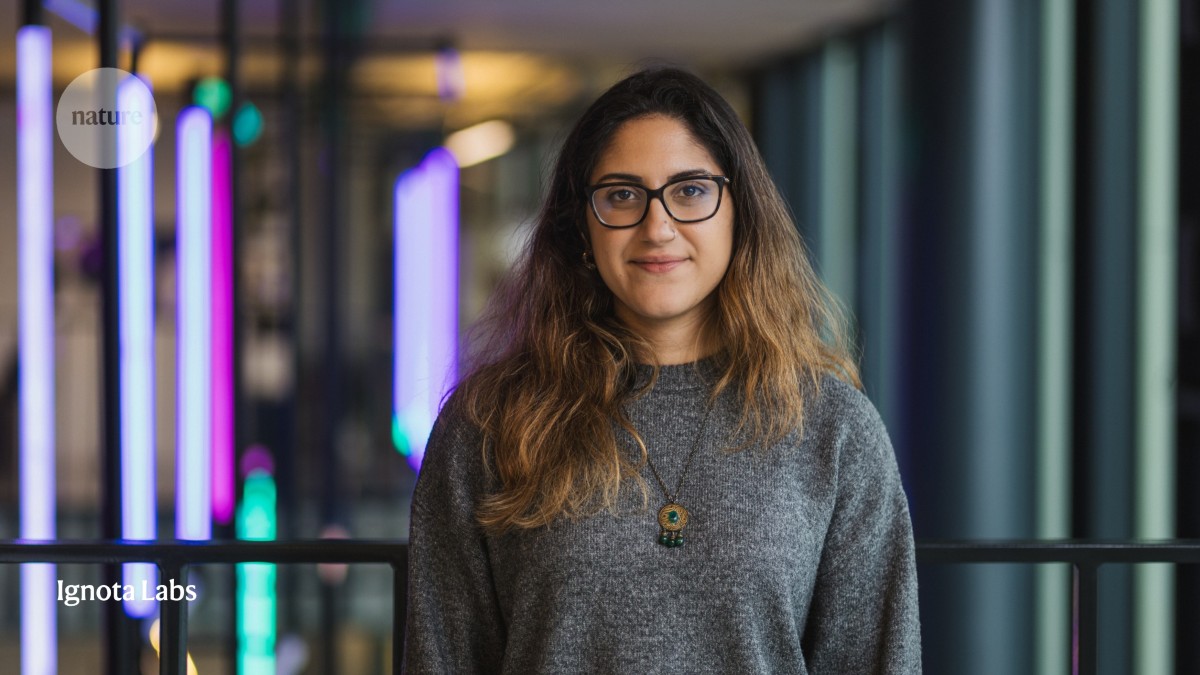
Layla Hosseini-Gerami draws on her background in chemistry and bioinformatics to help identify failed drugs and fix issues around their toxicity.Credit: Ignota Labs
Ignota Labs, a Cambridge-based startup, leverages artificial intelligence to figure out why certain drugs have stumbled in clinical trials, then re-engineers the most viable candidates to give them a second chance at reaching patients.
Founded in 2021 by Layla Hosseini-Gerami, Jordan Lane, and Sam Windsor, the company secured $6.9 million in funding in February 2025. Since then, it has assembled a robust pipeline of promising therapies, including treatments targeting autoimmune disorders and blood cancers.
Hosseini-Gerami, who serves as the company’s chief data-science officer, brings together expertise in chemistry, bioinformatics, and data science to unravel how drugs interact with the body. In April 2025, she was named to Forbes magazine’s ’30 Under 30′ list for European science and health care, recognized for her work harnessing AI to speed the delivery of safe medicines to patients. Here, she shares the story of how the company — and her place in it — came to be.
When did you first get interested in AI?
During my undergraduate chemistry studies at the University of Leeds, UK, from 2014 to 2018, there were no AI courses available. At that point, AI was already making waves across many sectors but was still in its early stages. My first real encounter with AI came in 2016, during a year-long industrial placement as a machine-learning intern at Optibrium, a drug-discovery software firm in Cambridge.
Nature Spotlight: Drug discovery
At Optibrium, I developed models to forecast the molecular characteristics of various drug compounds. My particular focus was on pKa — a measure of a molecule’s acidity — which affects a compound’s solubility, permeability, and capacity to bind to its intended target. The experience of building these models and then watching them get integrated into software used by pharmaceutical professionals inspired me to stay in the field and pursue doctoral research.
Nearing the end of my time at Optibrium, I contacted Andreas Bender, a molecular informatician now at Khalifa University in Abu Dhabi, who went on to become my PhD supervisor at the University of Cambridge. I had been exploring various research groups, but what drew me to him was his emphasis on scientific rigour and building AI that genuinely moves the needle in pharmaceutical drug discovery. In this field, many compounds gain approval based on clinical efficacy alone, without researchers fully grasping their mechanism of action — such as which proteins they target or which biological pathways they influence. I created computational methods designed to close that gap, pinpointing the biological targets and pathways responsible for a drug’s therapeutic benefit.
Back then — roughly a decade ago — it genuinely felt like we were among the trailblazers working at the intersection of AI and science, because AI-driven drug discovery hadn’t yet captured the level of attention it commands today. Since that time, the field has advanced rapidly. The persistent challenge remains how to harness AI to tackle questions about biology and how drugs behave inside the body, which can be inherently variable and hard to predict.
How was Ignota Labs founded?
As I was wrapping up my PhD, I received a LinkedIn message from Lane, someone I hadn’t met before. He had previously served as principal scientist at BenevolentAI, an AI-driven drug-discovery company, and had accumulated a decade of experience spanning pharmaceutical and AI biotech firms as well as clinical-research organizations. In his message, he explained that he wanted to launch a company centered on drug safety and needed someone to lead the intersection of chemistry, biology, and AI. Windsor, our chief executive, had consulted on projects with Merck and Google DeepMind’s AlphaFold team, as well as digital-transformation initiatives within the NHS, before teaming up with Lane to establish Ignota Labs.
Lane and Windsor had discovered Bender’s research group and read my published papers. At the time, I was finalizing my PhD thesis, which used biological and chemical data to deepen understanding of how drugs work at a mechanistic level. That thesis later earned a 2022 outstanding thesis award from the University of Cambridge’s chemistry department.
Their combined experience gave them a sharp understanding of the field’s inefficiencies and how AI could address them. Millions of pounds are poured into drug development, yet candidates ultimately face less than a 10% probability of success. The process also consumes significant energy and water resources and depends on animal testing. A particularly striking concern for Lane was the failure of drug candidates due to safety issues that are difficult to foresee before animal or first-in-human studies. At that stage, many drugs are simply shelved. He believed my research was ideally suited to tackling this problem.
Ignota Labs was established around the time the biotech boom of 2020–21 came to an end. The downturn was driven by rising interest rates following the COVID-19 pandemic and a broad retreat of venture-capital funding, especially the departure of so-called “investor tourists” — those without a history of investing in a given area — from the life-sciences sector. These dynamics made fundraising considerably more difficult for early-stage biotech companies and raised the bar for what investors expected.
We had to sharpen our strategy and prove both scientific excellence and a viable commercial pathway. Our audience might lack deep knowledge of AI or pharmaceuticals, so we needed to communicate complex ideas in accessible terms. We brought on communications advisors to help with this, and we’ve gotten much better at articulating our mission. We can now also point to our pipeline, our corporate partnerships, and case studies that demonstrate our ability to rescue drugs.
How does Ignota Labs actually work?
We’ve developed an AI-powered platform designed to identify failed drugs and resolve their toxicity problems. The platform first sifts through thousands of failed candidates to surface the most promising ones — drugs with enormous potential to help patients that have run into an unforeseen safety problem, such as liver toxicity. From there, we apply deep learning techniques that integrate bioinformatics, chemoinformatics, and multimodal data to uncover the underlying cause of the safety issue and devise strategies to address it. Our central goal is to take these drugs, make the smallest possible chemical modifications, and return them to clinical testing as quickly as possible. This approach differs from drug repurposing, where the same molecule is simply tested against a different disease without creating new intellectual property or attempting to correct any flaws in the drug.
Examples of issues our technology can detect and address include off-target binding, where drugs attach to unintended molecules; pharmacokinetic problems, such as how quickly a drug is cleared from the body; and distribution issues, like a drug penetrating the brain when it shouldn’t.
The data we work with are extraordinarily complex. They span everything from molecular structure and biochemistry — such as the binding strength between a drug and a protein — all the way to whole-organism responses to a drug. The difficulty lies in connecting all these layers and extracting meaningful insights, which is precisely where AI plays its part. So rather than dealing with different data types in isolation each day, we’re focused on integrating them to generate the insights needed to rescue drugs.
As chief data-science officer — a role I took on in 2022 when we launched the company — I lead the research and development of AI tools that advance our mission of reviving failed drugs. This involves sourcing the data sets that feed our algorithms and overseeing the continued development of our SAFEPATH platform.
