



Follow ZDNET: Add us as a trusted source on Google.
ZDNET’s main takeaways
- PearOS is targeting Apple’s Liquid Glass appearance.
- The distro isn’t yet suitable for everyday users.
- PearOS also provides an Apple Intelligence-inspired experience.
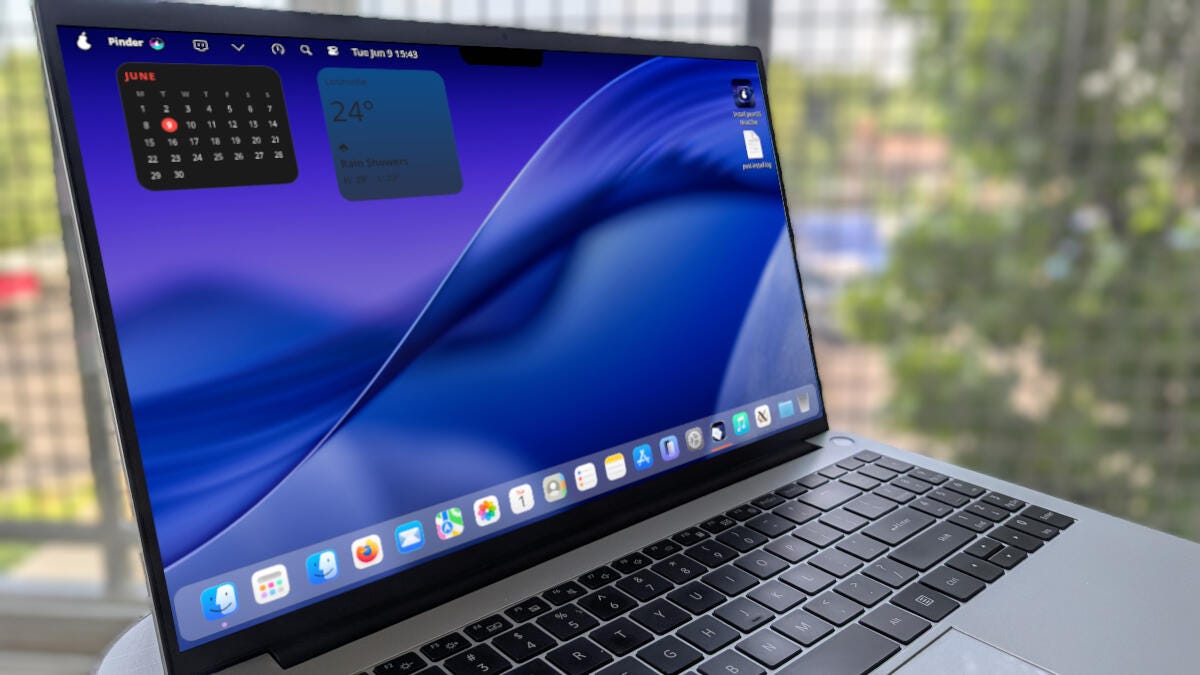
I’ve been tracking PearOS for a while. I previously reviewed PearOS, describing it as a Linux distribution that transforms an outdated laptop into something resembling a Mac.
After that initial review, the developers decided to raise the bar and introduce a Liquid Glass-style aesthetic for the distro. While PearOS still has limitations — the “development team” is just a single individual, so updates come slowly — the newest release features a new foundation, a fresh design, and a complete overhaul.
Also: The top Linux laptops in 2025: Tested by experts for students, hobbyists, and professionals
The newest release still uses Arch Linux and KDE Plasma as its base and continues to promise the upcoming Soda desktop environment, though that component is still marked as “currently unavailable.” This latest version, named NiceCore, has begun incorporating what the developer refers to as a “Liquid Gel” design.
You can view the developer’s progress with Liquid Gel on the official PearOS website. I expected the NiceCore version of PearOS would include some Liquid Gel elements. What I discovered was quite impressive. I’m not entirely sure if NiceCore came with the Soda/Liquid Gel desktop, but I do confirm this release includes the new installer (details on that shortly). I’m not fully convinced what I’m seeing is Liquid Gel, but it’s still a stunning desktop.
The setup
This is where PearOS gets a bit tricky. To be candid, I recall the prior version’s installation being equally challenging. This time, however, the installation simply wouldn’t finish, and I ended up on the default test account (despite having set up a user account). My assumption is this happened because I tried running PearOS inside a virtual machine.
Even more puzzling is that the user I configured during setup was visible. I could see the directory under /home. Yet when I signed out and tried to switch to that user, the system would simply reboot. I could even switch to my user account… but actually logging into the desktop was impossible.
Alright, I’ll attribute this to the new installer used by NiceCore.
The interface
As mentioned, the NiceCore iteration of the PearOS desktop may or may not be Liquid Gel, but it definitely includes elements of it, and let me tell you — it’s visually striking. From the panel to the Notch app (yes, the developer has recreated the MacOS notch), everything looks remarkably like Apple’s design. At the same time, it’s equally unstable. If PearOS were stable in its current form, it would absolutely be a leading candidate to displace Pop!_OS. Unfortunately, that’s not the case, but I went into this review knowing I was dealing with a project still in early development. Even as an unstable release, it left an impression.
Indeed, there’s even a Notch app. It doesn’t function yet, but hopefully the developer will add some capabilities later.
Jack Wallen/ZDNET
One feature of PearOS that surprised me was the built-in Piri tool (Apple’s Siri equivalent), which aims to deliver an Apple Intelligence-style experience on the desktop. By default, Piri is turned off, so you need to activate it and then allow the 2.3GB model to download.
The Pear Intelligence feature should be immediately recognizable.
Jack Wallen/ZDNET
Piri reacts to voice commands and even lets you activate Pear Intelligence (once Piri has been turned on and the model downloaded).
It’s remarkable, even though (like the desktop) it’s still being refined.
Regarding other applications, the built-in software is minimal, so you’d probably end up needing to install several items yourself (like an office suite, image editor, etc). You do receive a keyboard launcher that’s set up for file searching, app launching, basic math, and more.
The PearOS search/launcher is excellent.
Jack Wallen/ZDNET
Additionally, you get the “Parari” web browser, which (curiously) wouldn’t open.
Also: 8 ways I quickly improved my Linux skills – and you can as well
If you access the Pear Menu, you’ll notice the developer has done a fantastic job crafting a refined look and feel, with just the right level of transparency and blur.
The dark theme menu does appear more Liquid Glassy.
Jack Wallen/ZDNET
However, once you toggle to a lighter theme (which I always do), the glassy effect becomes more frosted. At the same time, not all apps respected the switch from dark to light. For instance, the Notes app refused to follow the lighter theme. Despite that, the desktop is still stunning.
Why, oh why do so many distros default to a dark theme?
Jack Wallen/ZDNET
I hope that once Liquid Gel fully comes together, the theme will extend to all apps, giving it a genuine MacOS Liquid Glass feel. I realize it’s not everyone’s preference, but if you’re fond of Liquid Glass and want to make the switch to Linux, PearOS could be a perfect alternative. I just hope the developer stays on course, since it would bring something innovative to the Linux desktop.
Also: Want to breathe new life into your old computer? Try one of these 8 Linux distros for free
Overall, the latest version of PearOS looks like it’s shaping up to be an incredible desktop OS. While I wouldn’t suggest using it in its current condition, you should definitely monitor this distro. When PearOS reaches a stable release, you can count on it becoming one of my all-time favorite Linux distributions.
