



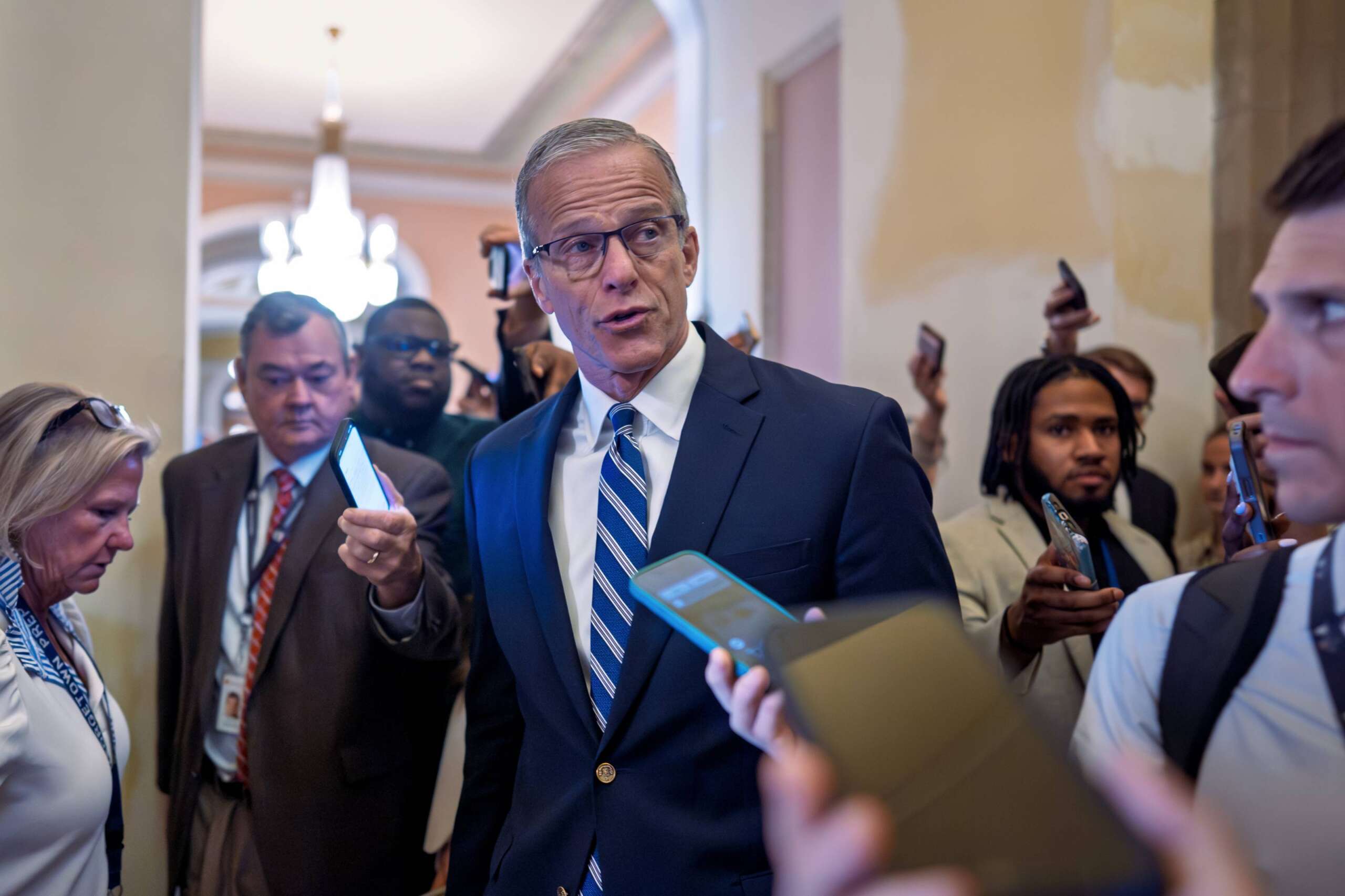
WASHINGTON (AP) — In the early hours of Friday morning, the Senate approved a bill to finance President Donald Trump’s immigration enforcement agencies. This came after weeks of setbacks and intense criticism over a separate $1.776 billion settlement fund that nearly caused the legislation to fail.
Following months of Democratic opposition, senators voted 52-47 to approve the $70 billion measure. This funding will support Immigration and Customs Enforcement and Border Patrol for the next three years, lasting through the remainder of Trump’s term. The bill now moves to the House, where it is anticipated to be addressed next week.
The final vote occurred just before 5 a.m. Republicans had just barely fended off several attempts from both parties to include a provision in the bill that would permanently prohibit Trump’s settlement fund, which is intended for allies who claim they have faced political persecution.
Overnight, Republicans overcame the last significant obstacle by rejecting an amendment from Louisiana Sen. Bill Cassidy, a member of their own party. His proposal would have redirected settlement payments to law enforcement officers injured during the January 6, 2021, Capitol attack by a mob of Trump supporters trying to overturn the 2020 election results.
These amendments tested party unity and turned what should have been a straightforward vote for Republicans—who aimed to highlight immigration enforcement during an election year—into a nearly full-day internal debate over whether to block the settlement fund. This occurred despite Acting Attorney General Todd Blanche stating earlier in the week that the fund would not proceed.
“This would have been finished hours ago if we hadn’t had to deal with some of the issues surrounding the fund,” Senate Majority Leader John Thune, R-S.D., remarked shortly before midnight.
Thune himself has criticized the fund, which is part of a settlement resolving Trump’s lawsuit against the IRS over leaked tax returns, a move that has frustrated many GOP colleagues. However, he has urged fellow Republicans for weeks to keep the bill focused on funding for ICE and Border Patrol, avoiding additions that might complicate its passage in the House.
Nevertheless, a group of Republican senators spent the entire day and night trying to legislatively block the fund’s payouts. This effort followed Trump creating new uncertainty about the fund’s status on Wednesday when he told reporters it was “very important” and said he didn’t know whether it was dead or on hold, amid recent tensions with the Senate.
The final 52-47 vote was almost entirely along party lines, with Alaska Sen. Lisa Murkowski as the sole Republican opposing it. Democratic Sen. Michael Bennet of Colorado was absent for the vote.
Senators Repeatedly Block Attempts to Ban Settlement Fund
On Thursday morning, the first vote on a Democratic proposal to ban the settlement fund remained open for hours as Cassidy and two other Republican senators deliberated. The Democratic motion was narrowly defeated when Cassidy ultimately voted against it, while the two other senators—Ohio’s Jon Husted and Alaska’s Dan Sullivan, both facing reelection this year—voted in favor.
The Senate then turned down a second amendment from Republican Sen. Thom Tillis of North Carolina, which would have also banned the settlement fund but redirected the money to a separate anti-fraud fund within the Department of Justice. Most Democrats opposed the amendment, ensuring its failure, but it garnered support from more than 10 Republicans.
Tillis argued the fund poses a political risk for the party.
“If Blanche says this is largely inoperative, why not use this moment to make that official?” Tillis said. “Otherwise, you’re leaving every one of our members who are up for election to deal with this issue between now and Election Day, which makes no sense for something the DOJ says they’re not pursuing.”
Cassidy’s amendment to compensate injured police officers was a direct challenge, as payments from Trump’s fund could potentially go to Trump supporters who assaulted police and attacked the Capitol on January 6. Cassidy lost his reelection bid last month after Trump endorsed his primary opponent.
He contended that despite Blanche’s remarks, the fund remains part of an active settlement and “absolutely can be used.”
The Senate also rejected several other Democratic proposals aimed at blocking or restricting the fund, including amendments to prevent payments to January 6 defendants who harmed law enforcement officers.
Senate Minority Leader Chuck Schumer, D-N.Y., stated that Republicans are now “leaving taxpayers to rely on nothing more than a promise from Donald Trump’s personal fixer. That is not accountability. That is a permission slip.”
ICE and Border Patrol Funding Delayed for Months
Passing this bill to fund ICE and Border Patrol would break the Democratic blockade, which had demanded policy reforms following the fatal shootings of two protesters by federal agents in January.
Senate Republicans employed a complex procedural strategy to bypass the filibuster and pass the budget legislation without any Democratic votes. However, it took weeks to bring the bill to the Senate floor as Republicans dealt with various obstacles created by Trump and the White House—including a $1 billion proposal for White House security and Trump’s ballroom that they eventually abandoned, along with the strong bipartisan opposition to the settlement fund.
Democrats argue that any funding bill for the Department of Homeland Security should include restrictions on federal immigration authorities, such as better identification for federal officers and increased use of judicial warrants, among other demands.
After federal agents shot Renee Good and Alex Pretti in Minneapolis, Trump agreed to a Democratic request to separate the Homeland Security bill from a larger spending measure that was enacted. However, bipartisan negotiations stalled, and the department’s funding expired in mid-February with no agreement on changes to the Trump administration’s immigration enforcement methods.
Congress eventually funded the remainder of DHS at the end of April with Democratic support, but ICE and Border Patrol have continued to operate without regular funding.
___
Associated Press writers Kevin Freking and Lisa Mascaro contributed to this report.
Copyright
© 2026 The Associated Press. All rights reserved. This website is not intended for users located within the European Economic Area.
