



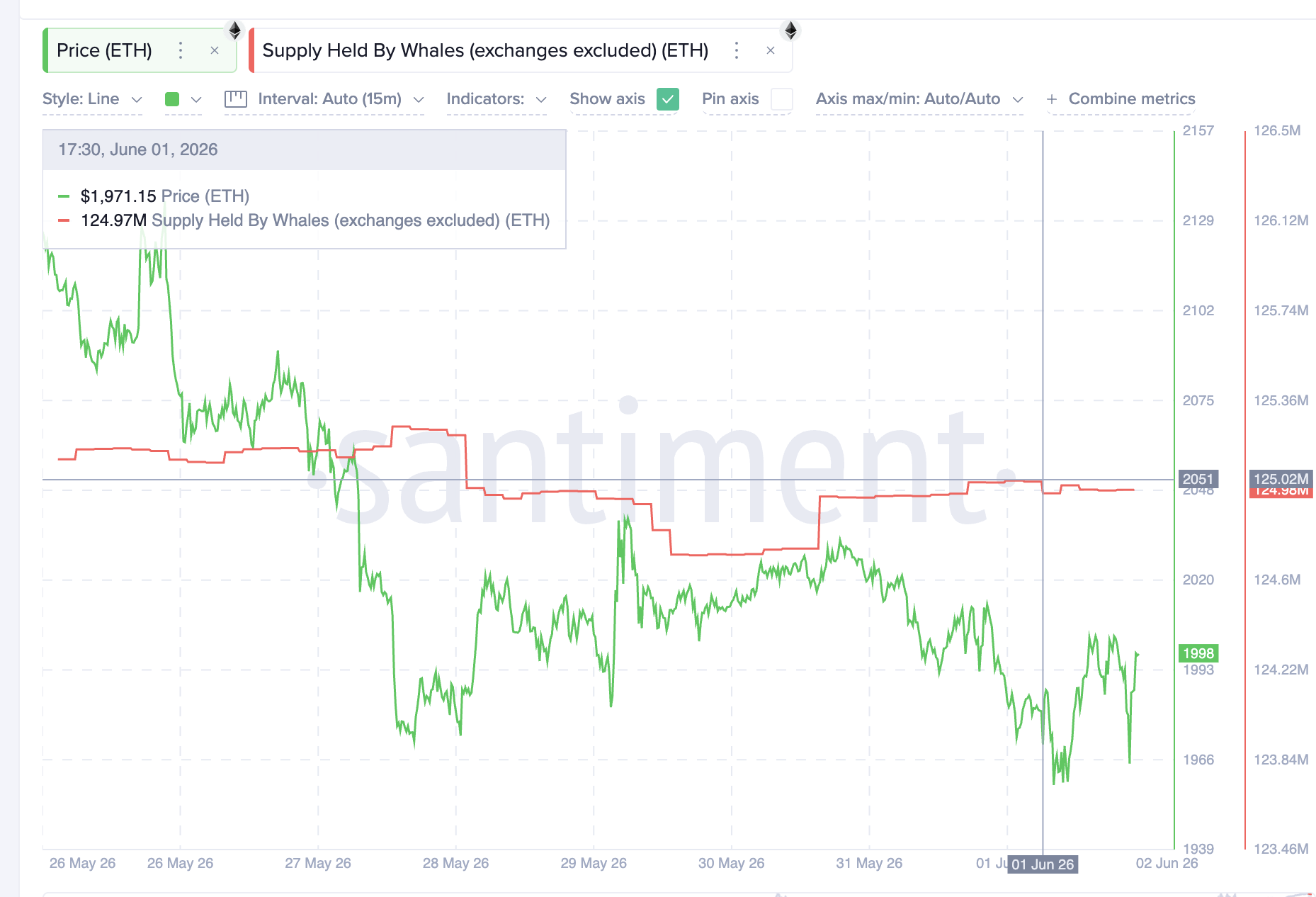
The Ethereum (ETH) price is hovering around the key $2,000 level after years of Bitcoin sales by Strategy shook the market, causing a split in on-chain activity: big traders are betting against the market while Hyperliquid traders quietly take the opposite side.
Over the past month, ETH's value has dropped more than 13%. What makes recent events noteworthy isn't the selling itself, but who is on the other side of the trade. Here's how everything connects.
The Trigger: Large ETH Holders React Negatively to Bitcoin's Troubles
The catalyst came from Bitcoin, not Ethereum. When Strategy revealed it had sold Bitcoin for the first time in years, going against its long-standing policy of never selling, many large holders reacted by reducing risk across the entire market, and Ethereum was caught in the fallout.
This bearish shift emerged quickly from two different angles. Blockchain analysis firm Onchain Lens showed a major trader opening a short position of 21,948 ETH, worth approximately $44 million, using 10x isolated leverage. The position was initiated near $2,004, with liquidation set to trigger at $2,339.76.
Looking for more insights like this? Sign up for Editor Harsh Notariya's Daily Crypto Newsletter here.
A few hours later, EyeOnChain identified a second wallet giving up: a trader who had purchased around 5,003 ETH near $1,999 during March and April, totaling roughly $10 million, transferred about 5,000 ETH valued at $9.8 million to Kraken as the price approached $1,960. Depositing coins to an exchange usually signals an upcoming sale, and a full exit here would result in a loss close to $200,000.
One trader initiated a new leveraged short position, while the other walked away from a two-month buying strategy. Same bearish outlook, different approaches.
The Confirmation: Exchange Reserves Decline and Long Positions Are Wiped Out
The overall data supports this view, and the price mechanics explain why the $2,000 level for Ethereum keeps breaking. According to Santiment, the supply held by ETH whales outside exchanges slipped from 125.02 million ETH on June 1 to 124.98 million the following day. The change is small, but when combined with the dip buyer's deposit to Kraken, it looks more like distribution than accumulation at these price levels.
The leverage data reveals where the real pressure is building. On the Binance ETH/USDT perpetual contract, a futures product with no expiration that tracks spot prices, the 7-day Coinglass liquidation map shows about $1.82 billion in total short liquidation leverage compared to roughly $781.93 million on the long side.


This is also the mechanical reason ETH keeps losing ground at $2,000. The declines aren't solely due to large traders selling, but also to long positions being liquidated in a cascade that pushes through weak support. On the surface, the story ends here: bearish and complete.
The Divergence: Hyperliquid Traders Bet Against the Downtrend
Then the narrative shifts. Over the past six hours, following the Strategy sale, perpetual flows have diverged between Ethereum and Bitcoin. Bitcoin absorbed net selling pressure totaling approximately $15.61 million, while ETH saw net buying pressure of roughly $9.10 million.
This is the contrarian signal. When the headline event is Bitcoin-specific, a Bitcoin-focused treasury company selling Bitcoin, the instinctive reaction is to sell the entire market. However, flow data indicates traders are using the correlated weakness to buy the asset that was never the story. Ethereum is actually benefiting from Bitcoin's bad news.

These two readings are now in direct opposition. A $44 million short and a wave of distribution signal more downside. The Hyperliquid flow data suggests someone is confidently taking the other side of that trade. And the heavily short-stacked book raises the stakes: with $1.82 billion in short leverage built up above, sustained buying that pushes ETH back through $2,000 would put those shorts, particularly the $44 million position with its $2,339.76 liquidation point, directly at risk of being squeezed. From a distance, the setup resembles a classic short squeeze scenario.
The Hyperliquid positioning data could be anticipating this move.
For now, the Ethereum price sits at the intersection of these two forces. The major traders have placed their bets. The question that upcoming sessions will answer is whether the quiet buyers on the other side are early or wrong.
The post A Whale Just Opened a $44 Million ETH Short: Why Hyperliquid Traders Are Moving Against It appeared first on BeInCrypto.
