



pros and cons
- Exceptional performance
- Easy to upgrade
- Strong speakers
Follow ZDNET: Add us as a preferred source on Google.
Whenever I start testing a new gaming laptop, I tend to get completely absorbed in the experience. Gaming is a huge passion of mine, and there have been plenty of occasions where I’ve booted up one of these devices after hours just for the sheer enjoyment of playing my favorite games on them. My budget desktop simply can’t keep up. That’s exactly what happened over the last few weeks as I put the MSI Raider 16 Max HX through its paces — one of the brand’s newest flagship offerings.
Also: Best VPN services 2026: Expert tested and recommended
What sets this laptop apart is the significant hardware upgrades under the hood. It still carries a few of the typical shortcomings you’d expect from this category, but the Raider 16 does an impressive job of keeping those downsides in check while still delivering the kind of experience gamers are looking for.
Best laptop deals of the week
Deals are selected by the CNET Group commerce team, and may be unrelated to this article.
Smarter design
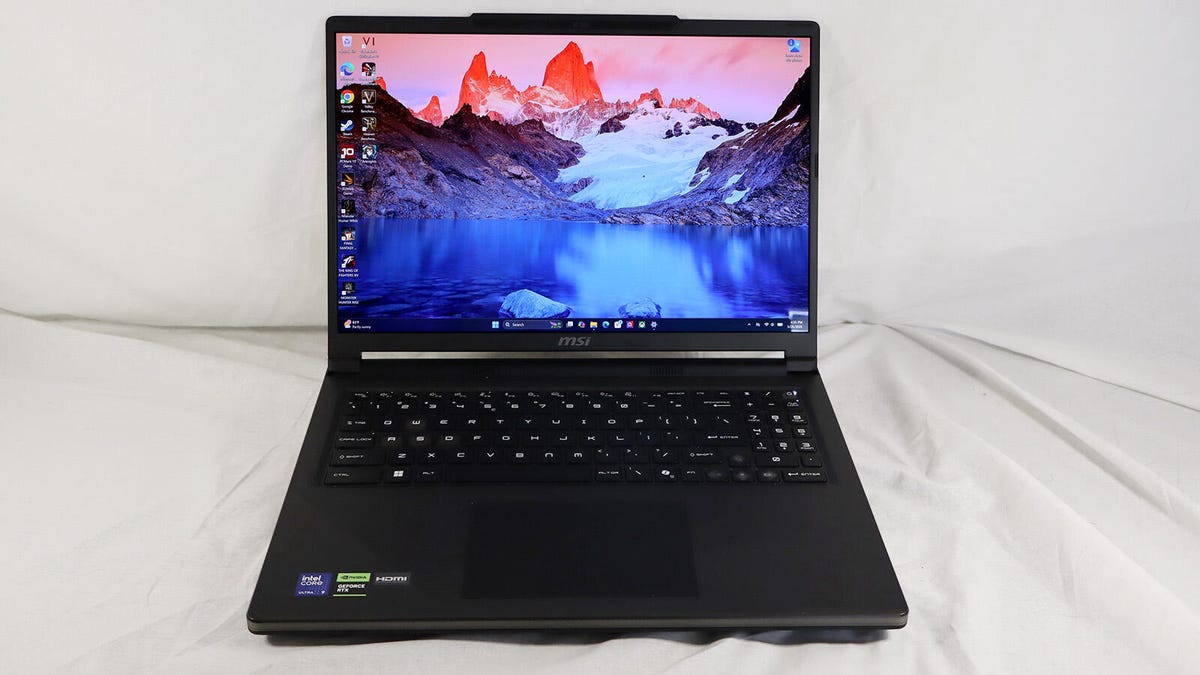
To my eye, MSI has clearly drawn inspiration from the latest design trends. Over the past few years, I’ve watched manufacturers steadily move toward slimmer gaming laptops. The old-school bulky look is gradually fading away. The Raider 16 comes in at 14.29 x 10.62 x 0.86 inches and tips the scales at 5.73 pounds. For context, the previous-generation Raider GE68 HX measures 14.97 x 11.73 x 1.09 inches and weighs 6.06 pounds.
That said, it’s still a fairly sizable machine with a thick black chassis. Carrying it around can be a bit of a hassle, though I do value the generous selection of ports that its larger footprint makes room for. The extra bulk seems to be a direct result of the new cooling system MSI built into the Raider 16.
I’ll get into the cooling system in more detail shortly, but first I want to spotlight one of my favorite features: the Quick Access Panel. Tucked on the bottom of the chassis is a small panel secured by two tiny screws. Popping it off gives you direct access to the SSD and memory slots. You’ll find the factory-installed components there, plus extra slots for upgrades.
Also: I built my own Wi-Fi router with a Raspberry Pi for Starlink and solar control – here’s how
Adding an extra drive or memory stick is incredibly straightforward. Just undo the small mounting screw, slide the new parts in, and lock them down. That’s all there is to it. The SSD I installed was already formatted, so I was able to start using the additional 4TB of storage immediately. For anyone planning to expand their system down the road, this is a fantastic convenience — and something I wish more laptop makers would adopt.
Vibrant visuals
As you’d expect from a premium gaming laptop, the MSI Raider 16 Max HX features a 16-inch, 2.5K Quad HD+ (2560×1600 pixels) OLED display. It’s absolutely gorgeous. Colors pop with richness, the panel renders fine detail beautifully, and thanks to VESA DisplayHDR True Black 1000, the contrast is deep and striking. The screen isn’t 4K, which might let some people down, but honestly I don’t think that matters much given the blazing 240Hz refresh rate. In my view, a high refresh rate matters more than raw resolution, since it keeps in-game animations buttery smooth. That smoothness can genuinely be the difference between winning and losing in competitive titles.
I had an absolute blast playing Monster Hunter Wilds on this screen. The game’s creatures looked phenomenal.
At one point, I went up against this massive rocky beast, and the display rendered incredible detail across its scales, wings, and talons. I could clearly see the rough, jagged texture of the stones embedded in its hide, along with the visible battle damage that accumulated as the fight wore on. The experience was further amplified by the laptop’s powerful speakers. Audio comes through rich and full-bodied. I could hear the raw, guttural effort behind each creature’s roar, which added a whole extra dimension of immersion.
Beyond gaming, the display is also a great fit for content creators tackling visually intensive work — whether that’s graphic design, photo editing, or video production.
Elite performance
The MSI Raider 16 Max HX is driven by top-of-the-line hardware. My review unit arrived with an Intel Core Ultra 9 290HX Plus processor, 32GB of DDR5 RAM, and an Nvidia GeForce RTX 5090 GPU. Below, you’ll find a benchmark comparison table showing how the MSI Raider 16 Max HX measures up against other premium laptops.
As the numbers show, the results are outstanding — surpassing other high-end contenders like the Alienware 16 Area-51 and the Lenovo Legion 9i. In day-to-day use, it’s blisteringly fast, effortlessly running demanding games without a hint of stutter while simultaneously pushing frame rates well into the triple digits. Outside of gaming, the Raider 16 has more than enough muscle for high-resolution video work. I edited some old drone footage to see how it handled a creative workload in real time. Scrubbing through the timeline felt snappy, video playback was fluid, and exporting the finished project was nearly instantaneous.
Also: This 4TB WD Black SSD is nearly $1,200 off at Best Buy – and I’m vouching for it
One of the laptop’s standout strengths is its ability to sustain stable performance over extended sessions without significant throttling. MSI’s Raider can easily pull double duty as a workstation, even if it doesn’t have the sleek profile of one.
To keep the Raider 16 running at its best, MSI reworked several internal components. The company shared with me that it shrunk the motherboard, which freed up space for larger fans. There’s a “vacuum optimized heat pipe” that channels heat toward the cooling fins, along with a set of fans that pull in cool air and expel warm air through five separate vents. I have to say, the whole setup works remarkably well. No matter how hard I pushed the laptop, it stayed completely cool to the touch.
Another upside is quieter fan operation. MSI says the fans stay under 50 decibels under load. To verify this, I ran multiple decibel meter apps from the Google Play Store. The readings hovered right around 50 decibels — one app showed slightly higher, one slightly lower, and one right at 50 — so the claim checks out. For reference, 50 decibels is about the same as the gentle hum of a refrigerator.
ZDNET’s buying advice
If you’re interested in the exact configuration I reviewed, the MSI Raider 16 Max HX is currently listed at Micro Center for $3,500. Micro Center also carries a more budget-friendly Raider 16 priced at around $2,500. That model keeps the same Intel Core Ultra 9 processor and 32GB of RAM but swaps the Nvidia GeForce RTX 5090 for an RTX 5070 Ti GPU.
No matter which version you go with, you can count on outstanding performance. I wholeheartedly recommend MSI’s Raider 16 for its consistently powerful performance, superb cooling system, and gorgeous OLED display. It’s the top pick right now for anyone who wants a single machine that excels at both high-end gaming and demanding workstation workloads.
