



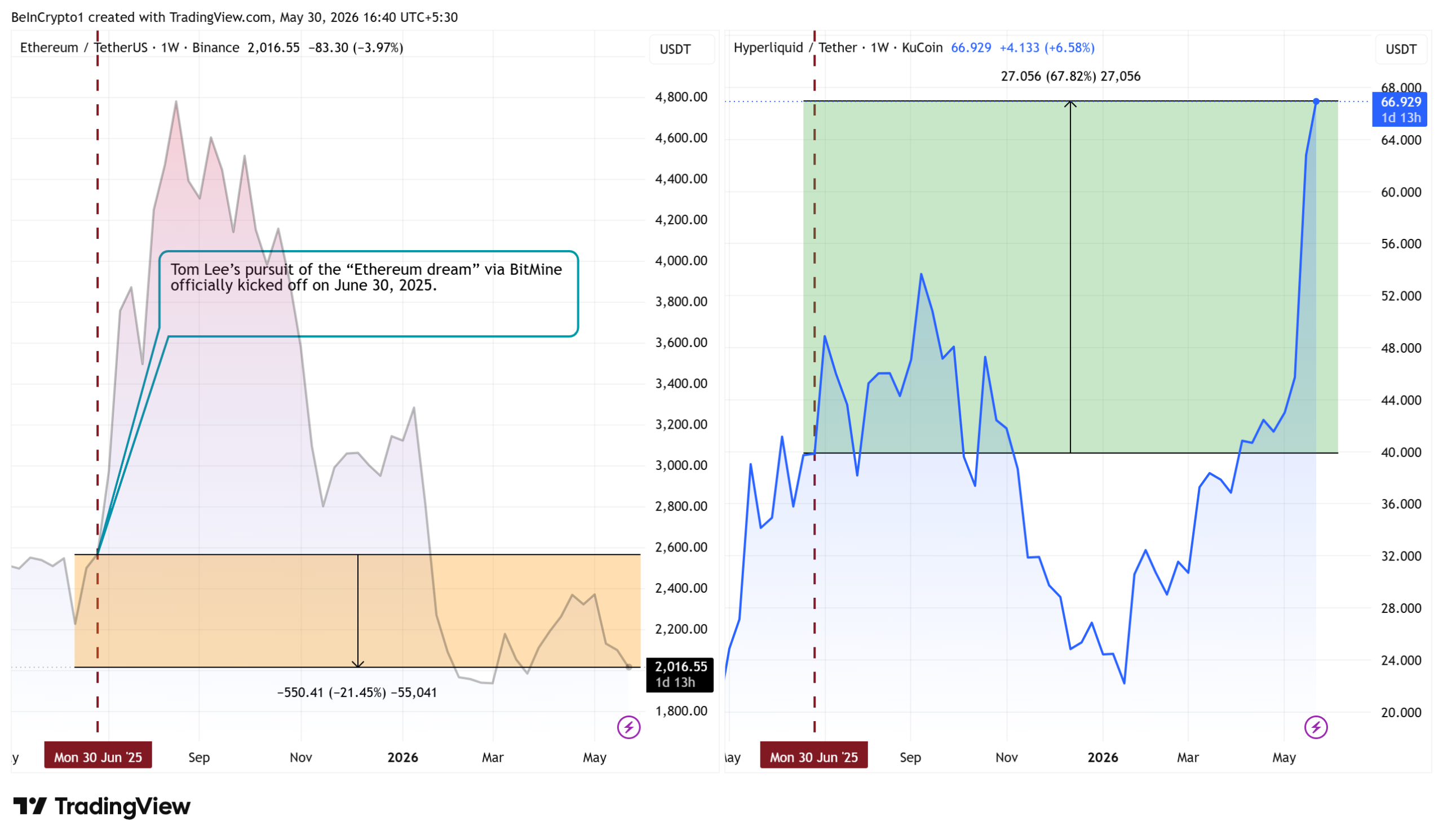
Tom Lee’s BitMine chose to buy 5.4 million Ethereum (ETH) over Hyperliquid (HYPE), a decision now facing a stark outcome. Since June 30, 2025, the Ethereum position has lost 21%, while HYPE has surged 68% during the same period.
The central question is whether Tom Lee successfully established the institutional foothold he aimed to build—or whether he selected the wrong asset in a cycle that has already favored perpetual exchange tokens.
Both perspectives remain defensible until ETH either regains momentum or declines further.
The Conviction Case
BitMine unveiled its Ethereum treasury strategy on June 30, 2025, backed by a $250 million private placement.
Tom Lee, Fundstrat’s head, took on the role of chairman. The strategy was never about chasing the cycle’s top-performing token. Its goal is to acquire approximately 5% of the ether supply (through alchemy) as a publicly traded vehicle for institutional ETH exposure.
This investment thesis rests on three foundations:
- Ether’s staking yield transforms the treasury into an income-generating asset rather than a passive holding.
Approximately 87% of the stake is held on BitMine’s MAVAN staking platform, producing around $276 million in annualized revenue.
- Liquidity is critical at this scale.
BitMine has taken $8 billion in losses without disrupting ETH’s order books.
“Tom Lee is down eight billion dollars on ETH and Vitalik decides to write a sci-fi novel,” David Hoffman, co-owner at Bankless, remarked.
Indeed, Ethereum co-founder Vitalik Buterin announced he would pause his usual blog posts to write science fiction exploring decentralized governance, testing governance concepts through storytelling rather than academic research.
Meanwhile, HYPE’s $14.9 billion market cap could not have withstood a similar capital injection without significant slippage.

Follow us on X to get the latest updates in real time
- The third foundation is institutional suitability.
Tom Lee’s bullish outlook positions Ethereum as the settlement layer for tokenized assets, stablecoins, and on-chain agents.
This thesis hinges on ETH evolving into financial infrastructure—not outperforming every other token in the cycle.
The Miss Case
The counterargument is compelling. HYPE traded at $67.14 at the time of writing, up 101% year-over-year and 68% since BitMine’s strategic shift.
Hyperliquid channels most fee revenue into open-market HYPE buybacks. Since launch, the HYPE repurchase program has absorbed over $1.16 billion in fees.
If BitMine’s capital had been deployed into HYPE instead, it would now reflect approximately $44 billion in gains. That number grows even larger if HYPE reaches $100.

“If Tom Lee had bought HYPE instead of ETH for BitMine, he would have been up 520% and made $44 billion. He could have potentially overtaken Michael Saylor once HYPE hits $100,” suggested degennQuant, co-founder of Hyperbeat.
The danger for Lee lies in timing. Hyperliquid captured the dominant on-chain narrative of this cycle. The token commands roughly 57.8% of the perpetual DEX market.
Public endorsement from ICE chief executive Jeff Sprecher further fueled investor interest.
“This Hyperliquid we’re talking about—if you haven’t heard of it, it’s bigger than NASDAQ, okay? It’s 11 people. You look at it and think, wow, that’s quite something,” Sprecher told investors at the Bernstein 42nd Annual Strategic Decisions Conference.
Subscribe to our YouTube channel to watch leaders and journalists share expert insights
The Philosophical Divide
Kyle Samani departed Multicoin Capital in February, then publicly laid out a structural critique of Hyperliquid.
He argues that its validator set operates from a single facility. Thousands of its design decisions align with a centralized model but fail in a permissionless environment.
“Hyperliquid is essentially Binance 2.0 without a marketing team. It has made thousands of technical choices that function well in a centralized setup and would completely break in a permissionless, decentralized one. And now they’re many steps behind,” quipped Samani, former Multicoin co-founder.
Samani’s exit from Multicoin followed reports of HYPE purchases by the fund.
Tom Lee’s allocation rests on the opposite principle. Ethereum’s appeal to institutions is rooted in its credibility, validator distribution, and resistance to protocol-level control.
Hyperliquid prioritizes speed, low fees, and seamless trading experience.
Is HYPE a Superior Treasury Asset?
The answer depends on the timeframe the market rewards. A cycle measured in months keeps Hyperliquid ahead. A cycle measured in tokenization adoption favors the asset BitMine already holds.
This analysis frames Tom Lee’s decision as either patient discipline or a costly missed opportunity. Conviction and missed opportunities are often the same trade evaluated across different time horizons.
The post Hyperliquid vs Ethereum: Did Tom Lee Pick the Wrong Crypto Treasury Asset for BitMine? appeared first on BeInCrypto.
