



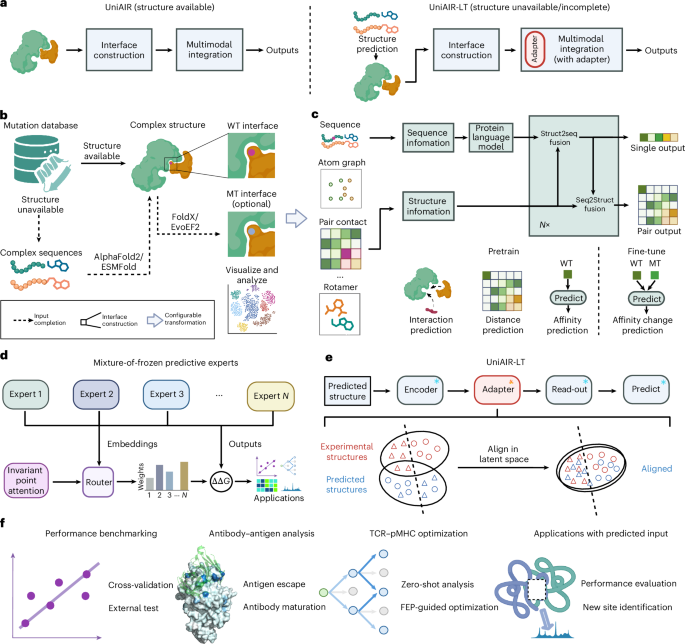
Rossjohn, J. et al. T cell antigen receptor recognition of antigen-presenting molecules. Annu. Rev. Immunol. 33, 169–200 (2015).
Batista, F. D. & Harwood, N. E. The who, how and where of antigen presentation to B cells. Nat. Rev. Immunol. 9, 15–27 (2009).
Paludan, S. R., Pradeu, T., Masters, S. L. & Mogensen, T. H. Constitutive immune mechanisms: mediators of host defence and immune regulation. Nat. Rev. Immunol. 21, 137–150 (2021).
Flajnik, M. F. & Kasahara, M. Origin and evolution of the adaptive immune system: genetic events and selective pressures. Nat. Rev. Genet. 11, 47–59 (2010).
Shan, S. et al. Deep learning guided optimization of human antibody against SARS-CoV-2 variants with broad neutralization. Proc. Natl Acad. Sci. USA 119, e2122954119 (2022).
Pappas, L. et al. Rapid development of broadly influenza neutralizing antibodies through redundant mutations. Nature 516, 418–422 (2014).
Reddehase, M. J. Antigens and immunoevasins: opponents in cytomegalovirus immune surveillance. Nat. Rev. Immunol. 2, 831–844 (2002).
Vázquez-García, I. et al. Ovarian cancer mutational processes drive site-specific immune evasion. Nature 612, 778–786 (2022).
Willmann, K. L. et al. Biallelic loss-of-function mutation in NIK causes a primary immunodeficiency with multifaceted aberrant lymphoid immunity. Nat. Commun. 5, 5360 (2014).
Wang, G. et al. Deep-learning-enabled protein–protein interaction analysis for prediction of SARS-CoV-2 infectivity and variant evolution. Nat. Med. 29, 2007–2018 (2023).
Wiehe, K. et al. Mutation-guided vaccine design: a process for developing boosting immunogens for HIV broadly neutralizing antibody induction. Cell Host Microbe 32, 693–709.e697 (2024).
Cheng, J., Liang, T., Xie, X.-Q., Feng, Z. & Meng, L. A new era of antibody discovery: an in-depth review of AI-driven approaches. Drug Discov. Today 29, 103984 (2024).
Cho, S. et al. Structural basis of affinity maturation and intramolecular cooperativity in a protein-protein interaction. Structure 13, 1775–1787 (2005).
Homola, J. Surface plasmon resonance sensors for detection of chemical and biological species. Chem. Rev. 108, 462–493 (2008).
Lequin, R. M. Enzyme immunoassay (EIA)/enzyme-linked immunosorbent assay (ELISA). Clin. Chem. 51, 2415–2418 (2005).
Fowler, D. M., Stephany, J. J. & Fields, S. Measuring the activity of protein variants on a large scale using deep mutational scanning. Nat. Protoc. 9, 2267–2284 (2014).
Frank, F. et al. Deep mutational scanning identifies SARS-CoV-2 Nucleocapsid escape mutations of currently available rapid antigen tests. Cell 185, 3603–3616.e3613 (2022).
Boder, E. T. & Wittrup, K. D. Yeast surface display for screening combinatorial polypeptide libraries. Nat. Biotechnol. 15, 553–557 (1997).
It looks like you’ve provided a list of academic references (citations) rather than an article with paragraphs and sentences to paraphrase. Paraphrasing involves rewriting sentences and paragraphs to improve clarity or flow while keeping the original meaning.
Since these are citations, the text is already in a standard, concise format. However, I can make the journal names slightly more readable or ensure the formatting is consistent if you’d like.
If you have the main body of the article (the text *referencing* these sources), please paste that, and I will be happy to paraphrase it for you!
To improve performance, experts in mixture-of-experts models are designed to specialize. Adv. Neural Inf. Process. Syst. 38, 48767–48809 (2026).
Luo, S. et al. A rotamer density estimator learns, without supervision, how mutations affect protein-protein interactions. In The Eleventh International Conference on Learning Representations (2023).
Bushuiev, A. et al. Learning to engineer protein–protein interactions with improved generalization. In International Conference on Learning Representations 21010–21035 (2025).
Su, J. et al. SaProt: modeling protein language with a structure-aware vocabulary. In International Conference on Learning Representations 6987–7009 (2024).
Li, M. et al. ProSST: protein language modeling with quantized structure and separated attention. Adv. Neural Inf. Process. Syst. 37, 35700–35726 (2024).
Shanehsazzadeh, A. et al. Enabling de novo antibody design through generative artificial intelligence. Preprint at bioRxiv (2024).
Borrman, T. et al. ATLAS: a resource connecting binding affinities with structures for wild-type and mutant TCR-pMHC complexes. Proteins Struct. Funct. Bioinf. 85, 908–916 (2017).
Google Scholar
Gao, Y. et al. Pan-peptide meta learning for recognizing T-cell receptor–antigen binding. Nat. Mach. Intell. 5, 236–249 (2023).
Google Scholar
Sidney, J., Peters, B., Frahm, N., Brander, C. & Sette, A. HLA class I supertypes: an updated classification. BMC Immunol. 9, 1 (2008).
Google Scholar
Garry, R. F. Lassa fever—the road ahead. Nat. Rev. Microbiol. 21, 87–96 (2023).
Google Scholar
Carr, C. R. et al. Deep mutational scanning reveals functional constraints and potential for antibody escape in the Lassa virus glycoprotein complex. Immunity 57, 2061–2076.e2011 (2024).
Google Scholar
Zhang, Y. et al. Epitope-anchored contrastive transfer learning for paired CD8+ T cell receptor–antigen recognition. Nat. Mach. Intell. 6, 1344–1358 (2024).
Google Scholar
Sim, M. J. W. et al. High-affinity oligoclonal TCRs define effective adoptive T cell therapy targeting mutant KRAS-G12D. Proc. Natl Acad. Sci. USA 117, 12826–12835 (2020).
Google Scholar
Feng, Z. et al. A sliding-attention transformer architecture for predicting T cell receptor–antigen–human leucocyte antigen binding. Nat. Mach. Intell. 6, 1216–1230 (2024).
Google Scholar
Ullanat, V., Jing, B., Sledzieski, S. & Berger, B. Deciphering the language of protein-protein interactions. Nat. Commun. 17, 1199 (2025).
Google Scholar
Bran, A. M. et al. Equipping large language models with chemistry tools. Nat. Mach. Intell. 6, 525–535 (2024).
Google Scholar
Liu, A. et al. DeepSeek-V3.2: advancing the frontier of open large language models. Preprint at (2025).
OpenAI. GPT-5.2 release. (2025).
Korpela, D. et al. EPIC-TRACE: predicting TCR binding to unseen epitopes using attention and contextualized embeddings. Bioinformatics 39, btad743 (2023).
Google Scholar
Karnaukhov, V. K. et al. Structure-based prediction of T cell receptor recognition of unseen epitopes using TCRen. Nat. Comput. Sci. 4, 510–521 (2024).
Google Scholar
Springer, I., Tickotsky, N. & Louzoun, Y. The role of T cell receptor alpha and beta CDR3 regions, MHC typing, and V and J genes in predicting peptide binding. Front. Immunol. 12, 664514 (2021).
Google Scholar
Facundo, D. & Batista, M. S. N. How B cell responses to antigen depend on binding strength: a lower threshold, an upper ceiling, and the critical role of dissociation rate. Immunity 8, 751–759 (1998).
Google Scholar
Irving, M. et al. The combined effect of T cell receptor binding kinetics and the amount of peptide displayed by MHC molecules determines the strength of CD8+ T cell activation. J. Biol. Chem. 287, 23068–23078 (2012).
Google Scholar
Dunbar, J. et al. SAbDab: a comprehensive database of antibody structures. Nucleic Acids Res. 42, D1140–1146 (2014).
Google Scholar
Leem, J., de Oliveira, S. H. P., Krawczyk, K. & Deane, C. M. STCRDab: a database dedicated to the structural analysis of T-cell receptors. Nucleic Acids Res. 46, D406–D412 (2018).
Google Scholar
Liu, H. et al. PPB-Affinity: a benchmark dataset of protein–protein binding affinities designed to accelerate AI-driven drug discovery. Sci. Data 11, 1316 (2024).
Google Scholar
Jankauskaitė, J., Jiménez-García, B., Dapkūnas, J., Fernández-Recio, J. & Moal, I. H. SKEMPI 2.0: a comprehensive update on the effects of mutations on protein–protein interaction energies, kinetics, and thermodynamics. Bioinformatics 35, 462–469 (2018).
Google Scholar
Rodrigues, C. H. M., Myung, Y., Pires, D. E. V. & Ascher, D. B. mCSM-PPI2: a computational tool for predicting how mutations alter protein–protein interactions. Nucleic Acids Res. 47, W338–W344 (2019).
Google Scholar
Nahta, R. & Esteva, F. J. HER2-targeted therapies: understanding the molecular basis of trastuzumab resistance. Breast Cancer Res. 8, 215 (2006).
Google Scholar
Huang, X., Pearce, R. & Zhang, Y. EvoEF2: a highly accurate and efficient energy function for computational protein design. Bioinformatics 36, 1135–1142 (2020).
Google Scholar
Pearce, R., Huang, X., Setiawan, D. & Zhang, Y. EvoDesign: engineering protein–protein binding interfaces using evolutionary interaction profiles combined with a refined physical energy function. J. Mol. Biol. 431, 2467–2476 (2019).
Google Scholar
Ahdritz, G. et al. OpenFold: retraining AlphaFold2 reveals deeper insights into its learning behavior and generalization capabilities. Nat. Methods 21, 1514–1524 (2024).
Google Scholar
Jumper, J. et al. Breakthrough protein structure prediction achieved with AlphaFold. Nature 596, 583–589 (2021).
Google Scholar
Jorgensen, W. L., Chandrasekhar, J., Madura, J. D., Impey, R. W. & Klein, M. L. Evaluation of simplified potential functions for modeling liquid water. J. Chem. Phys. 79, 926–935 (1983).
Google Scholar
Berendsen, H. J. C., van der Spoel, D. & van Drunen, R. GROMACS: a high-efficiency parallel implementation for molecular dynamics simulations. Comput. Phys. Commun. 91, 43–56 (1995).
Google Scholar
Abraham, M. J. et al. GROMACS: enabling high-performance molecular simulations via multi-tiered parallelism across laptop and supercomputer platforms. SoftwareX 1–2, 19–25 (2015).
Google Scholar
MacKerell, A. D. et al. A full-atom empirical potential for conducting molecular modeling and dynamic simulations of proteins. J. Phys. Chem. B 102, 3586–3616 (1998).
Google Scholar
Darden, T., York, D. & Pedersen, L. Particle mesh Ewald: an Nlog(N) scalable algorithm for computing Ewald sums in large-scale molecular systems. J. Chem. Phys. 98, 10089–10092 (1993).
Google Scholar
Essmann, U. et al. A smooth particle mesh Ewald method. J. Chem. Phys. 103, 8577–8593 (1995).
Hess, B., Bekker, H., Berendsen, H. J. C. & Fraaije, J. G. E. M. LINCS: a linear constraint solver for molecular simulations. J. Comput. Chem. 18, 1463–1472 (1997).
Bussi, G., Donadio, D. & Parrinello, M. Canonical sampling through velocity rescaling. J. Chem. Phys. 126, 014101 (2007).
Parrinello, M. & Rahman, A. Polymorphic transitions in single crystals: a new molecular dynamics method. J. Appl. Phys. 52, 7182–7190 (1981).
Jorgensen, W. L. Free energy calculations: a breakthrough for modeling organic chemistry in solution. Acc. Chem. Res. 22, 184–189 (1989).
Deng, Y. & Roux, B. Calculation of standard binding free energies: aromatic molecules in the T4 lysozyme L99A mutant. J. Chem. Theory Comput. 2, 1255–1273 (2006).
Boresch, S., Tettinger, F., Leitgeb, M. & Karplus, M. Absolute binding free energies: a quantitative approach for their calculation. J. Phys. Chem. B 107, 9535–9551 (2003).
Mobley, D. L., Chodera, J. D. & Dill, K. A. On the use of orientational restraints and symmetry corrections in alchemical free energy calculations. J. Chem. Phys. 125, 084902 (2006).
Han, R. hanrthu/UniAIR: Initial Release of UniAIR v1.0.0. Zenodo (2026).
