



# Google’s Agentic Video Understanding: How Gemini Flash Is Redefining Video Analysis
## The Problem with Video as an Input Modality
For years, video has been the most expensive and least efficient modality to process when working with large language models. When a Gemini model is asked to analyze a 90-minute lecture or a multi-hour webinar, it has traditionally handled the entire file the same way — extracting frames at a fixed rate of one frame per second and processing them all in a single linear pass. Whether the user’s question is a broad “summarize this” or a highly specific “what time does the speaker switch to the pricing slide,” the model treats every second of the video identically.
This single-pass architecture forces an uncomfortable tradeoff. Developers can either pay the full cost of ingesting the entire timeline into the model’s context window, or they can pre-chunk the video into segments and risk losing the specific detail that matters most. Fine-grained moments — a quick visual transition, a fleeting expression, a specific data point on a slide — are easily missed when sampling is rigid and uniform across the entire duration.
The result is a system that is wasteful when broad analysis is needed and imprecise when granular answers are required.
## What Google Introduced This Week
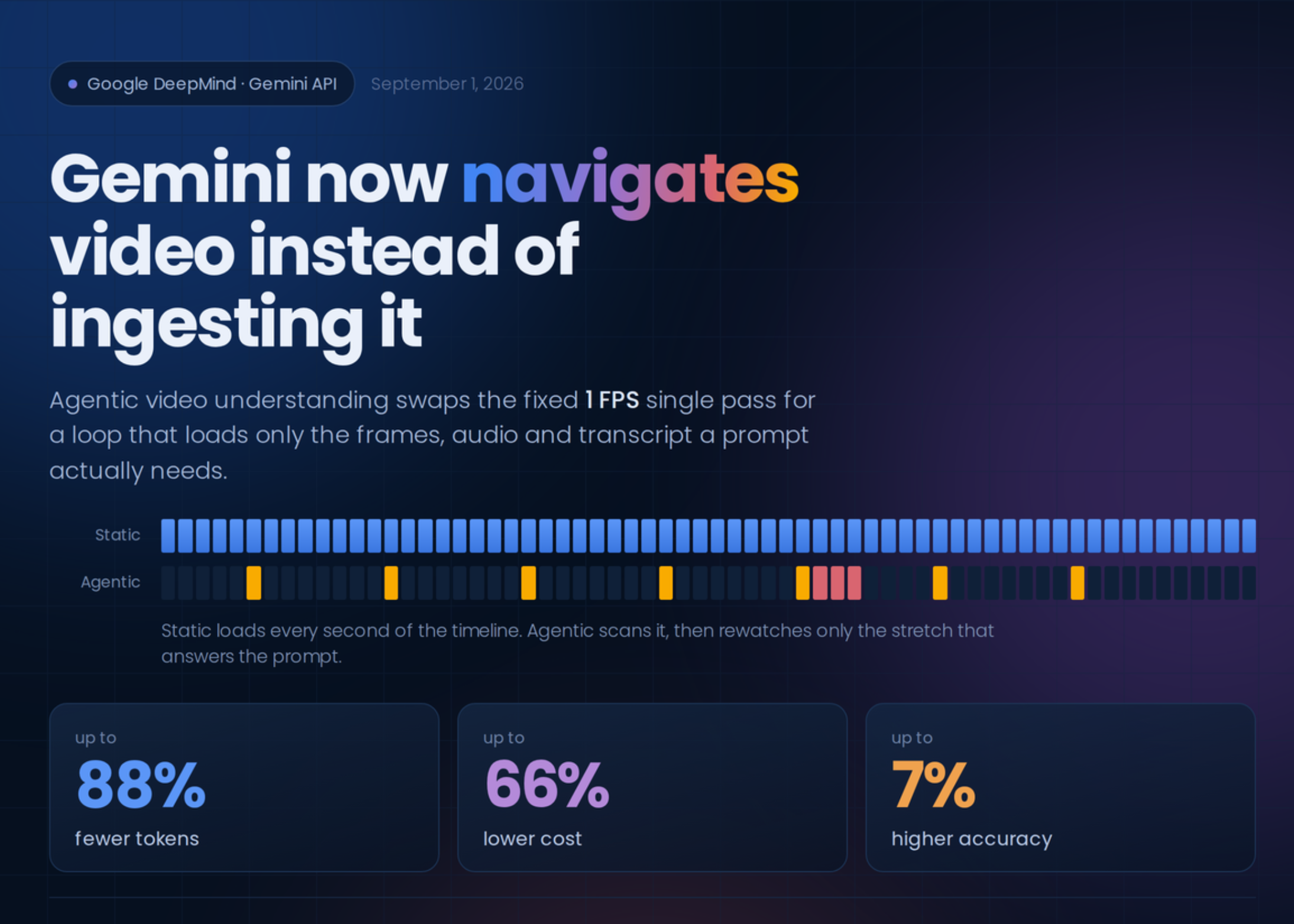
Google has unveiled a new agentic video understanding capability across its Gemini Flash model lineup. Rather than treating a video as a linear sequence of frames to be consumed front to back, the model now navigates the content dynamically. It decides what to examine, at what frame rate, and through which sensory modality — visual frames, audio tracks, or text transcripts — based on the specific question being asked.
The reported improvements are significant. Google cites up to 88% fewer tokens consumed, up to 66% lower processing cost, and up to 7% higher accuracy on standard video benchmarks compared to the previous static processing approach. These gains are most pronounced on long-form content, ranging from 10-minute instructional videos to recordings that span several hours.
The feature is available now through the Gemini API, accessible via Google AI Studio and the Gemini Enterprise Agent Platform. It supports both direct file uploads and public YouTube URLs. Pricing follows standard Gemini API token billing with no additional surcharges for the agentic capability itself.
## How Agentic Processing Differs from Static Processing
In the static model, video is processed in a single fixed pipeline: frames are extracted at one frame per second, audio is encoded at 1 Kbps in a single channel, and timestamps are inserted every second. Everything is fed into the model in one continuous block. The model has no ability to skip ahead, zoom in, or revisit specific segments.
Agentic processing replaces this rigid pipeline with an iterative loop. The model uses its own reasoning capabilities alongside native video tools to search, scan, and inspect specific segments across frames, audio channels, and transcripts. It loads only the portions of the video that the prompt requires, adjusting its approach dynamically. For instance, if a question asks about a moment in a two-hour recording, the model might first scan the transcript to locate the relevant section, then selectively re-sample frames from that segment at a higher frame rate to verify details.
While developers could theoretically build similar workflows manually by orchestrating external tools and API calls, the agentic capability runs this entire loop internally within the model. This eliminates the development overhead of managing search logic, chunk boundaries, and token budgets separately.
## Understanding the API Response Structure
Agentic processing introduces two new step types in the API response: `processing_call` and `processing_result`. These steps interleave with the model’s internal reasoning (`thought` steps) and appear before the final model output, giving developers a transparent view of how the model arrived at its answer.
The flow typically follows this pattern. The user’s prompt is sent with `”processing”: “agentic”` specified, and the video part carries this mode designation. The model first issues a `thought` step to inspect the transcript and identify relevant topics. It then makes a `processing_call` to request a specific segment or audio transcript, which returns as a `processing_result`. The model continues with additional reasoning and tool calls, potentially loading visual frames at varying resolutions or frame rates, until it has gathered sufficient evidence. The final `model_output` contains the grounded answer, complete with timestamps and references.
An important implementation detail for multi-turn conversations: in stateless calls, every returned step must be passed back in the subsequent request’s step list. Omitting steps results in the loss of video context without any API error to signal the problem.
## Four Capabilities Unlocked by Dynamic Processing
Google identifies four distinct capabilities that become possible when a model can dynamically navigate video content rather than consuming it in a single fixed pass.
**Sub-second moment retrieval** addresses a fundamental limitation of 1 FPS sampling. Rapid cuts, split-second visual transitions, and brief visual events fall entirely between consecutive frames at a fixed one-per-second rate. By selectively resampling narrow time windows at higher frame rates, the model can detect and precisely timestamp these fleeting moments — enabling use cases like automated clip editing or forensic frame-level analysis.
**Needle-in-a-haystack search** solves the long-form video dilemma. Previously, querying a multi-hour recording meant either ingesting millions of tokens across the full duration or preprocessing the video into a lossy summary that might discard the one piece of relevant information. The agentic approach allows the model to search efficiently across hours of content while consuming a fraction of the tokens.
**Anomaly detection** benefits from selective high-resolution inspection. Rather than paying the token cost of high-frame-rate processing across the entire file, the model can identify regions of interest and re-examine them at higher rates to detect rapid motion, subtle visual artifacts, or unusual patterns — without inflating the overall cost.
**Counting actions and objects** becomes more reliable when the model can revisit and re-examine segments. Fixed sampling at 1 FPS tends to under-count fast-moving objects and repeated physical actions that occur between sampled frames. Agentic processing allows the model to scan, rewatch, and verify counts across different frame rates until the answer is consistent.
## Cost Comparison: Static vs. Agentic
The token economics of video processing differ significantly between the two modes. In static processing, token consumption is predictable and fixed: each frame at low resolution costs 66 tokens, while high-resolution frames cost 258 tokens. Additionally, audio contributes approximately 32 tokens per second, along with metadata overhead. This makes static costs easy to calculate in advance.
Agentic processing, by contrast, is variable. Google reports that on long-form content, the best-case reduction reaches up to 88% fewer tokens compared to static processing. This means a 30-minute video that might consume 180,000 tokens in static mode could require approximately 21,600 tokens in agentic mode. However, actual savings depend on the complexity of the query, the navigation path the model takes, and whether additional reasoning (thought) tokens are generated during the interactive loop. Reasoning tokens are billed separately from tool-use tokens.
## When to Use Each Mode
Google’s guidance is to default to agentic mode for most use cases, but there are two notable exceptions where static processing remains the better choice.
For videos under five minutes in length, agentic navigation adds internal reasoning overhead and multiple tool round-trips before generation begins, which can increase the time to first token. For these short clips, static processing may actually deliver faster responses.
When the task requires inspecting every single frame — such as frame-by-frame annotation or precise clipping with custom offsets and frame rates — static mode is the only option. The agentic mode does not currently support custom frame rate configuration or clipping offsets.
For tasks that demand the lowest time to first token on short content, static mode again has the advantage. For everything else — particularly long-form content or queries targeting specific moments — agentic mode delivers better cost efficiency and answer quality.
## Frequently Asked Questions
**Is agentic video understanding available for self-hosted models?**
No. The feature is exclusively available as a hosted API offering. There are no open weights, and it cannot be deployed on local infrastructure or private compute environments.
**Which models support agentic video processing?**
The capability is available across Gemini’s Flash model family at launch. Availability on other model tiers has not been specified in the initial release documentation.
**Can I use agentic mode with YouTube videos?**
Yes. The API accepts both direct file uploads and public YouTube URLs as input sources, and the agentic processing loop applies in both cases.
**Are there any additional fees for agentic video processing?**
No. Billing follows the standard Gemini API token pricing model. There is no separate feature fee or premium tier for agentic video understanding. Note that reasoning tokens generated during the agentic loop are billed as thought tokens separately from the tool-use tokens consumed during processing calls.
**What happens if I omit processing steps in a multi-turn conversation?**
The video context will be lost for that turn without any error returned by the API. All steps returned in previous responses must be included in the `steps` array of subsequent requests to maintain continuity.
**How much improvement in accuracy does agentic mode provide?**
Google reports up to 7% higher accuracy on standard video benchmarks compared to static processing. Real-world performance gains may vary depending on the type of content and the nature of the query.
**Does agentic mode work with audio-only content?**
The agentic loop is designed for multimodal video content that includes visual frames, audio tracks, and transcripts. It is not specifically designed for audio-only inputs, though the transcript navigation component remains applicable.
## Conclusion
Google’s introduction of agentic video understanding marks a meaningful shift in how large language models interact with video content. By replacing a rigid, one-size-fits-all processing pipeline with an adaptive loop that selects what to examine and when, Gemini Flash dramatically reduces both the cost and token footprint of video analysis while improving accuracy on benchmarks.
The feature is not without limitations — it remains confined to hosted API usage, lacks support for custom frame rates and clipping offsets, and may introduce latency for short-form content where static processing would be faster. However, for the most demanding video analysis tasks, particularly those involving long-form recordings or the need to pinpoint specific moments within hours of content, the advantages are substantial.
As agentic capabilities mature across other modalities and model tiers, the broader pattern is clear: AI systems are moving from passive ingestion toward active exploration, making them better researchers and more efficient analysts of complex, multimodal information.
Thank you for reading
