




However, this model works both ways. On the positive side, it enables businesses to attract funding by riding market enthusiasm. On the downside, it locks them into absorbing the swings of the underlying asset whenever prices drop.
For a publicly traded company, the challenges are even more pronounced. Accounting rules require financial setbacks to be disclosed promptly, and any asset movements under such circumstances draw heavy scrutiny.
The ongoing debate around Trump Media & Technology Group (TMTG) illustrates this perfectly. Facing paper losses on its crypto strategy, the company transferred 2,650 BTC to Crypto.com, after pulling its applications to launch its own cryptocurrency ETFs.
Market participants absorbed the news without much alarm, but the key question lingers: is this a deliberate trading move, or a step toward an eventual forced exit from digital assets?
The reasoning behind the $200 million transfer
Trump Media was never designed to be a financial or investment firm — it was built as a tech holding company. Its central product is Truth Social, a social network created after Donald Trump was banned from mainstream platforms.
In March 2024, the company listed publicly via a SPAC merger. Through the following spring, TMTG stayed entirely focused on social media, and it was only then that the leadership chose to pivot, starting to build up a cryptocurrency reserve.
To fund this, the company secured roughly $2.3 billion through stock sales and by issuing zero-coupon convertible secured notes.
Early on, the company signaled its intent to build a Bitcoin reserve, with Crypto.com and Anchorage Digital acting as custodial partners. In reality, the strategy proved to be wider in scope than originally announced.
The company allocated capital into the Cronos (CRO) token, tied to Crypto.com, and submitted filings to launch multiple cryptocurrency ETFs simultaneously.
But the crypto strategy has not delivered the expected returns.
As of December 31, 2025, Trump Media reported holding 9,542 BTC at a cost basis of $1.131 billion and a fair value of $836.4 million, along with 756 million CRO valued at a cost basis of $113.9 million and a fair value of $68 million.
The company’s first-quarter 2026 filing made the financial strain even clearer. TMTG retained identical BTC and CRO positions on its balance sheet, but their fair values slid to $647 million and $53 million, respectively.
In addition, TMTG reported an unrealized loss on digital assets approaching $244 million (including pledged holdings). The company’s overall net loss was pegged at $405.9 million.
Several days after the filing went public, the company also retracted its ETF launch applications. Then, in late May, wallets tied by Arkham to Trump Media moved 2,650 BTC to Crypto.com’s infrastructure — worth over $200 million at prevailing market prices at the time.
Some observers view these transactions as groundwork for a sale, or at minimum, a way to secure liquidity for over-the-counter (OTC) transactions. However, the U.S. Securities and Exchange Commission (SEC) does not mandate that companies reveal public wallet addresses, leaving outside observers unable to independently confirm their motives.
Firms frequently move crypto assets to post collateral for dollar-denominated loans. Notably, TMTG disclosed in its quarterly report that it had pledged 4,260 BTC as security for its convertible notes.
Another 2,000 BTC was sent to a third-party partner as collateral for options trading, with that partner also granted the authority to move those assets freely at its own discretion.
Excerpt from Form 10-Q. Source: SEC.
A TMTG spokesperson also stated that the Bitcoin had been “moved, not sold,” characterizing the action as part of an extended trading strategy.
Market response to both the loss figures and the Bitcoin transfer to the exchange remained relatively muted — most likely because the market had already factored in such an unfavorable outcome.
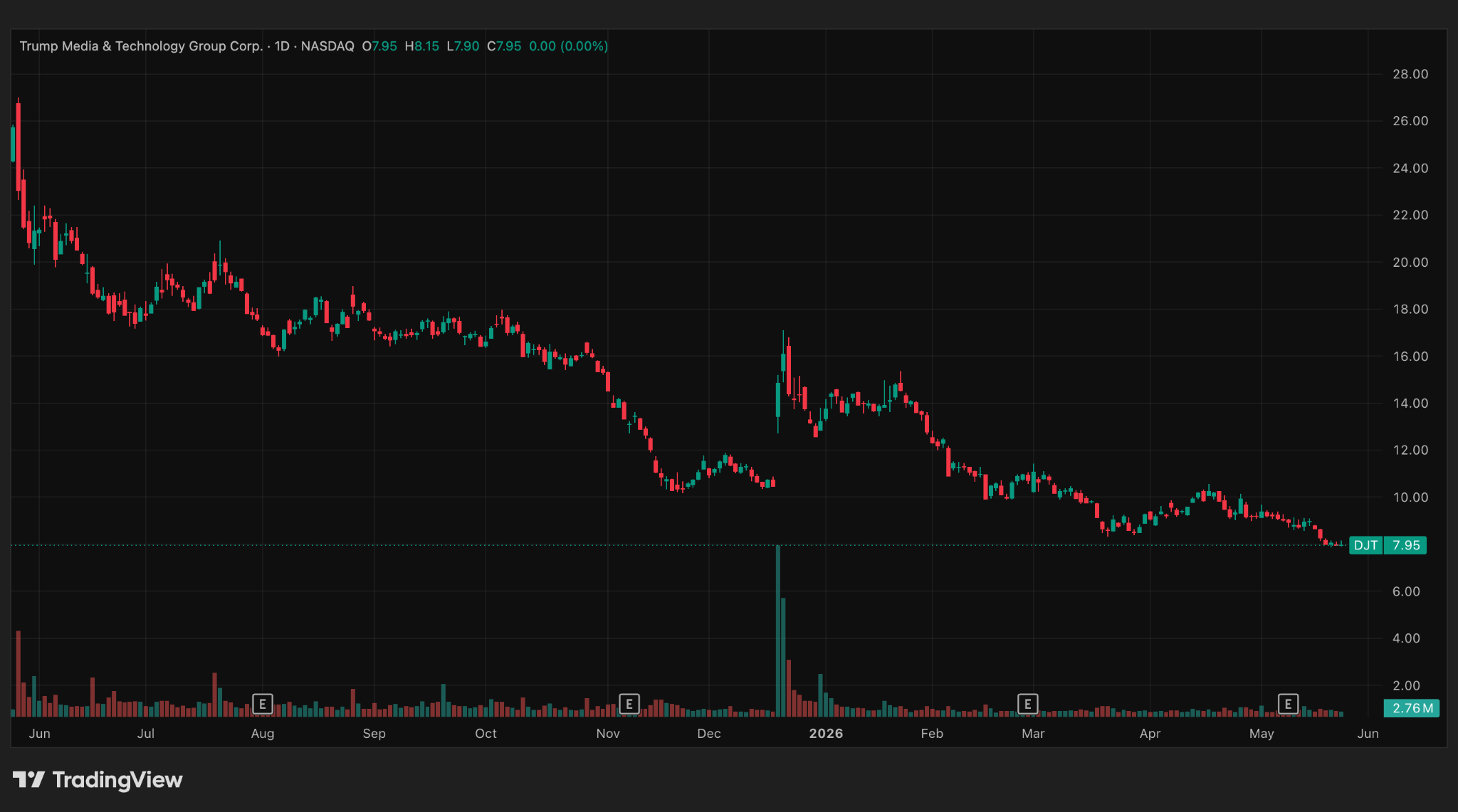
Since the start of 2026, Trump Media & Technology Group’s (DJT) share price has dropped by nearly 40%. Source: TradingView.
From the start, many analysts voiced doubts about Trump Media’s ability to carve out a meaningful position in a crowded crypto ETF landscape dominated by heavyweights like BlackRock and Fidelity.
The challenge was made worse by the fact that TMTG’s proposed products offered almost no meaningful differentiation from rivals’, leaning mainly on branding and political appeal.
The mirage of onchain transparency
The Trump Media episode highlights a structural problem: despite blockchain’s inherent openness, gauging the true condition of corporate crypto holdings remains enormously challenging. A sizable onchain transfer could signal a distressed liquidation or simply a routine operational step with no intention to offload assets.
But being a publicly listed company comes with its own obligations. To avoid triggering panic among conventional investors, management must virtually justify every fund movement. In this environment, transparent and timely communication becomes just as critical as the underlying financial approach.
These situations also raise a significant regulatory question. Should the SEC compel public companies to disclose their blockchain addresses for full independent verification? Or are wallets a proprietary advantage, the revelation of which would undermine corporate trading strategies? For now, there is no clear answer.
Specifically regarding TMTG, the company’s crypto operations do not yet resemble a well-oiled business with transparent economics. The arrangement with Crypto.com’s parent entity and the abrupt withdrawal of ETF applications increasingly look like improvised efforts to monetize a political brand, rather than a deliberate, long-range strategy.
At the end of the day, the real puzzle is not whether the company will offload its Bitcoin. The question goes deeper. Can this kind of organization, fundamentally, endure the sustained pressure of an aggressive crypto strategy over time?
