



Being a digital asset is the root of Bitcoin’s greatest strengths. Its programmability enables self-custody methods that make theft and seizure extremely difficult. Because it exists digitally, value can be transferred and settled anywhere in the world in just minutes.
However, Bitcoin has often been criticized for being hard to conceptualize. In its pure form, Bitcoin cannot be physically touched or held; it is something you can only imagine and comprehend. For many, this presents a major hurdle, leading to numerous efforts to introduce Bitcoin into the physical world, though this is no simple task.
For more than ten years, both entrepreneurs and artists have worked on the challenge of creating a physical representation of Bitcoin that keeps its most essential properties as cash-like as possible. While a perfect solution doesn’t exist yet, considerable progress has been made, leaving behind a fascinating collection of creations.
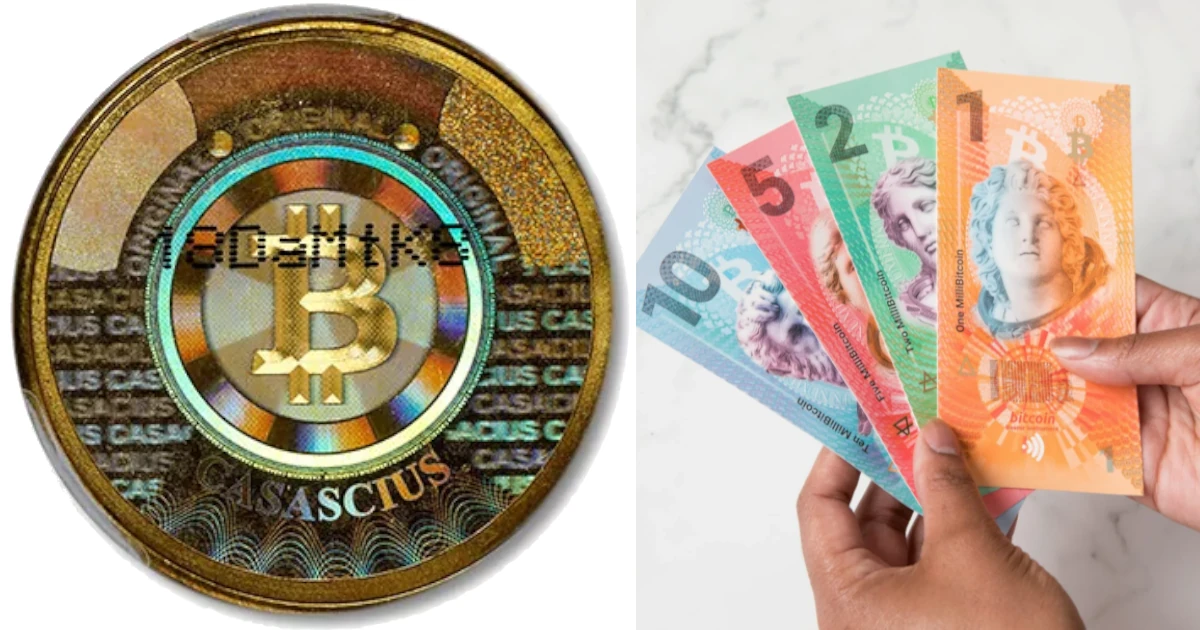
Casascius Coins
(Image by Stacks Bowers Galleries)
First created on September 6, 2011, when Bitcoin was trading at only about $8, Casascius coins are undoubtedly the most legendary physical Bitcoin items in history, inspiring many imitators. The coins are named after Mike Caldwell’s Bitcointalk forum username, which seems to be derived from the phrase “call a spade a spade.” Casascius coins established many of the methods that future attempts at physical Bitcoin would build upon.
One challenge with making Bitcoin physical is securing the private key. Since Bitcoin is native to the digital world, it exists only as a cryptographic private-public key pair, a secret used to create a public key, using Bitcoin-compatible cryptography. For the Casascius coin, Caldwell created the private keys on an offline computer and printed them, attaching them to the signature precious metal coins, after which he likely destroyed the digital copy on his computer. He detailed the security measures he took on his website so buyers could review them.
The printed private key was then protected by unique tamper-evident stickers that, if peeled off, would leave a clear “honeycomb pattern” mark. This allowed buyers of the coins to determine whether the private keys on a Casascius coin had been accessed before purchase from a third-party reseller.
This concern over key management is the greatest risk when creating physical bitcoins. In Caldwell’s case, it relied on the buyer trusting him not to act dishonestly. He was also remarkably transparent and cautious by the standards of that era. To this day, his reputation remains strong, if not legendary, proving that buyers who have earned significant profits from the collectible value of these items, which still commands a premium above the combined value of the Bitcoin and precious metal, trusted him wisely.
Casascius coins were discontinued in November 2013 after the Financial Crimes Enforcement Network (FinCEN), an agency within the Treasury Department, informed Mike Caldwell that producing physical bitcoins classified him as a money transmitter business, subject to heavy regulatory requirements. The trust needed to create the private keys was likely a centralized factor that drew scrutiny.
RavenBit Coins

A year after the end of Casascius coins, RavenBit launched, aiming to solve the trust issue around minting physical bitcoins in a decentralized way. RavenBit coins, very similar in design to Casascius, did not come with keys already created. Instead, they shipped with the tamper-evident sticker still unpeeled, allowing users to create their own key pair, attach it to the coin, and then apply the tamper-evident sticker themselves.
This approach effectively decentralized the minting process. In theory, this is a significant innovation, but in practice, it simply created thousands of untrusted, anonymous minters operating without brands or reputations, using office printers that were likely infected with malware. If you received a RavenBit coin from someone, how could you be sure the person who purchased it and generated the private key hadn’t kept a copy or failed to take adequate precautions?
The RavenBit project has since been abandoned, but it likely provided a valuable lesson for the industry. To successfully create physical Bitcoin, we need to adopt more advanced technology.
Opendimes
To get around the issue of having to trust the entity that creates (the “mint”) — whether central or regional — when using physical bitcoins, the company Coinkite, which makes hardware wallets, created the Opendime. This small device was specifically designed to act as a Bitcoin bearer instrument. When asked about the inspiration behind the project, NVK, who co-founded Coinkite, explained to Bitcoin Magazine: “Bitcoin is fundamentally digital cash. The best we can do in physical form is an equivalent of an analog backup. There may eventually be a way for someone to manually compute secp256k1 curve math by hand.” In essence, right now you always need some kind of computing device to produce a valid Bitcoin key — that device essentially acts as the mint.
The Opendime was engineered to address this reality head-on. Inside, there is a microchip that can create a private-public cryptographic key pair and protect the private key using a tamper-resistant silicon layer.
During the initial setup, users must supply a data file or some form of input to contribute randomness, which the chip then partially uses to construct the Bitcoin wallet. This guarantees that the random number generation process — whose source code is publicly available — has an even stronger randomness foundation when creating those Bitcoin keys.
The public address of the Opendime wallet can always be checked by plugging the device into a computer, just like inserting a regular USB drive. The stored balance can then be viewed on any blockchain explorer.
Users are free to send bitcoin to the Opendime, but if they wish to spend the BTC stored on it, they must physically pierce the device. Doing so activates a circuit that reveals the private key, but also makes it clearly visible that the device has been unsealed.
Opendimes represent a major step forward in the evolution of bearer-asset technology. They currently sell for roughly $20 each, having gradually increased from a starting price of about $13 back in 2016. This growth in value has also made them something of a cultural icon, with artists incorporating them into high-end Bitcoin artwork and weaving them into Bitcoin meme culture.
While $13–$20 is extremely affordable for a piece of hardware capable of securely storing cryptocurrency, and the trust-in-the-mint concern is effectively resolved since users can deposit their own bitcoin directly, the price and physical design still fall short of replicating what cash offers. On a practical level, $20 is a significant upfront cost. If Casascius applied roughly a 20% premium above the bitcoin value for his coins, then each Opendime would need to hold at least $100 worth of Bitcoin just to justify its own hardware cost — and for it to function as actual currency, that price barrier rules out most everyday purchases.
Last but not least, despite the undeniably cool, edgy USB-stick aesthetic that appeals to the cypherpunk spirit, the device provides no visible way for someone to know what is stored inside it. This means each Opendime is effectively unique and non-interchangeable with any other — unlike cash, where every bill is the same. A more affordable and likely more interchangeable solution is still needed.

Building on the Opendime idea, Belgian hardware wallet maker Satochip developed an open-source Bitcoin wallet shaped like a credit card. It works in much the same way as Opendime: it can create Bitcoin private and public key pairs, and in some versions, it can sign transactions too. People can use smartphone apps to communicate with the card through NFC. Satochip also offers other shapes, such as rings and coins, which carry the same chip and features.
Satochip hardware can cost as little as 13 Euros when bought in bulk, which is less than an Opendime. That brings it a bit closer to being practical for everyday cash-style purchases, though not by a wide margin. These cards are really designed to serve as secure hardware wallets rather than everyday spending tools. And the tiny but powerful computer chips inside them aren’t cheap, which is why there seems to be a price floor around $10 that hasn’t been broken yet.
Too Expensive? The Core Challenges
So how inexpensive does physical Bitcoin hardware actually need to be for it to make practical sense, if it ever can?
According to the Federal Reserve, producing U.S. dollar coins and bills costs between 4.1 cents and 11.3 cents per unit. Lower denomination bills are proportionally more expensive, with $1 notes costing 4.1 cents to make.
That means a 20,000 Satoshis note — worth roughly $16 at current prices — would need to cost well under a dollar in hardware to be worthwhile. Most chips powerful enough to handle Bitcoin cryptography sit above that target. However, one chip shows what might be possible: NXP’s NTAG X DNA chip.
This chip comes in a thin sticker-antenna form, just a couple of millimeters thick. It supports various cryptographic functions, including ECDSA and ECC. It can generate secrets, sign them, and even encrypt messages. But despite its capabilities, it doesn’t support Bitcoin’s specific cryptographic curve, secp256k1, so it can’t natively perform Bitcoin operations.
Even so, this 2025-generation NTAG chip can be bought for around $3 when supply is available, demonstrating how low the price can go for a chip that handles cryptography.
Unfortunately, the flexible, foldable paper-bill form factor that people around the world are accustomed to can easily damage computer chips. NVK learned this firsthand through experiments with Bitcoin bearer asset hardware.

The closest anyone has come to replicating the familiar paper-cash experience is OfflineCash, which produces a stunning collectible set of Bitcoin-denominated bills embedded with an NTAG-style NFC chip. The chip stores a key generated by the user, while the company generates a second key on its servers, creating a 2-of-2 multisignature wallet. The server key is placed on a time lock, which eventually converts the multisig address into a 1-of-1 wallet, allowing the user to withdraw the bitcoin. This approach attempts to address the trusted-trusted-mint concern, though it essentially recreates the same multi-mint problem. Still, the cash-like design is undeniably impressive.
Producing a Bitcoin-native NTAG chip could easily cost several million dollars, and getting Bitcoin cryptography right on such hardware is error-prone unless the manufacturer is deeply knowledgeable. It would also need to be fully open source to ensure there are no hidden backdoors.
There’s another fundamental obstacle with physical Bitcoin bearer assets. Even if an affordable chip in a cash-like form were achievable, you’d always need an internet connection to confirm that the note is genuine — that it actually holds real bitcoin — since the asset is inherently digital. One workaround is simply to trust an issuer of Bitcoin-denominated cash instruments and treat the face value of a bill as good, but that would miss
It’s an appealing idea: physical, self-custodied cash you can trust. In a supportive regulatory environment, it could likely work well.
So, while physical Bitcoin notes—like those from OfflineCash Company, which use a secure chip for bearer assets without relying on a trusted mint—would be impressive, we’re not quite there yet. Right now, it might even be unnecessary, since no one deals in bitcoin-denominated change anyway; you’d just get regular cash back. But perhaps in a future where Bitcoin is universally adopted. NVK believes there’s a better alternative to physical cash for now, which is why Coinkite developed the Tapsigner.
The Tapsigner

Powered by Coinkite’s Bitcoin NFC chip—similar to NXP’s X DNA NTAG but potentially more advanced and costly—the Tapsigner comes in a standard debit card size. It features a secure element chip, NFC tap-to-pay functionality, and a range of stylish designs. Inside, it houses a complete Bitcoin wallet with secp256k1 cryptographic functions, enabling it to generate keys, securely store private keys, and sign transactions internally. These signed transactions are then broadcast via a paired smartphone, which also acts as a visual interface for users to confirm details.
The Tapsigner can serve as a bearer asset, but it’s even more effective as a reloadable hardware wallet that allows spending set amounts of bitcoin, much like a credit card. This solves the change problem and enables tap-to-pay at wallets that already support this widely used feature.
With affordable cards like the Tapsigner, priced around $20, the challenge of bitcoin-denominated payments shifts back to mainstream retail adoption and integration with major business accounting and payment platforms—a space that Cash App and Square are actively expanding.
