



Here is the paraphrased version of the article:
# Introduction
Data engineering has grown increasingly complex. Today’s pipelines must be faster, more dependable, and simpler to maintain — all while data volumes and variety continue to expand. Most data engineers rely on familiar tools, but the Python ecosystem now offers a much broader range of options, and some of the most valuable tools remain relatively unknown.
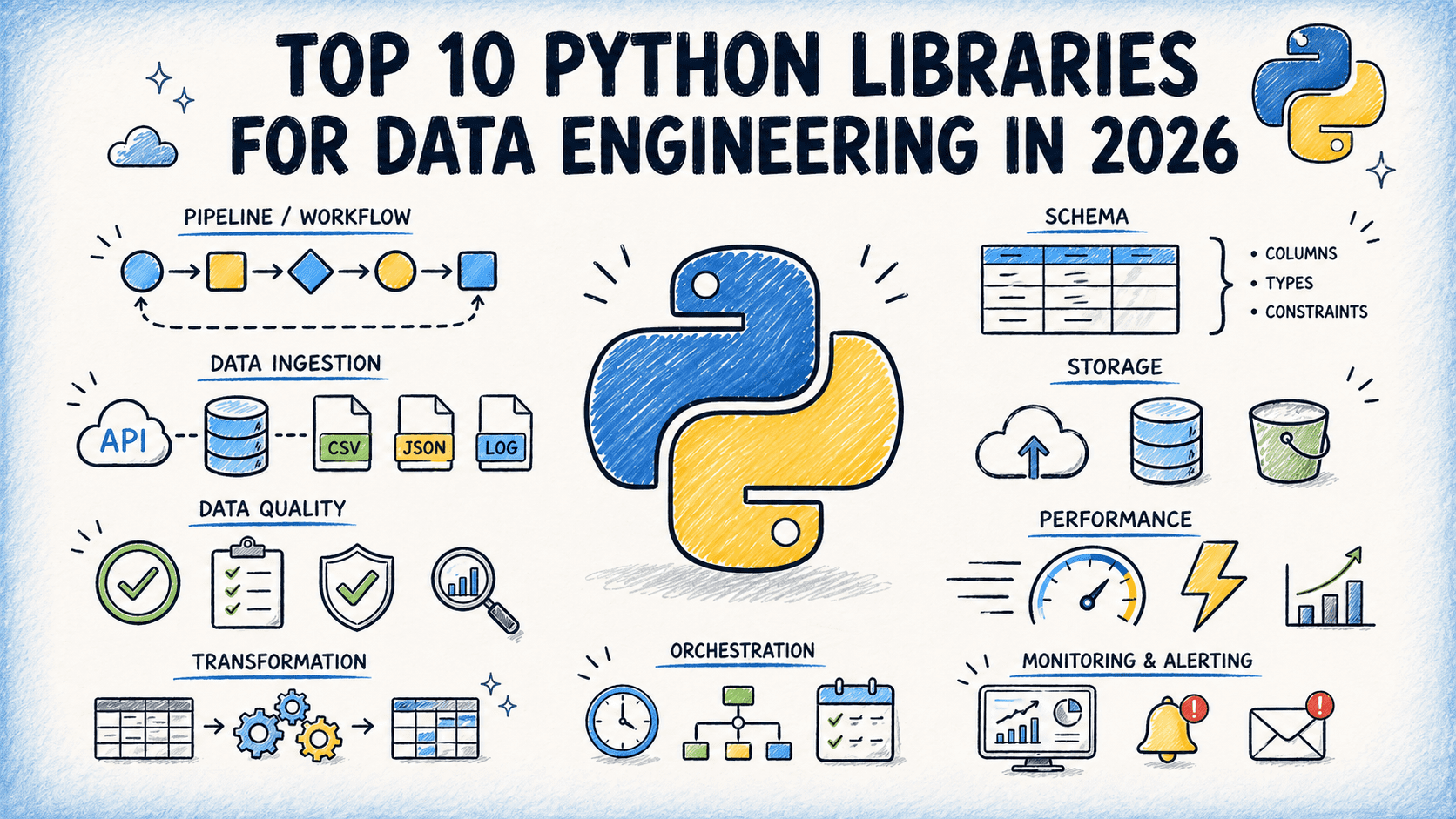
In this article, we’ll explore Python libraries grouped into four key areas that consume the most effort in data engineering work:
- Pipeline orchestration and workflow management for creating reliable, observable data flows
- Data ingestion and format handling for efficiently connecting to diverse sources
- Data quality and schema management for maintaining trustworthy pipelines
- Storage, serialization, and performance for fast data movement and efficient storage
We’ll also highlight a learning resource for each library so you can move from reading to building right away. If you’re looking to swap out a cumbersome part of your current stack or simply want to discover new tools, hopefully a few of these deserve a place in your toolkit.
# Pipeline Orchestration and Workflow Management
// 1. Scheduling and Monitoring Pipelines with Prefect
Scheduling and monitoring data pipelines becomes frustrating when your orchestrator creates obstacles. Prefect is a modern workflow orchestration library that simplifies defining, scheduling, and tracking data pipelines in pure Python, with minimal infrastructure overhead.
Here’s a list of features that make Prefect useful:
- Allows you to transform regular Python functions into observable, retryable pipeline components with minimal boilerplate
- Offers a clean UI for tracking runs, reviewing logs, and diagnosing failures instantly, without needing a separate database or cluster to begin
- Includes automatic retries, caching, concurrency limits, and parameterization by default, handling most production needs before you ever write custom logic
Prefect Foundations | Learn Prefect covers everything you need to start orchestrating workflows with Prefect.
// 2. Managing Safe SQL Transformations Across Environments with SQLMesh
Handling SQL transformations, testing them, and deploying changes safely across environments is one of the trickiest aspects of data engineering. SQLMesh is an open-source data transformation framework that builds on dbt’s concepts with deeper semantic understanding of your models and genuine CI/CD for SQL pipelines.
Here’s what SQLMesh offers:
- Grasps the complete lineage and semantics of your transformation DAG, letting it identify precisely which models need rebuilding after a change instead of re-executing everything
- Enables virtual model environments, so you can test changes on a portion of production data without duplicating entire tables or disrupting active pipelines
- Works with multiple execution engines including DuckDB, Spark, BigQuery, Snowflake, and Trino
SQLMesh Quickstart Guide walks you through creating a multi-environment transformation project from the ground up.
# Data Ingestion and Format Handling
// 3. Building Connector-Free Data Ingestion with dlt
Writing connectors and ingestion scripts from scratch is tedious and repetitive. dlt (data load tool) is an open-source Python library that enables you to create data ingestion pipelines from any source to any destination with minimal code.
Key features that make dlt worth exploring:
- Automatically generates schemas from your data and adapts them as upstream sources evolve
- Manages incremental loading, deduplication, and merge strategies
- Provides an expanding collection of verified sources and destinations that integrate with just a few lines of Python
Introduction to dlt in the official docs guides you through building your first ingestion pipeline.
// 4. Processing Real-Time Streams with Bytewax
Creating real-time data processing pipelines in Python usually requires either heavyweight Flink or Spark Streaming configurations or writing low-level Kafka consumer loops. Bytewax is a Python stream processing framework built on Rust that delivers a dataflow programming model for streaming pipelines with an intuitive, native Python API.
Features that make Bytewax useful:
- Defines stateful stream processing logic in pure Python using a functional dataflow API
- Includes windowing, stateful operators, and failure recovery by default, covering the most common real-time aggregation and enrichment tasks
- Connects with Kafka and Redpanda as input/output sources, serving as a practical lightweight alternative to Flink for teams seeking Python-native stream processing
Bytewax Quickstart in the official docs constructs a complete streaming pipeline in under fifty lines of Python.
// 5. Scaling Distributed Large-Scale Batch Processing with PySpark
When datasets exceed what a single machine can process, you need a distributed execution engine. PySpark is the Python API for Apache Spark, the industry-standard framework for large-scale batch and streaming data processing across clusters.
Features that make PySpark essential at scale:
- Distributes computation across a cluster seamlessly
- Offers a DataFrame API that mirrors pandas conventions while executing lazily across partitions, plus a SQL interface for teams that prefer queries over code
- Connects with the broader Hadoop and cloud ecosystem — HDFS, S3, Delta Lake, Hive, Kafka — making it a natural fit for organizations with existing data infrastructure
PySpark Getting Started Tutorial in the official docs is the clearest entry point for understanding the distributed programming model.
# Data Quality and Schema Management
// 6. Validating Pipelines and Generating Data Docs with Great Expectations
Data quality problems that reach production are difficult to troubleshoot and costly to resolve. Great Expectations is a Python library for defining, documenting, and validating data quality rules throughout your pipelines.
Here’s what Great Expectations offers:
- Enables you to write human-readable “expectations” like
expect_column_values_to_not_be_nullthat serve as both tests and documentation for your datasets - Produces data docs from your expectations suite, giving stakeholders insight into data quality without requiring them to read code
- Works with Airflow, Prefect, Spark, and SQL-based data warehouses, allowing you to embed validation checkpoints at any pipeline stage
Quickstart | Great Expectations and Create Expectations in the official docs are both helpful for getting your first expectations suite running.
// 7. Enforcing Schemas at the Function Level with Pandera
Detecting schema violations before they spread through a pipeline is far cheaper than debugging corrupted data downstream. Pandera
Pandera is a statistical data validation library that adds type-hinting and schema enforcement to pandas and Polars DataFrames.
What makes Pandera valuable:
- Allows you to define schemas that set expected data types, value ranges, nullability, and statistical properties for each column, then checks DataFrames against those schemas at runtime
- Works with Python type annotations, so schemas can be enforced as function argument and return type checks using
check_typesdecorators — placing validation right alongside your transformation logic - Supports Spark and Dask alongside pandas and Polars, so you can reuse the same schema definitions across different execution engines within the same pipeline
How to Use Pandas With Pandera to Validate Your Data in Python by Arjan Codes provides clear coverage of schema definitions and validation patterns.
# Storage, Serialization, and Performance
// 8. Running In-Process Analytical Queries with DuckDB
Running analytical queries on large files without standing up a data warehouse is slow and cumbersome. DuckDB is an in-process analytical database that executes fast OLAP queries directly on Parquet, CSV, and JSON files from within Python.
What makes DuckDB valuable:
- Runs SQL directly against local files and remote object storage without moving data into a separate system, making it perfect for lightweight ETL and data exploration
- Connects natively with pandas and Arrow, so query results flow into DataFrames immediately and memory is shared instead of duplicated
- Operates embedded inside your Python process with zero server configuration, yet handles datasets far larger than what pandas can fit in memory
DuckDB Tutorial for Beginners: Installation to First Query and A Guide to Data Analysis in Python with DuckDB offer solid practical introductions to how DuckDB fits into modern data stacks.
// 9. Transforming DataFrames at High Performance with Polars
Pandas is user-friendly but runs into performance limits quickly as data grows. Polars is a DataFrame library built in Rust that outperforms pandas on most transformation tasks, offering a clean API and genuine multi-threading.
Here are some features that set Polars apart:
- Runs operations in parallel across all available CPU cores by default, with no additional setup required
- Offers lazy evaluation through
LazyFrame, letting Polars optimize entire query plans before running them, much like a query planner in a database engine - Processes datasets larger than available RAM via streaming execution, making it a practical pandas alternative for mid-scale ETL without needing Spark
Python Polars: A Lightning-Fast DataFrame Library and Pandas vs. Polars: A Complete Comparison of Syntax, Speed, and Memory cover the API usage and performance characteristics.
// 10. Writing Backend-Agnostic Data Transformations with Ibis
Crafting backend-specific SQL or toggling between pandas and PySpark for different environments leads to brittle, hard-to-migrate code. Ibis is a Python DataFrame library that translates the same expression code into SQL for over 20 backends, including BigQuery, Snowflake, DuckDB, Spark, and Postgres.
What makes Ibis valuable:
- Delivers a single, unified Python API for data transformations regardless of backend — eliminating the need to juggle SQL dialects
- Employs lazy evaluation, meaning expressions are compiled and run on the backend engine rather than pulling data into Python, keeping large-scale transformations performant
- Allows you to fall back to backend-specific SQL when necessary, so you’re never held back by abstraction boundaries
10 minutes to Ibis in the official tutorials is the fastest way to get up and running.
# Summary
These Python libraries tackle real-world challenges you’ll encounter in data engineering work. To recap, we explored useful libraries for orchestrating workflows, ingesting data from diverse sources, enforcing data quality, running fast analytical queries, and managing transformations reliably across environments.
| LIBRARY | PRIMARY USE CASE | BEST FOR |
|---|---|---|
| Prefect | Workflow orchestration | Scheduling, retries, and monitoring pipeline runs |
| SQLMesh | SQL transformation management | Safe deploys and environment isolation for SQL models |
| dlt | Data ingestion | Building source-to-destination pipelines with minimal code |
| Bytewax | Stream processing | Real-time, stateful pipelines on Kafka/Redpanda in Python |
| PySpark | Distributed batch processing | Petabyte-scale ETL and transformations across clusters |
| Great Expectations | Pipeline data validation | Writing, documenting, and reporting on data quality rules |
| Pandera | Schema enforcement | Validating DataFrame schemas inline with transformation code |
| DuckDB | In-process OLAP queries | Running SQL on local files and object storage without a warehouse |
| Polars | Fast DataFrame transforms | Multi-threaded, out-of-core pandas replacement for mid-scale ETL |
| Ibis | Backend-agnostic transforms | Writing one DataFrame API that runs on 15+ SQL backends |
Happy data engineering!
Bala Priya C is a developer and technical writer from India. She enjoys working at the intersection of math, programming, data science, and content creation. Her areas of interest and expertise include DevOps, data science, and natural language processing. She loves reading, writing, coding, and coffee! Currently, she’s focused on learning and sharing her knowledge with the developer community by authoring tutorials, how-to guides, opinion pieces, and more. Bala also creates engaging resource overviews and coding tutorials.
