



By Marc Kavinsky, Lead Editor at IoT Business News.
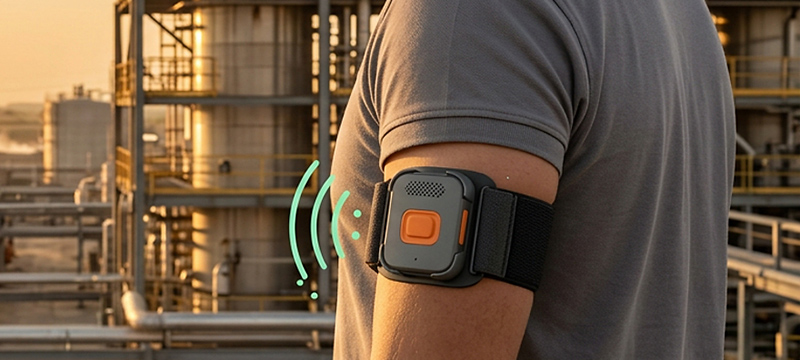
Zackat Labs has introduced a connected worker-safety platform centered on its W3 wearable, a Bluetooth-connected gas detector, AT&T cellular IoT connectivity, and device management via AT&T Control Center.
Industrial safety monitoring is evolving beyond stationary sensors and routine inspections, since many hazards in field operations are both mobile and personal. Heat stress, fatigue, and gas exposure don’t always happen where a facility has installed equipment, and supervisors typically need actionable alerts instead of yet another flow of raw sensor readings.
This is the backdrop for Zackat Labs’ new connected safety platform, which brings together the company’s W3 wearable monitoring device, an integrated gas detector, and cellular IoT connectivity from AT&T Business. RCW Energy Services, a Texas-based provider of water management and support services for oil and gas, industrial, and construction operations, is both a customer and distributor of the W3 solution.
The W3 wearable is built to track physiological signals such as core body temperature, heart rate variability, and other indicators tied to fatigue and dehydration. According to Zackat Labs, the system translates those readings into early warnings before a worker hits a critical threshold, with notifications sent to supervisors’ mobile phones and the W3 dashboard.
The environmental component comes from Zackat Labs’ single- and four-gas detector, which pairs with the W3 device over Bluetooth. Gas exposure warnings are delivered through the same connected application, instead of requiring a separate monitoring process.
One unified safety signal, not just another wearable
The key differentiator here isn’t simply that a worker is wearing a connected device. Wearable safety products and gas detectors are both well-established categories. What makes this announcement more noteworthy is the effort to combine physiological heat-stress tracking and gas detection into a single alerting environment, with the gas detector linked locally to the W3 and the platform then backed by cellular IoT connectivity.
That architecture matters for deployment teams. A Bluetooth connection between the gas detector and W3 suggests Zackat Labs is focusing on a shared field interface and alerting path rather than handling each safety sensor as a standalone connected device. The trade-off is a familiar one in industrial IoT: streamlining supervisor workflows and connectivity management can cut down on operational fragmentation, but it also means that device pairing, assignment, and field procedures become critical parts of the deployment model.
AT&T Business’ involvement goes beyond basic SIM provisioning. The company is powering the W3 platform with cellular IoT connectivity for near real-time transmission of physiological and environmental data from field workers to supervisors and safety teams. Zackat Labs will also leverage AT&T Control Center to roll out and manage cellular connectivity across devices, including provisioning, activation, and ongoing monitoring through a single portal.
For connectivity providers, this is the kind of use case where device lifecycle management matters just as much as network access. Wearables used by distributed crews must be activated, tracked, and supported across shifting job sites and work teams. The press release doesn’t reveal deployment scale, but the inclusion of Control Center signals that Zackat Labs is gearing up for centrally managed device fleets rather than ad hoc connectivity.
Why industrial IoT buyers should pay attention
This announcement aligns with a wider trend in industrial IoT: a shift from asset-focused monitoring toward worker-focused telemetry. Oil and gas services, construction, and industrial field operations frequently involve temporary sites, mobile crews, and environmental exposure that fixed infrastructure can’t fully cover. A connected wearable can go wherever the worker goes, while a gas detector stays anchored to the immediate work area.
For enterprises, the real value will hinge on how alerts are woven into safety processes. A notification sent to a supervisor’s phone is only helpful if escalation steps, worker check-ins, and incident documentation are clearly defined. System integrators working with this kind of platform will probably need to focus less on sensor installation and more on workflow integration: who gets alerts, how they respond, and how dashboard data fits into existing environmental health and safety systems.
OEMs and device makers can also view the launch as further evidence that industrial wearables are becoming part of broader connected-safety ecosystems rather than standalone products. The combination of body-state tracking, Bluetooth peripheral integration, and cellular backhaul reflects a layered strategy: on-body sensing, local environmental sensing, mobile or dashboard alerting, and managed IoT connectivity.
RCW Energy Services’ participation gives the platform an initial field-services foothold. The company serves oil and gas, industrial, and construction markets and is distributing W3 solutions while using the technology for its own service technicians. That alone doesn’t guarantee broad market adoption, but it does place the product in the kind of operational setting where heat stress awareness and gas hazard monitoring are both pertinent.
The main takeaway for IoT professionals is that Zackat Labs isn’t marketing W3 as a general wellness wearable. The company is building a connected safety platform around specific industrial risks, with AT&T managing the cellular layer and RCW offering a path into field-service operations. Its success will depend not just on sensing performance, but on how reliably the entire alerting chain works in the complex operational reality of crews, supervisors, devices, and hazardous worksites.
