



Follow ZDNET: Add us as a preferred source on Google.
ZDNET’s key takeaways
- Summer blackouts happen more often than you might think.
- Assess your backup power needs and essential devices.
- Solar panels provide grid independence and long-term savings.
Even though winter blackouts can be worse due to cold, rain, and shorter days that slow down repairs, power cuts actually occur most often in summer.
This happens because of several factors: increased electricity use from air conditioning, soaring temperatures that cause transformers to overheat and power lines to droop, and an outdated electrical infrastructure designed decades ago when energy demands and severe weather were less common.
Also: I used a single power station to keep my off-grid cabin running – how it all worked out
Even without technical failures, utility providers sometimes carry out planned power cuts known as Public Safety Power Shutoffs (PSPS) during extreme weather to reduce the risk of electrical equipment sparking wildfires.
If you’re curious about what’s coming, forecasts indicate an intensely hot summer ahead, with regions like California, Nevada, and Arizona likely to see temperatures reach 100°F for the first time. This creates ideal conditions for straining the power grid, which explains why blackouts are becoming more severe.
So, what steps can you take?
For me, portable power stations and solar panels are now essential. You could opt for gas generators—they do deliver strong power output at a reasonable price—but I’ve grown to dislike them. Fuel-powered units produce unpleasant odors, release harmful emissions, need consistent upkeep, and pose a fire risk if mishandled.
Also: Are wind power generators actually viable at home? I tried one, and the results blew me away
A unit that plugs into either the electrical grid or solar panels is a far more practical solution.
Which devices need to stay powered?
Keeping critical appliances running during an outage is vital. What counts as critical? For me, these are the essentials:
- Medical devices: Such as a Continuous Positive Airway Pressure (CPAP) machine.
- Refrigeration: Preventing food spoilage during hot weather.
- Communications: Maintaining internet router operation and keeping phones charged.
- Lighting: Ensuring safe movement around the house after dark.
These are the fundamental needs. Anything beyond this is extra comfort.
How much energy will you need?
You might assume that the bigger the system, the better, but that drives up costs, and most people have limited budgets for portable power stations.
Also: I stopped leaving these 7 gadgets plugged in, and my electric bill thanked me
A smarter approach is to measure each appliance’s energy consumption or use a digital calculator like EcoFlow’s tool. Aim for a backup system that powers your essentials, includes a few comforts, and gives some capacity buffer.
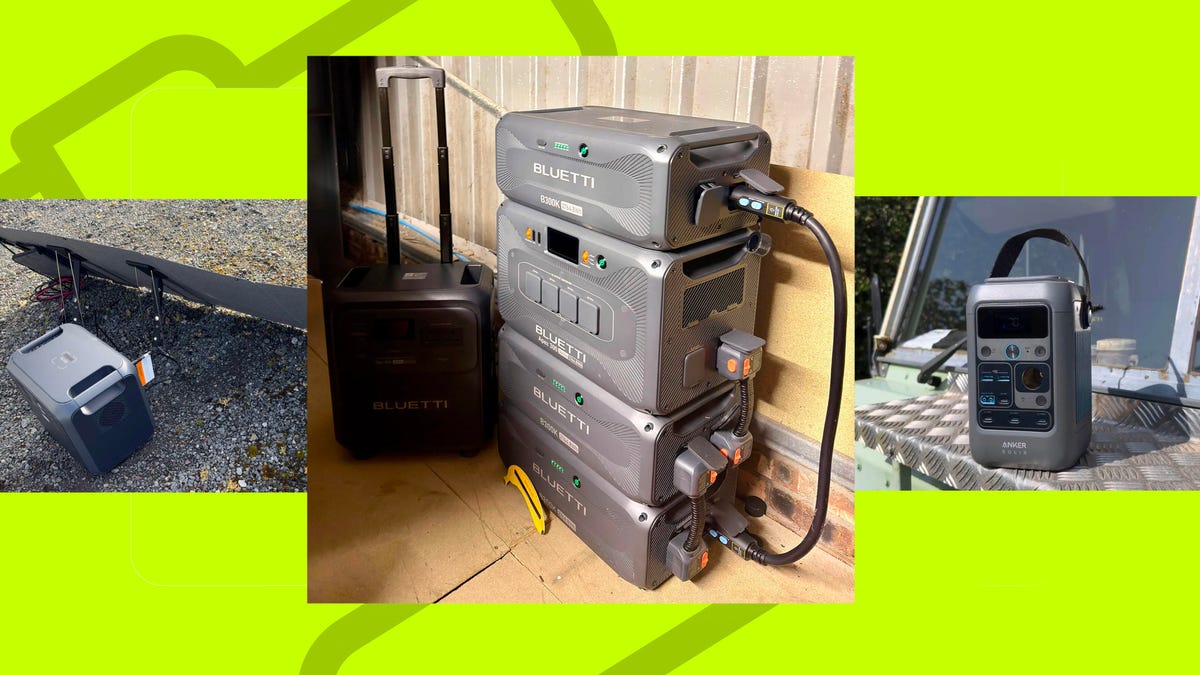
I’m a big fan of power stations.
Adrian Kingsley-Hughes/ZDNET
You should also consider how long you’d need the system running. Based on available statistics, the typical household experiences about six hours of outages annually. This is just an average—major events like floods, wildfires, or hurricanes can make that number climb significantly.
Also: I spent two years testing wind power at home – here’s why solar is still my preferred source
I reached out to a representative from power equipment company Jackery for advice on the best portable power solutions. Their recommendations covered two categories of users:
- For full-home emergency preparedness, consider modular and expandable systems—ones that let you begin with a compact setup and scale up over time. The Jackery Explorer 5000 Plus connects directly to your home’s electrical circuits and supports expansion batteries that can deliver up to two weeks of household backup power.
- For renters or apartment dwellers, portable and expandable units that don’t consume too much space are the way to go. Options like the Jackery Explorer 300 or Explorer 1000, or for those with slightly more room, the HomePower 3000.
I’m building an off-grid system that includes a Bluetti Apex 300 along with multiple B300K expansion batteries providing 12 kWh of total capacity, plus an Elite 400 for portable backup when needed.
What about solar panels?
Power stations are excellent for grid connection and storing electricity when supply is steady. But solar panels let you capture free energy to recharge your system regardless of grid status. This strategy gives you genuine energy self-sufficiency—though it comes at a cost.
You’ll also need space for your panels, like a garden, balcony, or rooftop. Panels come in portable, semi-portable, or permanently installed varieties depending on your living situation.
Whether I’m at home or out and about, I try to make use of my solar panels.
Adrian Kingsley-Hughes/ZDNET
Regarding energy generation, a 200W solar panel can produce between 0.8 kWh and 1.2 kWh per day (roughly 290 kWh to 440 kWh annually), based on whether you’re in a region with abundant or limited sunlight. The average American household consumes 30 kWh daily, so covering total usage would require a large number of panels. You’d need to drastically cut energy use (or invest heavily in panels).
The greater the number of panels, the more electricity you can collect.
Also: How I boosted my portable solar panels’ power by up to 30% – 11 expert-approved tips
My requirements are fairly basic, so I’m covering them with a few 350W flexible panels and two rigid 200W panels.
Another way to save money
Harvesting
Solar energy isn’t the only way to cut your electricity costs. Power stations offer another money-saving strategy by allowing you to charge them during off-peak hours, when rates at their lowest (known as Time of Use, or TOU), and then tapping into that stored energy during periods of peak pricing.
Related:The overlooked specification that determines if a portable power station is genuinely worth the investment
In essence, you purchase electricity at a low rate, store it, and consume it when prices spike.
Numerous modern power stations can take advantage of TOU pricing by giving you control over the charging schedule.
Contact your electricity provider to find out whether TOU pricing is available in your area.
Alternative solutions
Power stations aren’t a one-size-fits-all solution. Perhaps you rarely face blackouts, are comfortable going without grid power for a while, or your finances don’t stretch to both a power station and solar setup. Don’t worry, because there are still backup options you can keep on hand just in case.
Related:My top pick for a travel-friendly portable power station that handles every device – now $150 cheaper
Portable power banks are excellent standalone options, particularly higher-capacity models like the Anker Solix C300, which offers 288Wh of energy, a 300W (600W surge) AC socket, and a built-in emergency light (and there’s even a 60W solar panel available for this unit). I’ve been consistently impressed by the performance of the Solix C300 (along with the C300 DC, the variant without the AC socket).
The Anker Solix C300 DC has proven to be a fantastic compact power station for short outages or camping adventures.
Adrian Kingsley-Hughes/ZDNET
On the other hand, if your needs are simple, like keeping a mobile phone topped up, you can simply have a power bank plugged into a charger and ready at all times.
If you own an electric vehicle (EV), you might be able to use it as a massive mobile battery to supply your home with power. The vehicle needs to support vehicle-to-home (V2H), such as a Ford F-150 Lightning, Nissan Leaf, or Tesla, and will need a V2H power transfer system professionally installed – or as a minimum, a vehicle-to-load converter.
The bottom line
A wide range of options exist – from budget-friendly to decidedly not budget-friendly – to help you weather a power cut, and they can even generate savings by harnessing solar energy or leveraging cheaper electricity rates during specific times of day.
The amount of backup power you want, along with how much energy you’d like to generate from the sun, comes down to your budget. A couple of hundred dollars gets a compact, easy-to-carry unit perfect for emergencies, while spending a few thousand nets you a system capable of powering your home for an entire day.
